
It’s been a while. . . . I had surgery on my hand on May 31, and it’s healing–slowly. Since then, I’ve done some reading and knitting and crocheting, and a bit of traveling to see some state parks, but that’s another post.
Today is about the reading.
I set a reading goal at the beginning of the year of 52 books—a book a week. Well, to say I’m a voracious reader is a bit of an understatement. I reached the 52 books in June. So, I upped my goal to 100, and at the midpoint of July, I’ve read 63. So, I may need to amend my goal once again.
This month has been a bit different in my reading selections. A couple of the books I’ve read are in the genre of magical realism. I had to look it up because I just didn’t teach much in the way of magical realism, and the only other book that qualified as magical realism that I’ve read was Allende’s House of the Spirits, which I thoroughly hated (that was one of the selections I had to read and plan a unit for teaching when I went through National Board Certification in 2000.) However, I loved the three books I’ve read that had a magical realistic bent to them.
Of course, there are my usual picks of purely escapist historical romance and a mystery or two.
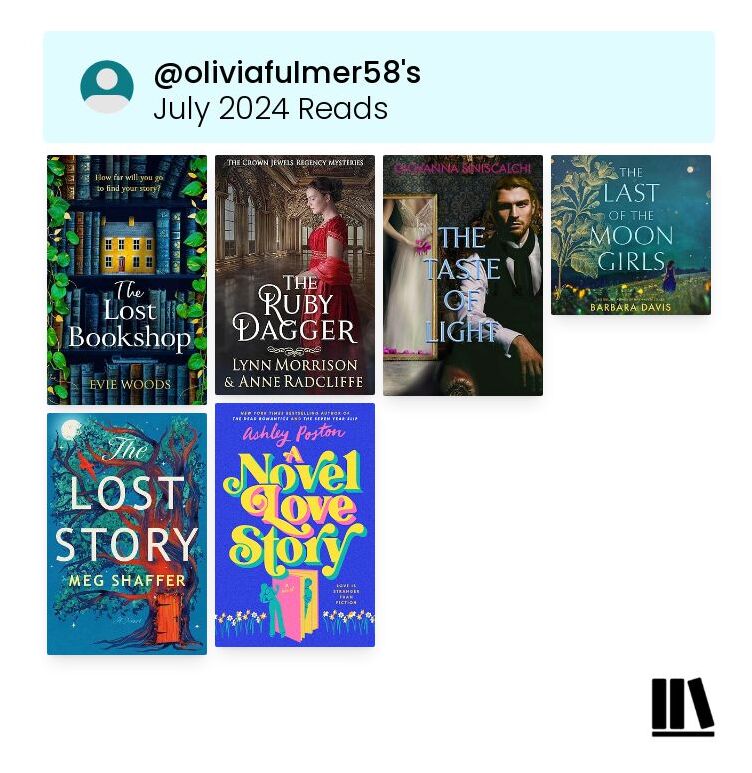
(How cool is this? StoryGraph, a reading tracker app, creates a graphic of book covers! StoryGraph is like Goodreads–sort of.)
Anyway, I can’t pick a favorite from the six books I’ve read so far, but my top two are The Lost Bookshop and A Novel Love Story. The Lost Bookshop is about a “magical” Bookshop in Dublin, Ireland. Martha escapes an abusive marriage and takes a job as a housekeeper for a retired actress, Madame Bowden, in exchange for room and board in a basement room. Henry is a scholar looking for the lost manuscript of Emily Bronte’s second novel. Opaline has escaped an unwanted marriage by going on a “grand tour” of sorts to France where she meets Sylvia Beach ( a real, historical person who opened a Bookshop in Paris and published James Joyce’s novels in the 1920s and hosted a number of American expats, such as Hemingway) and works for her until her brother discovers her whereabouts. She, too, escapes to Dublin where she opens her own bookshop, which somehow just disappears. The novel tells the story of how these three lives, two contemporary and one from the 1920s, intersect and influence each other. It is a book about second chances to find love, self-discover, and the love of books and reading and the way books can impact one’s life.
A Novel Love Story by Ashley Poston also features a bookshop along with a curmudgeonly bookshop owner, a lost traveler, and a town lifted right out of the traveler’s favorite romance series with all its characters in place. Eileen is traveling to a cabin in the Hudson Valley for the annual book club retreat–alone because everyone else has “life” interruptions. A rainstorm sends her in search of a place to wait it out, and she finds her way into Eloraton, the fictional setting of her favorite romance series. She meets the inhabitants, all characters from the novels except for the owner of the bookshop, Anderson Sinclair. Try as she might, she cannot place him in the plots of any of the novels and assumes that he must be a character the author envisioned for the fifth novel, which she never wrote because of her untimely death. Eileen isn’t looking for love after having her heart broken several years ago when her fiance dumped her a week before the wedding. However, with a title like A Novel Love Story, you know there will be romance involved. This book is also about the power of books and reading–and about finding second chances. it is a sweet story, with a glimpse through the open bedroom door but without pages and pages of descriptions of graphic sex. After finishing the book, though, I thought about the story of Brigadoon, that mythic village that appears once every 100 years in the wilds of Scotland. (I may have to find that movie and watch it again!) This is that kind of story.
And my third favorite, or a strong tie for first, is The Lost Story by Meg Shaffer. Two friends go in search of Emilie’s lost sister in the woods of the Red Crow State Forest, the same forest where they went missing for six months nearly fifteen years earlier. The thing is, Shannon has been missing for twenty years. After Emilie’s mother dies of cancer, Emilie discovers she has a half-sister who had been given up for adoption. She hires Jeremy to find her sister, given his success in finding missing girls, but Jeremy can only take on the mission if his best friend from childhood, Rafe, goes with him. However, they have been estranged (and hostilely so) for the last fifteen years. Reluctantly, though, Rafe agrees, since doing so will give him his memories back. This book is more than a book about restored memories; it is about restored relationships, about growing up, and about finding a place to “belong”. It is also about reclaiming the magic and imagination of childhood. I enjoyed getting lost in the world of Shanandoah (yes, that’s how it’s spelled in the novel) and getting to know Jeremy, Rafe, Emilie, and Skya (the queen). There are numerous allusions to C. S. Lewis’s Chronicles of Narnia throughout the novel.
The Last of the Moon Girls also fits into the realm of magical realism and follows many of the same themes as the previous books–self-discovery, restored relationships, finding that place that is home.
The last two books are more traditional historical romances with the happily-ever-after endings.
So, what’s next on my TBR pile? Probably too many to list. I just started Wolf Hall, a traditional historical novel that follows the life of Thomas Cromwell, one of Henry VIII’s advisors. I also have Vera Wong’s Unsoliticited Advice for Murderers, The Wishing Game, The Secret Book of Flora Lea, and Murder on Edisto on the list. That last book is the July book selection for my in-person book club, The Coffee Shelf Readers. I’ll start that book next week.
Now, it’s time to get lost in Tudor English. . . . Happy reading!
 Telling Stories