
I really slowed down my reading this month. Perhaps it was because some of the books were longer and “slower” reads. It’s also the beginning of the holiday season, and things get busy.
I seem to be falling back into familiar and comfortable genres this month–historical romances and mysteries as well as some fantasy and magical realism.
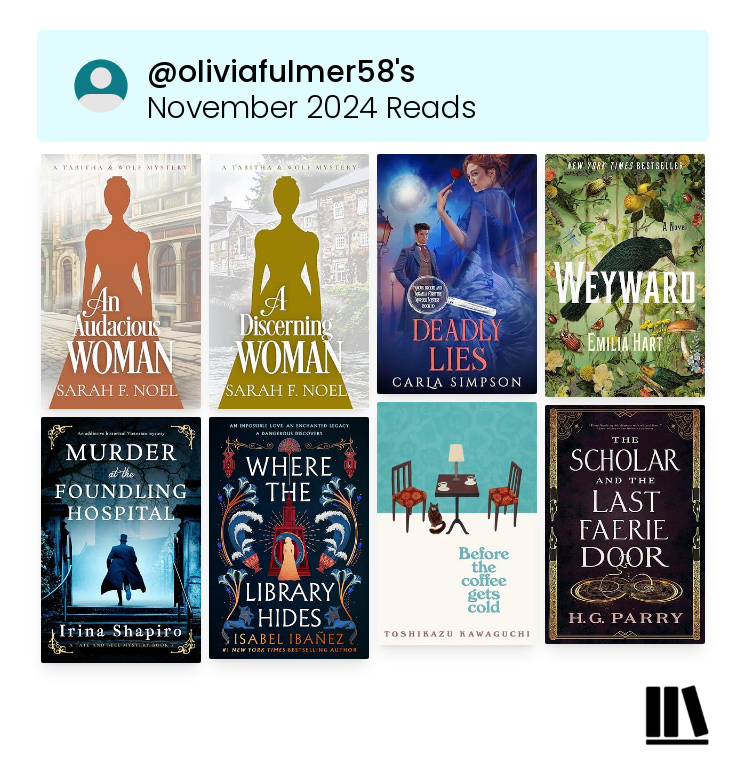
An Audacious Woman, A Discerning Woman, Deadly Lies, and Murder at the Foundling Hospital are all historical mysteries set in the 19th century. Sarah F. Noel’s “Tabitha and Wolf” mystery series features the recently widowed Lady Pembroke (Tabitha) and the new Earl of Pembroke (Wolf) as they investigate various murders while navigating a tricky romance. These novels are light and sometimes humorous, especially when Tabitha’s mother-in-law, the Dowager Countess of Pembroke decides she wants to become an investigator. Besides the mystery aspect, the novels are also about finding one’s family and belonging as Tabitha’s family includes not only the new Earl and the Dowager Countess, but a trusted family friend and two street urchins who become her wards.
Deadly Lies is the latest book in the Angus Brodie and Mikaela Forsythe Murder Mystery series by Carla Simpson. Lady Forsythe is an independent woman of the late nineteenth century who becomes involved with the often surely Angus Brodie when her sister goes missing (Book I). In this latest installment, they investigate the murders of two young women found with a red rose. Mikaela narrates the story as it unfolds with occasional glimpses into Brodie’s point of view when he goes off on his own. Mikaela, like her elderly great-aunt who raised her and her sister after her parents’ deaths, is intelligent, witty, and more than a little free-spirited. This series is mostly light-hearted and fun.
Murder at the Foundling Hospital is the third installment of the Tate and Bell series by Irina Shapiro. Set in London in the latter half of the nineteenth century, the novel follows Detective Bell and Nurse Gemma Tate as they investigate the murder of Amanda Tate, a fourteen-year-old foundling. Together, they piece together the clues that eventually bring the killer to justice, but at the expense of Gemma’s job at the Foundling Hospital. Shapiro uses more history in the development of the plot than Noel or Simpson as she draws on the details of the Crimean War for context. This novel is darker in tone and without the humor of Noel’s and Simpson’s novels, but it is no less a good read.
I seem to be choosing more books from the fantasy and magical realism genres. Weyward, Where the Library Hides, Before the Coffee Gets Cold, and The Scholar and the Last Faerie Door all incorporate some measure of paranormal or supernatural elements. Emilie Hart’s Weyward tells the story of three women of the Weyward family from three different time periods: one a 17th century woman accused and tried for witchcraft, a teenager from the 1940s, and a young woman from the present who retreats to her great-aunt’s cottage to escape an abusive marriage. All three women have an affinity with nature that is often called “witchcraft.” All three women have complicated and even dangerous relationships with the men in their lives. However, although bad things happen to these women, they come through their experiences stronger and more independent than ever. Resilience is the key. I enjoyed this book and truly did not want it to end. Perhaps there will be another Weyward book that tells the story of Kate’s daughter named after her ancestors, Altha the 17th century “witch” and Violet the 20th century botanist and scientist.
Where the Library Hides by Isabel Ibanez continues the story begun in What the River Knows. Inez has gone to Egypt at the end of the 19th century to find out what happened to her parents. At the end of the first novel, she discovers that her mother is still alive, and she receives a rather unromantic marriage proposal from her uncle’s assistant Whit. Where the Library Hides has the two, now married, searching for the lost loot from Cleopatra’s tomb and Inez’s mother. Ibanez throws in a plot twist near the end of the novel that I truly did not expect, but it made sense. This sequel ties up all the loose ends and brings the mystery to a very satisfactory close. The epilogue, though, may foreshadow some more books about characters introduced in this novel. I will be following Ibanez for other books.
Before the Coffee Gets Cold was our choice for the November book club. It also falls into the genre of magical realism. Four characters have the opportunity (and the desire) to travel in time. There are several rules, though, that govern their time travels: they can only meet people with whom they have met in the coffee shop; they will not change the present by going to the past or the future; and they can stay away for only as long as the coffee stays warm. Failure to drink the coffee before it gets cold will turn them into a ghost. Three choose to go back in time while one character chooses to go into the future. All three come away from their time travels with new understandings of themselves and others. I had my doubts about this book when I started it. It felt too objective. However, as we followed each character into their pasts, presents, and futures, the reader does get to know them and feel engaged with them. By the end of the first vignette, I was fully engaged and ready to devour the stories. I will certainly be reading the other books in the series.
H. G. Parry’s The Scholar and the Last Faerie Door combines the history of the post-World War I Lost Generation with fantasy. I’m not sure there’s a name for this genre! It’s a combination of historical fiction and fantasy and romance. Clover Hill wants to learn to do magic so that she can release her older brother from a Faerie curse he received at the battle of Amiens during the first world war. She attends Camford University where she becomes friends with three students who come from the class known as the Family, people who have had magic in their blood for generations. What makes Clover different is that she is not from a magical family but is an ordinary farm girl. However, through hard work, study, and research, she does learn magic and eventually obtains the spell to release her brother. However, she had to pay a high cost. This is a heart-breaking story of love and friendships that go awry and of lost trust; it is also a story of restoration, forgiveness, and reconciliation. Even though events become quite dire, there is a thread of hope throughout.
It was hard to pick a best book for the month, but I think I decided on Before the Coffee Gets Cold. It is an easy-to-read novel, even in translation from Japanese. The characters are for the most part likeable and relatable. There are really no villains in this book at all, unless, that is you count death, Alzheimer’s, and loss as villains. There are no murders to solve. In the end, the book is full of love and hope.
As the Christmas season approaches, I know I will have more books to read. I haven’t selected specific holiday books (yet), though I have started Tommy Orange’s book Wandering Stars, which follows a survivor of the Sand Creek Massacre. It’s a heavy way to begin this season of joy.
 Telling Stories