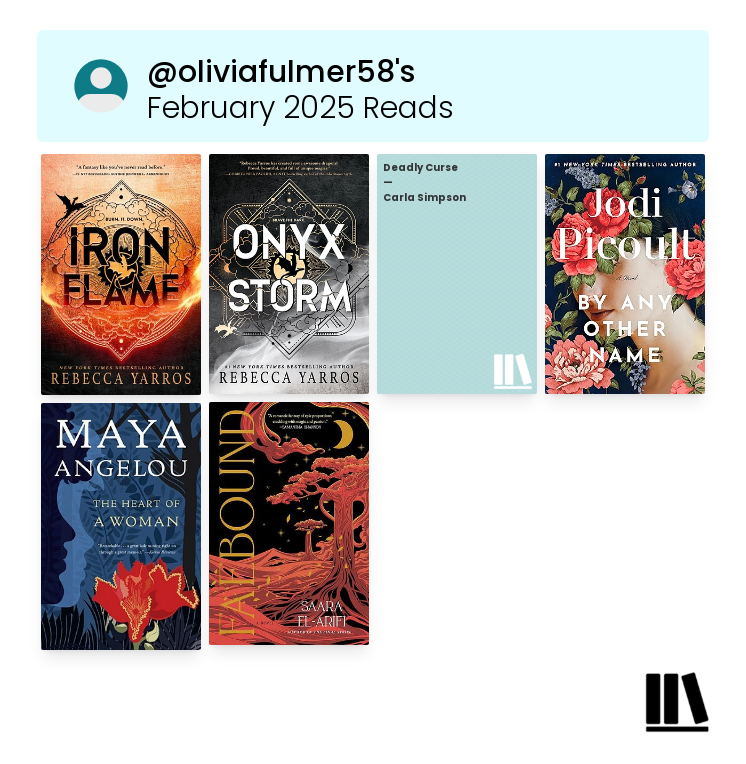
You would think that this being February, I’d be reading more traditional romance novels, but instead, I’ve been steeped in romantasy, murder mysteries, historical fiction, and memoirs.
I wanted to see what all the hype was concerning the Empyrean series, so last month, I dove in to read the three published novels so far in the series. I finished Iron Flame and Onyx Storm this month. I was somewhat underwhelmed by the series. I don’t mind an enemies-to-lovers trope; however, something bothered me about the relationship between Violet and Xaden. It was a little too “violent” at times. While they claimed to love each other, there was a lack of tenderness that I expect from a loving relationship. Perhaps the military academy setting and the constant threat of war explain the relationship.
Carla Simpson did not disappoint me in the latest addition to the Angus Brodie-Makaela Forsythe mystery series, Deadly Curse. Makaela and her partner/husband Angus Brodie assist the Metropolitan Police in solving the murder of a well-known and respected Egyptologist and his assistant and uncover a ring of thieves selling stolen ancient artifacts. Makaela’s voice as narrator is one of the things I enjoy most about the series; she is often cheeky and doesn’t take herself seriously.
I am not a real Jodi Picoult fan, but I had to read By Any Other Name. The title hints at the story since it is a direct allusion to Shakespeare, namely to the play Romeo and Juliet (Juliet’s monologue in the famous balcony scene in Act II). Picoult explores the possibility that William Shakespeare was not the factual Shakespeare but a closet Jew named Emilia Bassano, a courtesan and later a tutor and teacher. Bassano is historical; she was the first woman in English to have a book of poetry published. In this dual-time period historical novel, Picoult traces the dilemma women playwrights have had getting their works produced on stage. I have to admit that so far, this has been my favorite book so far.
My book club is reading The Heart of a Woman by Maya Angelou as our February selection. The memoir recounts Angelou’s life during the late 1950s and early 1960s when she began her work with the Southern Christian Leadership Conference and with the movement toward the end of apartheid in South Africa. I mostly listened to this book in Audible. Hearing the author read her own work brought it to life. This book has given me new insights into her poetry, especially “Phenomenal Woman” and “And Still I Rise.”
When I checked it, my Google Pixel phone suggested articles I might read. I clicked on one with suggestions for other books similar to the Empyrean, and Faebound by Saara El-Arifi was mentioned. Similar to the Empyrean books, the protagonists are bound to mythical beasts called obeah. Yeeran, her sister Lettle, and a Waning province’s army captain find themselves as prisoners in the fae kingdom. Yeeran and Rayan discover that they are half-elf, half-fae. Most of the novel covers the time they are in the underground world of the fae as they try to figure out how to return above ground to the world of elves. The novel has some romance, one of which is the enemies-to-lovers trope. I found this book a very slow starter; however, the last three or four chapters made me not want to put the book down. I enjoyed the story, though it is not a novel I would reread.
I have quite a few novels on my TBR list; the biggest problem is deciding which one to read next. That will be the decision for tomorrow.
Time flies when you’re having fun, right? January certainly flew by. Maybe it just seems that the months go by faster because I’m getting older.
So, I jumped on the Fourth Wing/Empyrean series flights this week. I just finished the second in the series this morning after two days of almost marathon reading sessions, thanks to my Kindle Unlimited subscription. And because I didn’t want to wait until the third book went to KU, I bought it and will probably start it this afternoon (after I do some laundry and eat lunch).
My take on the series: First, I enjoyed the story. I enjoyed the “enemies to lovers” subplot. I thought Rebecca Yarros created a believable fantasy world that allowed me willingly to “[suspend] disbelief,” as Samuel Taylor Coleridge says we have to do in order to engage our imaginations. I was able to buy into the world of the “war” college, the use of dragons, and magic and all that. My major criticism has to do with the language in the book. I am not really a prude; I do not pepper my own language with four-letter words because that’s not how I was brought up. I found the graphic language excessive. In fact, I found it distracted from what the characters were saying. Perhaps because I expected it in the second book, it was not as distracting, but I don’t think it was as prevalent.
Of the first two books, I actually liked Iron Flame better even though it seemed longer. I liked the twist at the very end (no spoilers, other than to say, there is a very interesting twist in the cliffhanger ending). I can’t help it; I’m a retired English teacher, so I do look for themes and foreshadowing and the like, and one of the themes that strikes me is the “power corrupts, and absolute power corrupts absolutely” theme. This theme is especially strong at the end of Iron Flame. Other motifs that appear throughout the series are “coming of age,” even though the characters are adults in their twenties (the characterization, though, makes them seem more like adolescents than adults), loyalty and betrayal, family/sibling/parent-child relationships, and the “found” family.
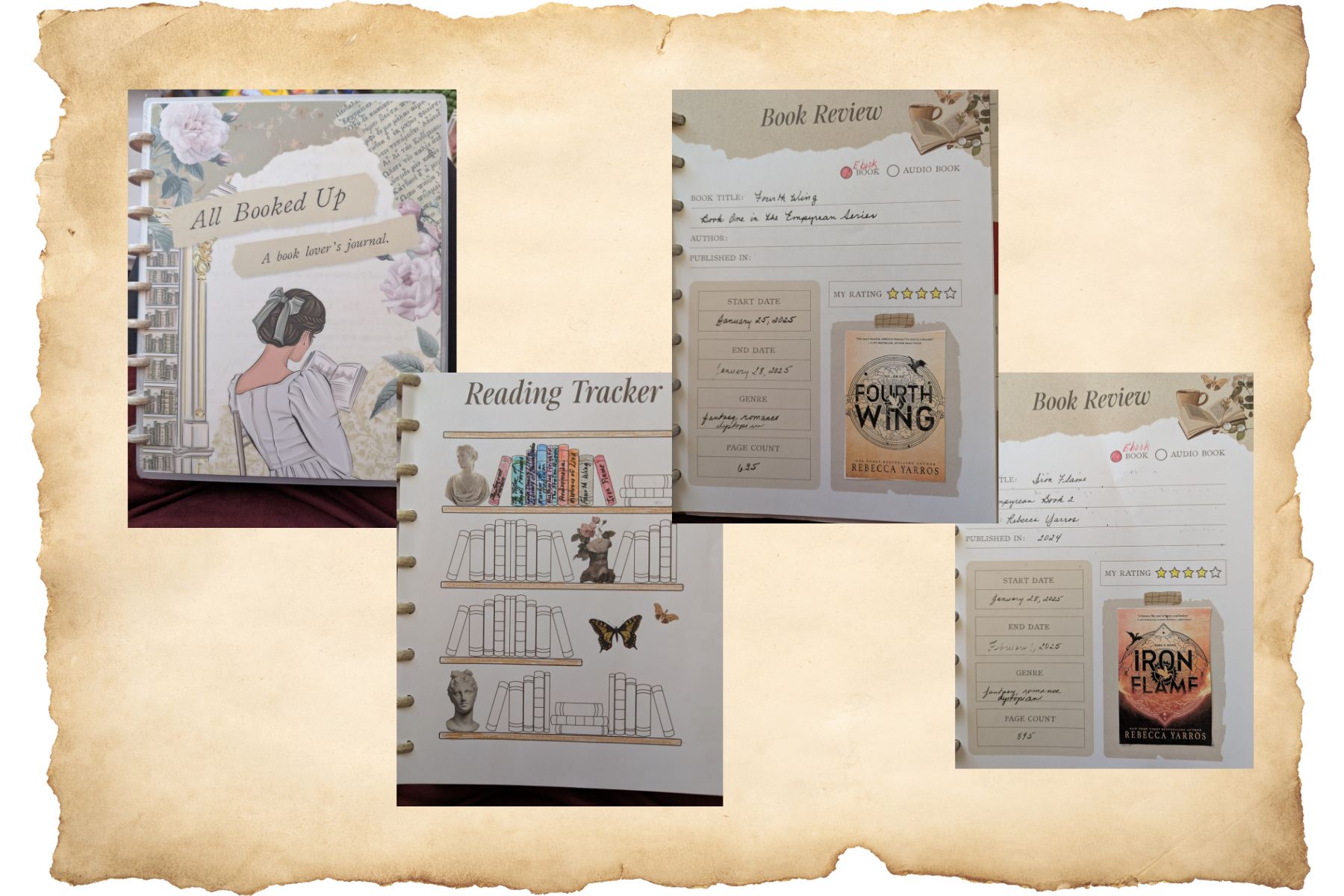
Last year, I began keeping a book journal/reading log, and I am continuing the practice this year. One of the things I do is list the genre of the books I’m reading because I will get into a rut if I am not making conscience decisions about what I’m reading. Sometimes, making those classifications is not easy. Fourth Wing and Iron Flame are definitely in the fantasy genre with its use of talking dragons and magic, and it is a romance as it traces the development of the relationship between Violet and Xaden. (The new term is romantasy), and I think it falls in the YA classification with the young protagonists. That being said, I would not recommend this novel for younger teen readers. I also classify this book as dystopian in many ways. It has the autocratic leadership with a secret agenda hidden from the citizens in the name of protecting them as well as the use of fear to control the characters. Fourth Wing reminded me of The Hunger Games in the way the cadets were allowed to kill each other off in order to secure their places as riders.
After I finish Onyx Storm, I will return to By Another Name. I do have a tendency to binge-read when I start a series in progress. Unfortunately, I will have to wait a couple of years before the fourth book in the Empyrean series is published. Rebecca Yarros has stated that she is not committing to the one-year turn around for this next book due to the mental and physical stresses that schedule puts on her. And there are some new books coming from the Book of the Month Club and the Aardvark Book Club in the next couple of weeks as well. February will be a busy reading month, too.
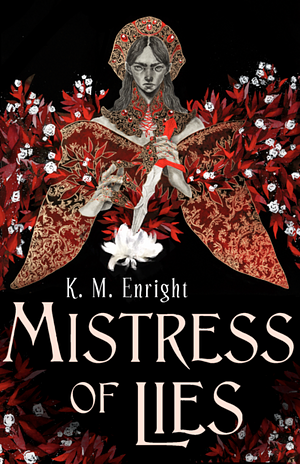
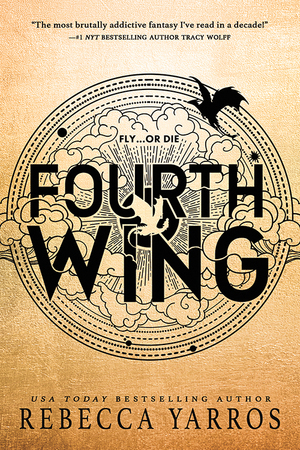
My tally for the month of January is probably nine books (unless I finish Iron Flame by Rebecca Yarros in the next day or two). I finished Mistress of Lies by K. M. Enright last week and Fourth Wing by Rebecca Yarros yesterday.
Both books are fantasy; Both books have some questionable characters, meaning I’m not sure I like them. However, I did like the books. Mistress of Lies addresses the question of what to do about a leader and government that are oppressive. Questions of class and gender are also at play in the novel. Politics and deception are the tools of survival in this dystopian-like novel.
Fourth Wing is a faster read. It relies on action to tell the story. My jury is still out on how many stars I would rate this book (if I were the rating type). I found the profanity and graphic language excessive; the use of the f-bombs and s-words did nothing to develop characterization or the atmosphere or tone of the novel. They were more annoying to me than anything else. The setting of the riders’ quadrant and the “fly or die” and the weeding out of the weak through death reminded me of The Hunger Games where the only way to win is to survive. While some of the characters do form alliances–and romances, the overall attitude of “every rider for him/herself” is prevalent as is the spirit of distrust among the characters. While there are some genuine loyalties formed, there are not many.
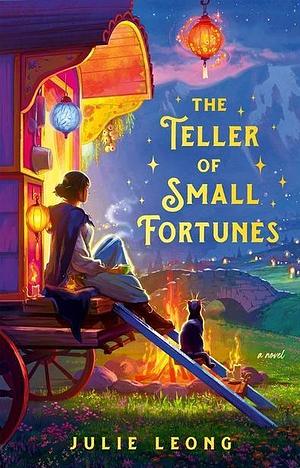
My pick of the month, though, is The Teller of Small Fortunes by Julie Leong, the story of a seer who must travel across two regions to find her family of a former thief, an apprentice baker, and a mercenary in search of his missing daughter, and a reconciliation with her mother. It is a “feel-good” story in the end.
Now, I have to finish By Another Other Name by Jodi Picoult and Yarros’s Iron Flame. Also in my TBR stack is the latest installment of the Makaela Forsythe and Angus Brodie mysteries, Deadly Curse, a fun mystery with a feisty protagonist and her broody Scots “side kick” (although Brodie would definitely bristle and make that uniquely Scottish noise if he knew I called him a sidekick!).
For the second year in a row, I have set a reading goal of 100 books. I managed to read and/or listen to 119 books. I have always been a voracious reader, resorting to reading cereal boxes when there was nothing else handy to read. I will probably exceed the 100 books again this year at the rate I’m going. So far, I’ve read seven books. I’ve broken down my goal into smaller ones as well: to read a classic a month, to read six nonfiction books this year, and to complete a formal reading challenge.
My reading challenges come from two sources: The Book Girls, who host several challenges such as the Book Lover’s year-long challenge with a different book related theme each month, a decades challenge, a “lifetime” challenge, and an In-case-you-missed-it challenge. Read with Allison also has a challenge list that inspires me to push out of my comfort zones. I also subscribe to the Book of the Month Club and the Aardvark Book Club as a source of books.
So far in January, I have finished seven books already.
I actually started two books in December of last year, The Secret Garden and The Teller of Small Fortunes. I had never read The Secret Garden as a child, but I had seen the movie with Gary Oldman several years ago and enjoyed it. I was entranced by the book and the way Mary and Colin grew as characters.
The Teller of Small Fortunes was a slow starter for me, and I put it aside during the holidays. However, once I picked it up again, I was hooked. This is the story of a fortune-teller who finds a family as she travels from town to town telling “small fortunes,” hoping to avoid the attention of the guild of magicians and seers. It is also a story of reconciliation and second chances.
Lula Dean’s Little Library of Banned Books caught me by surprise. I expected it to be more humorous, and there are some comic moments. But the subject is all too serious–and timely. Lula Dean sets out to clean up her town by getting rid of books that she believed would corrupt the young people. Strange things begin to happen, though, when she sets up her own Little Library in her front yard, stocked with “safe” titles, she thinks. People start getting books and adding their own. Then Lula decides to run for mayor after her rival runs on a plank to remove the statue of a Civil War general, who just happens to be Lula’s great-great-great grandfather. That’s when all you-know-what breaks out and the truth about the popularity of Lula Dean’s library comes to light. The novel is so timely because it mirrors what is happening throughout the country today as more and more communities face questions of censorship.
Every so often I have to reread a favorite classic. I have had a love-hate relationship with Wuthering Heights since I was in high school and my English teacher wanted me to read it. It was one of those books that I was not quite ready for at sixteen, but ten years later, it became MY book and the basis for my master’s thesis. On StoryGraph, Wuthering Heights is classified as a romance, but it is unlike the typical romance. If Cathy and Heathcliff are in love, it is a dangerously obsessive love. What I love about this novel now is the language Emily Bronte uses. It is clear that she is heavily influenced by the first generation Romantic poets Wordsworth and Coleridge as well as by Byron and other later Romantic writers. The final paragraph of the novel has to be my all-time favorite passage in literature:
“I lingered round them, under that benign sky; watched the moths fluttering among the heath, and hare-bells; listened to the soft wind breathing through the grass; and wondered how any one could ever imagine unquiet slumbers for the sleepers in that quiet earth.”
Lord Redmond and Daniel Haze return in Irina Shapiro’s latest mystery in the Redmond and Haze Mystery series. This time, they investigate the murder of a medium who had helped them in a previous case locate Daniel’s missing daughter. They also grapple with their trust of those who claim to communicate with the dead. Daniel uses his expertise as a police officer working for Scotland Yard while Lord Redmond uses the medical sciences to provide important clues to solve the crime. I’ve already pre-ordered the next book in the series.
The Stolen Queen is a historical mystery/thriller, according to StoryGraph. When an important artifact, a fragment of a statue of a little known female Egyptian pharaoh is stolen during the annual Met Gala, a curator must face a tragedy in her past to recover the stolen piece. She must also return to Egypt, the place where she faced that tragedy. With the help of Annie, Charlotte not only recovers the stolen artifact, but she also recovers her family. I enjoyed the dual time periods. The novel starts slowly; however, the last third of the book moves very quickly, and I was hard pressed to put it down. (I may or may not have stayed awake until the wee hours of the morning reading.)
I’m not sure what to say about Therese Bohman’s Andromeda. It is a very short novel, just under 200 pages. It is beautifully written, the language often poetic. Bohman creates some beautiful metaphors about reading and the importance it can have. There are two narrators: Sofie, a young intern hired to become an editor for the publisher’s Andromeda imprint, and Gunnar, the editor-in-chief, who mentors and grooms Sofie with the idea that she would take his place when he retired. The book is roughly divided into two halves with each narrator telling his or her story. Sofie focuses on her relationship with Gunnar and the publishing business whereas Gunnar narrates his “life story.” The thread that runs through both parts is the importance reading and books had in their lives and in their relationship. I have to admit, though, that I’m not sure I can say I liked the book, but I will say that I’m glad I read it.
Now, I’m ready to start book number eight from a pile of books I bought last year. That’s another one of my goals: to read last year’s purchases. I think I’m going to read Mistress of Lies by K. M. Enright next. I’ve seen it come up on several “best of 2024” lists recently. It’s been collecting dust for a while.
I have been choosing a word of the year for almost fifteen years now. Last year, my word was “manifest,” and some things really came into focus as a result. I became a reader again and discovered that I do like the magical realism genre after all (although I am not a big fan of Isabel Allende’s version in House of the Spirits). I began rereading some old favorites and found some new favorites. And I still read more than my fair share of Regency historicals, mysteries and romances alike.
This year, my word is “explore.” I want to explore more new ideas and discover new opportunities. One area that I want to explore is photography and creative, artistic photo editing. To that end, I enrolled in a year-long class, A Year of Creative Photography. Already, I have begun playing with new ideas–using brushes and creative filters to alter my usual more documentary photos into something completely different. I’m also exploring ways to use my new camera lens, the Lensbaby Velvet 56. I took this picture of the camellia right after Christmas and after watching the video in the classroom about creative editing, I played.
Using a couple of filters in Photoshop changed the emotion of the image. I am intrigued by the motion and the color.
I also have on my bucket list of explorations are more trips to visit the state parks in South Carolina. Right now, it’s just too darned cold to go out for any length of time. I’m also exploring more of my family’s history. I know some of the family history on my maternal grandmother’s side. We are descendants of the Salzburgers, a group of Austrians who immigrated to Georgia in the 1700s and settled about 30 miles from Savannah in a small community called Ebenezer. They founded a Lutheran church, Jerusalem Lutheran Church, which is the oldest continuous congregation in the United States. Like so many others, these Lutherans came seeking religious freedom as well as economic freedom. I’m sure there is more to their history than these few details, and that is one thing I want to explore.
I also enrolled in Ali Edwards’s One Little Word class, another year-long exploration, as a way to document my journey through this year of exploring. I’m working through those prompts now.
This is my second full year into retirement. While I enjoy sitting in the rocking chair with a good books—an exploration all its own, and in the corner of the couch with my knitting needles or crochet hook and yarn, I also want to keep my brain active by learning and growing. I am exploring ways to use my voice in my church and community. I am actively studying the Bible. One of my reading goals for this year is to read more nonfiction although I have found that sometimes I do better listening to nonfiction books on Audible than I do by reading the texts. (I wonder why that is?)
I did it. I set a reading goal of reading at least 52 books this year, and I met that goal before June. Then I set a new goal of 100 books and met that goal in October. As of today, I have read 119 books, and will probably read and finish one more before December 31. I started The Teller of Small Fortunes earlier this month but have not finished it.
In some ways, this was a slow month; I finished seven books. It was also a busy crafting month to get ready for Christmas as well as the other busy-ness that comes with the holiday season. I have to admit that I started a few and put them away or they are still in progress.
Five of the books I read this month fall into the category of historical novels, some with more romance than others. I read the latest installment of the Tabitha and Wolf novels, An Intrepid Woman, and enjoyed it. It is an easy read with a story that is more plot driven than character driven. Actually, the same can be said for the first five books. Of those books, I especially liked the Victorian mystery An Exhibition of Malice by Emily L. Finch, which is set against the background of the Industrial Revolution and the Great Exhibition of 1862, ten or so years after the exhibition sponsored by Prince Albert in the middle of the 19th century. If we think industrial espionage is only a modern thing, this novel suggests that stealing plans for inventions has been around for a whole lot longer.
The two contemporary novels, The Most Wonderful Crime of the Year and The Last Love Note were both good reads. The Most Wonderful Crime of the Year was a lot of fun. It is light-hearted and funny as well as a good mystery. It makes use of the “enemies to lovers” trope even though the enemy part is one-sided. And, of course, there is the happily ever after ending. This novel makes use of the Agatha Christie country-house mystery and a locked-room disappearance. Ally Carter also uses Agatha Christie’s own mysterious disappearance for inspiration in this novel.
When I began The Last Love Note, I thought I was going to read a rom-com. The first couple of chapters made me laugh out loud; however, the novel started getting pretty heavy as it developed into the story of a forty-year-old widow’s coming to terms with the death of her husband from early onset and rapid Alzheimer’s and single-parenthood. Yet, in spite of the heaviness of these plot threads, there is a lightness and at times some comic relief as she slowly learns that she can have a new life (and love) and a second chance at happiness. I admit that I did the ugly cry through the last ten chapters of the book.
As I finished this book, I thought back over the books I have read this year and looked at my list of best books of each month:
January–The Fury
January–The Fury
February–The First Ladies
March–The Lost Apothecary
April–Touch Not the Cat
May–Shakespeare: The Man Who Paid the Rent
June–The Women
July–TheLost Story
August–The Cliffs
September–Emily Wilde’s Encyclopedia of Faeries
October–Lady Macbeth
November–Before the Coffee Gets Cold
December–The Last Love Note
All of these books were such good ones, and it is hard to pick my favorite. I am going to go with The First Ladies, though. It is a novel about the friendship between Mary McLeod Bethune and First Lady Eleanor Roosevelt. These two women are often footnotes in the history books, and their roles in the civil rights movement are overshadowed by likes of Martin Luther King, Jr., Malcolm X, and other men. Yet this novel showed how important their work was. Moreover, it also showed how difficult interracial friendships can be, even today, when we are supposedly more enlightened. I often learn more history from the historical novels I read than from the history books, and this one certainly played into my interest in history.
I tried to read more nonfiction this year and actually finished three really wonderful books: Judi Dench’s autobiographical Shakespeare: The Man Who Pays the Rent, Killers of the Flower Moon, and The Boys in the Boat about the 1936 US Olympic eight-man rowing team. It would be hard to choose which is the better book, but I will admit that Shakespeare:The Man Who Pays the Rent is my favorite. Dame Judi Dench gave me such insight into the characters from the plays she performed, and I almost wished I were teaching again so I could share those insights with my students. I listened to both of the books on Audible and realized that I loved listening to nonfiction more than fiction. Killers of the Flower Moon is a difficult book to read and listen to because of its subject, the exploitation of Native Americans out of greed. I highly recommend this last book.
I am already lining up my books for the coming year. I can’t wait to see what selections will be offered in the Book of the Month and the Aardvark Book clubs. My book group that meets monthly at the local coffee shop will be reading Wuthering Heights as our first book of the year. I am looking forward to reading that one again. I wonder how much it has changed since I read it as a sixteen year old, a twenty-six year old, a thirty-something, and now as a sixty-six year old. And I wonder how my reading will compare to our high school senior’s reading. (Imagine a book club with three sixty-something women and one seventeen-year-old! We do love our girl, though. She has been a wonderful addition to our group!)
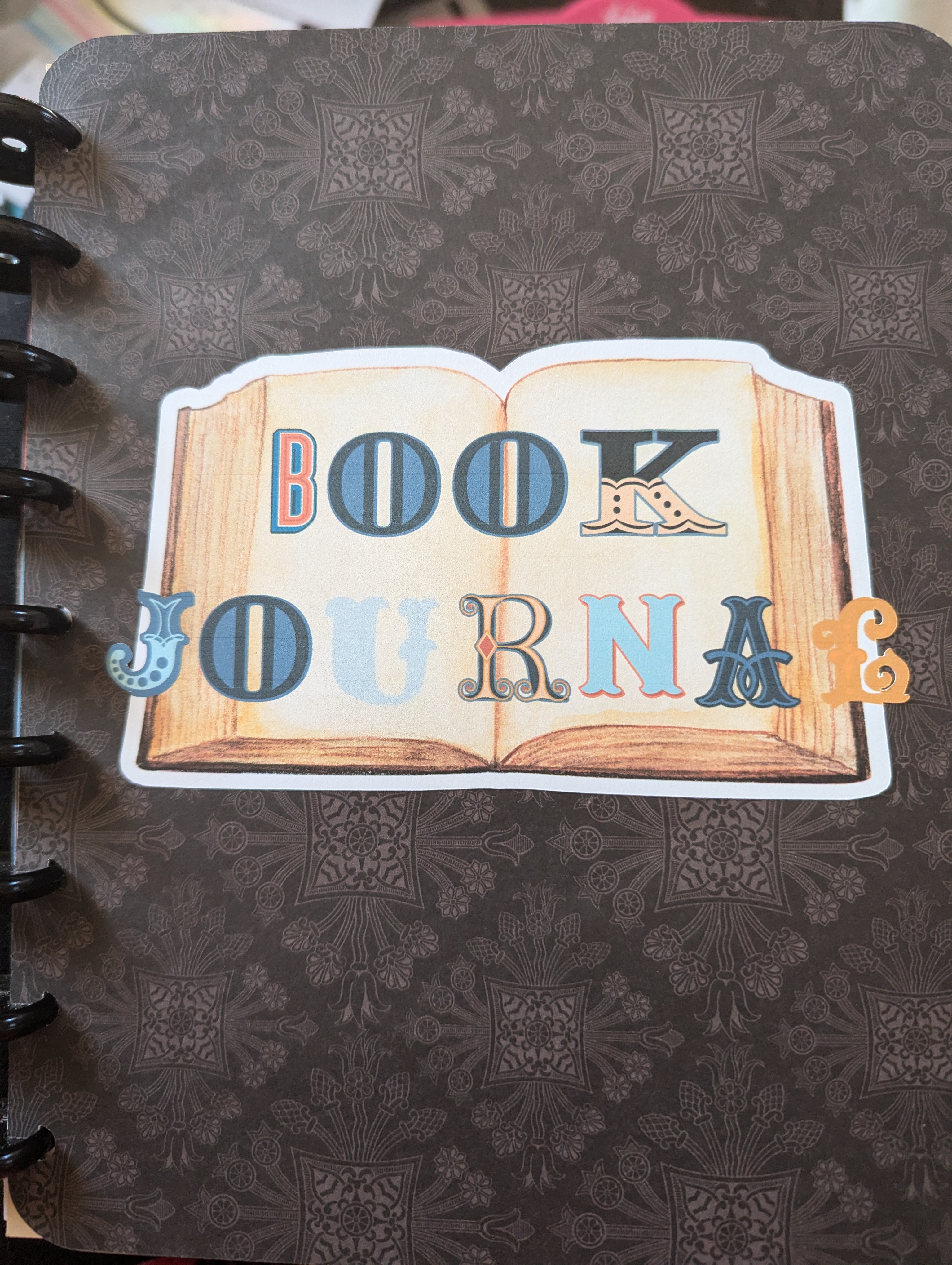
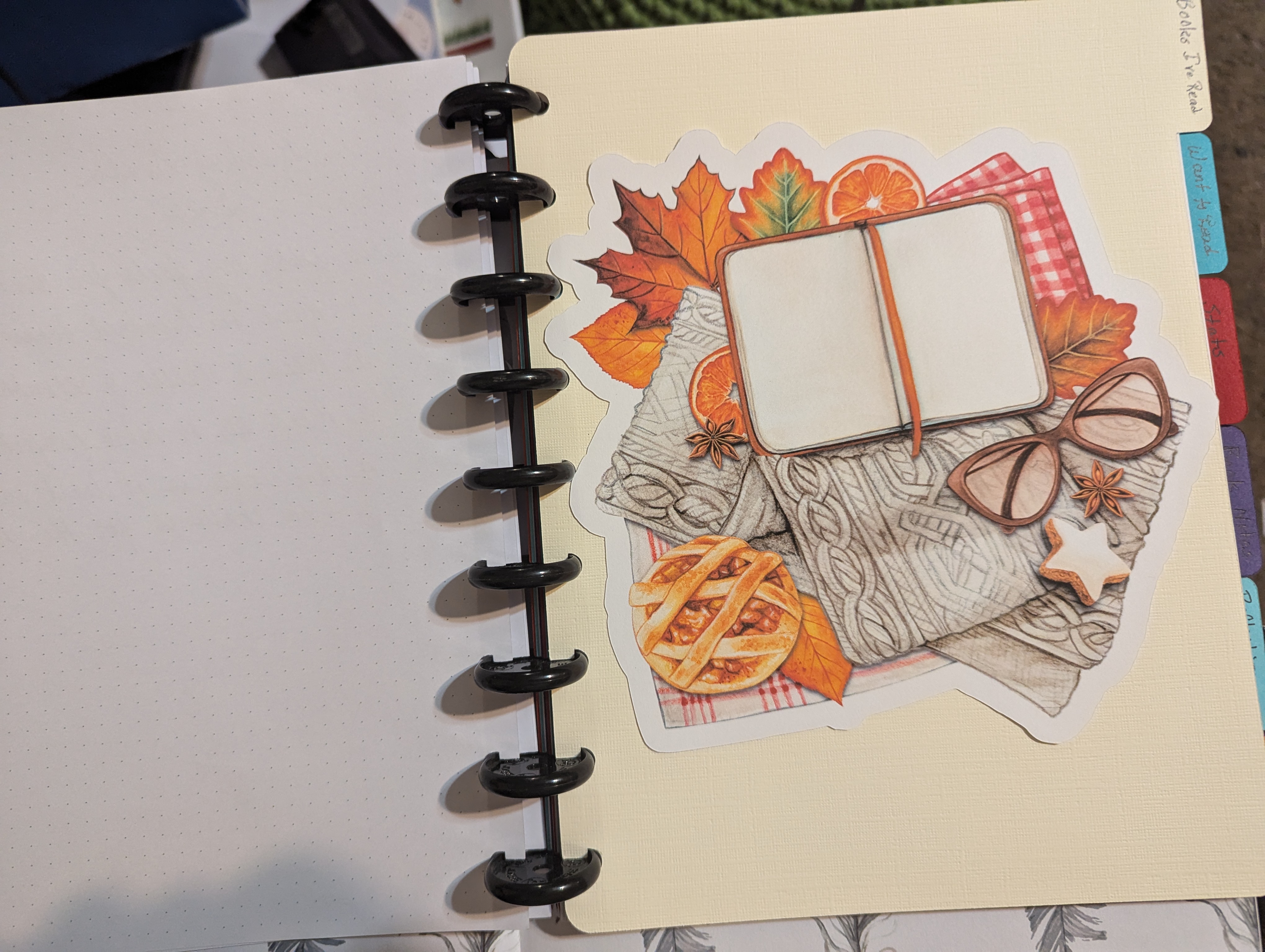
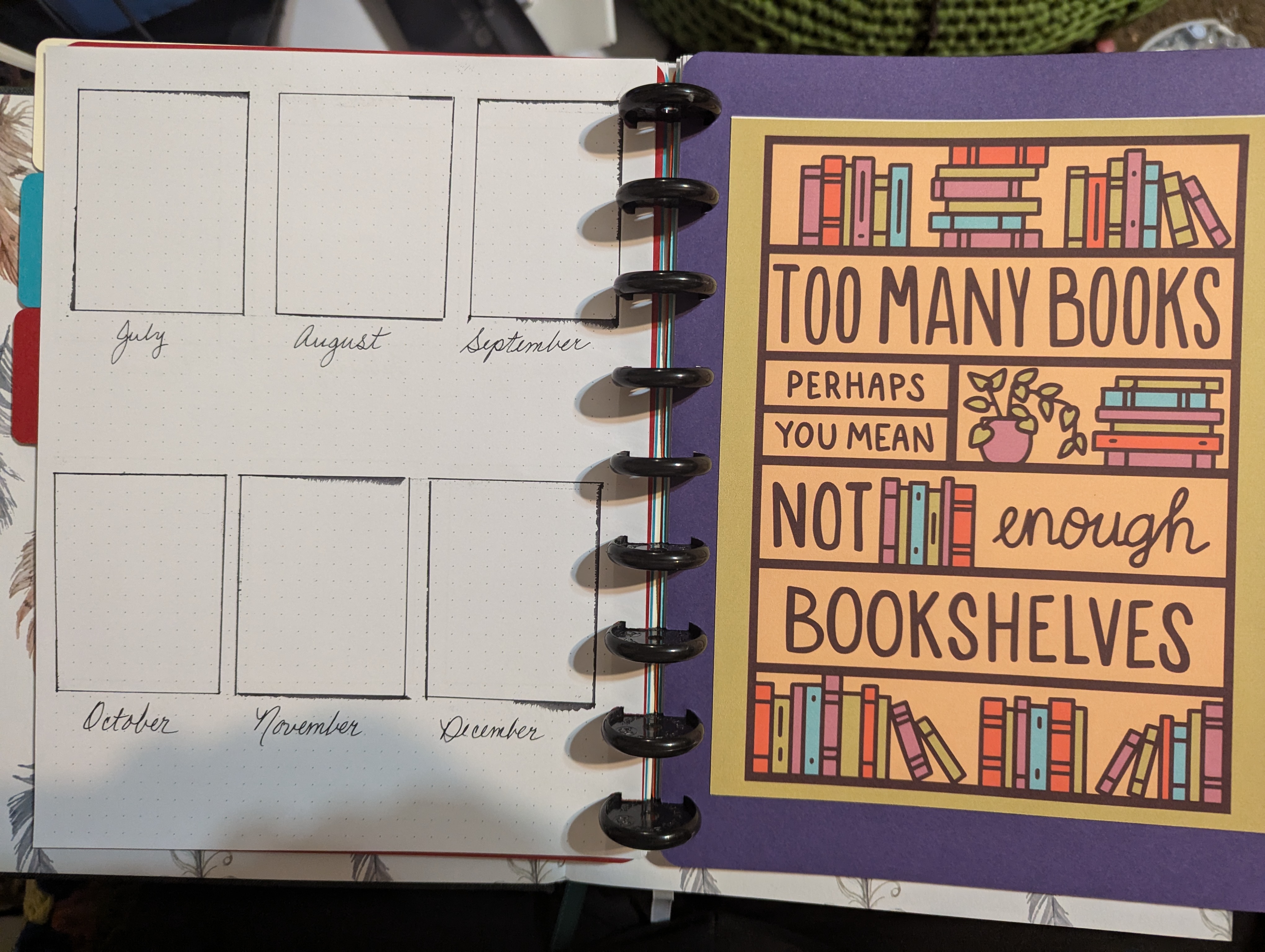
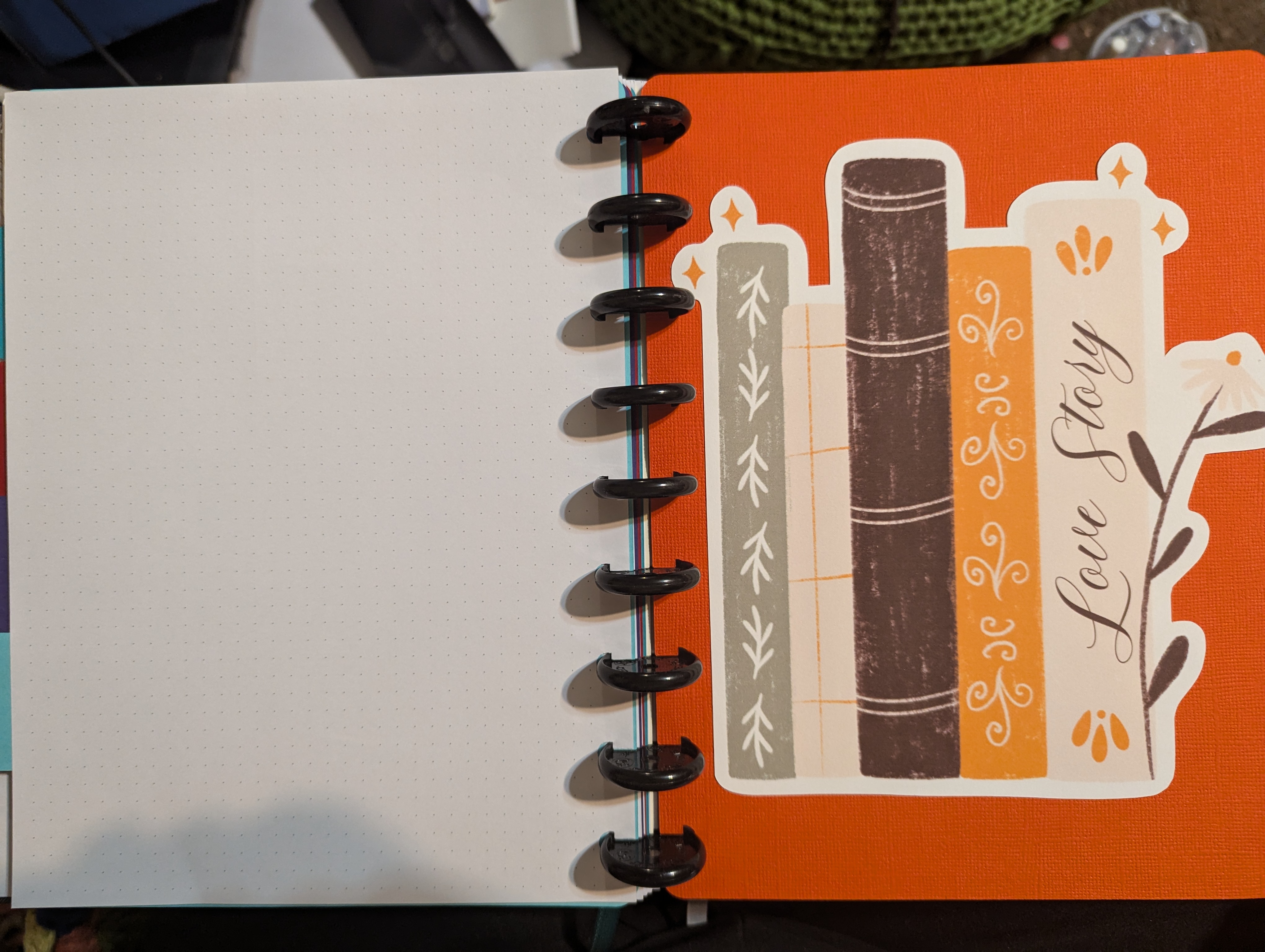
Yesterday afternoon, I “retreated” to the so-called craft room to make stuff. Thanks to Cricut’s Print-and-Cut feature, I printed out some extra-large “stickers” on card stock to cut and used a template from an Etsy seller to make dividers for the different sections of my book journal. Today I added a cover made of patterned paper and a combination of print-and-cut designs. I decided not to put the date so that I could reuse the cover and/or add to the journal in the future.
I also added a pocket page to hold stickers and such as needed.
There it is. I think I’m ready for reading in January.
Is it too early to start planning and setting reading goals for 2025? Probably, but it’s already the fourth day of December. I feel that the month may fly by before I’ve had time to blink.
Last year was the first year I set a reading goal. I began with a goal of fifty-two books—a book a week. As of yesterday, I have read 113 books. And I wrote in my book journal about every one. I really enjoyed the process. When I set up my book journal at the beginning of the year, I had all sorts of stuff in it and found that some of the things just weren’t relevant to me. I included five or six reading challenges, none of which I really followed. However, keeping statistics (books completed and genres, etc.) was revealing. I knew I tended to read a LOT of novels set in the Regency period, most of which involved either romance or mystery (or both). I found that I favored certain authors in the Regency genre. Keeping the statistics did help me broaden my reading.
I have purchased some printable reading and book journals and two bound journals. None of these completely suit me. One of the problems with the printables is the size. I do not want a letter-size journal. I use the classic Happy Planner for my daily planner/calendar, and I wanted that 7 by 9.25 inch size for my reading journal. I could resize the page in the printing app, but sometimes that meant the writing on the page was too small, or the space for writing responses was not optimal. And of course, there were things on the page that I didn’t care about tracking. A bound journal does not allow for additional pages or rearranging them if desired. So, I pulled out my dot grid refill paper, black felt-tip pen, and ruler and began designing. My pages are pretty plain right now, and I may embellish them later.
First, I made a list of what I wanted in the journal:
2025 Reading Goals
Books I’ve Read
Books I Want to Read
Monthly Statistics
Favorite Books of the Month
Favorite Book of the Year
Book Club Picks
Book Notes/Reviews
Reading Challenges
A Year-end Reflection
My reading goals for 2025 are
Read at least 100 books
Read or reread at one classic a month
Read or listen to at least six nonfiction books this year
Complete at least one book challenge
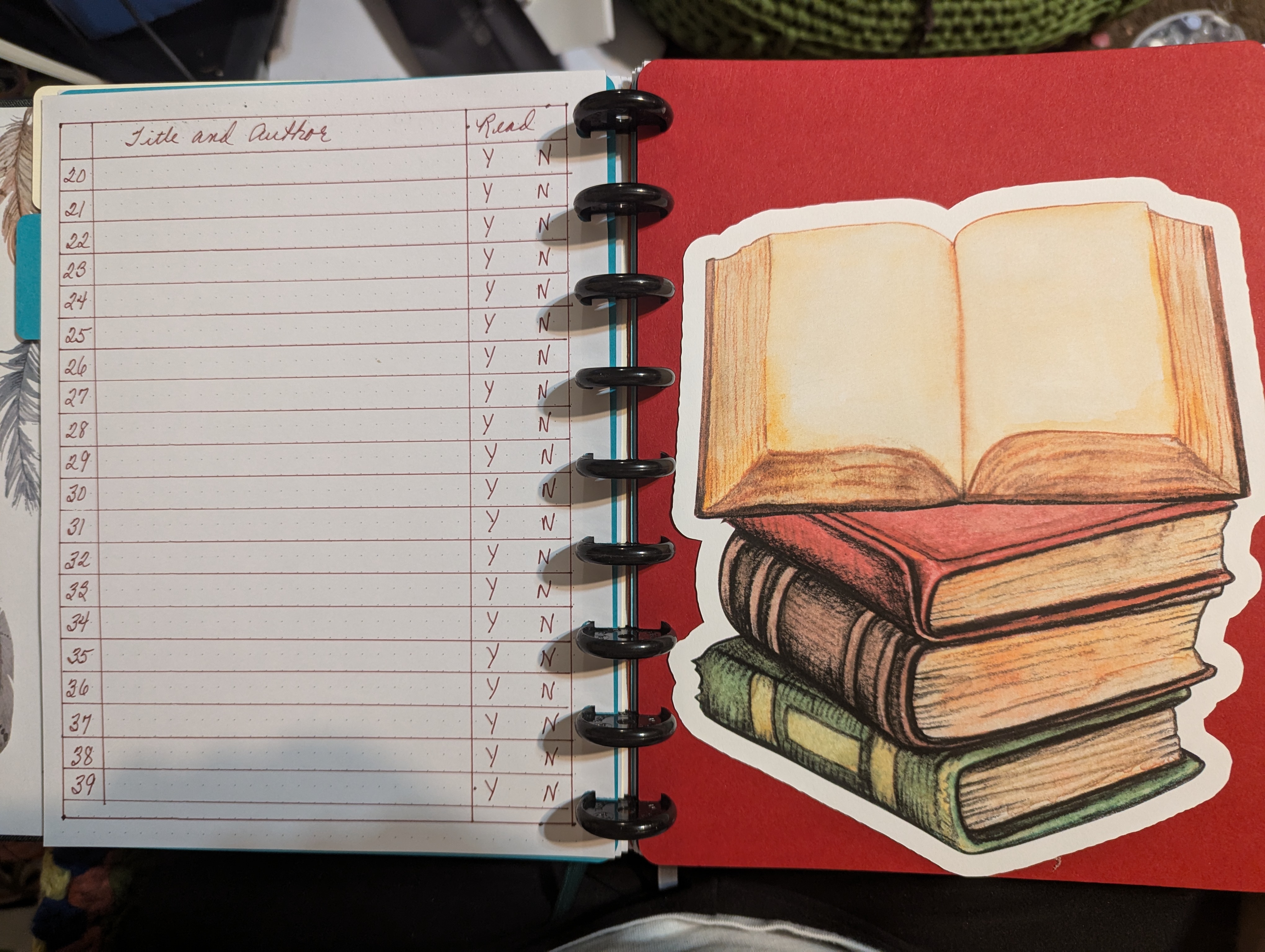
Next, I created the Books I’ve Read pages. It’s a simple table with four columns
Title and author
Genre
Format (book, e-book, audiobook)
Finished
This gives me an “at-a-glance” option to see the books I’ve read as well as a way to count them in a hurry. Another at-a-glance table lists the books I want to read with two columns for the title and author and a check box for whether I’ve read it or not.
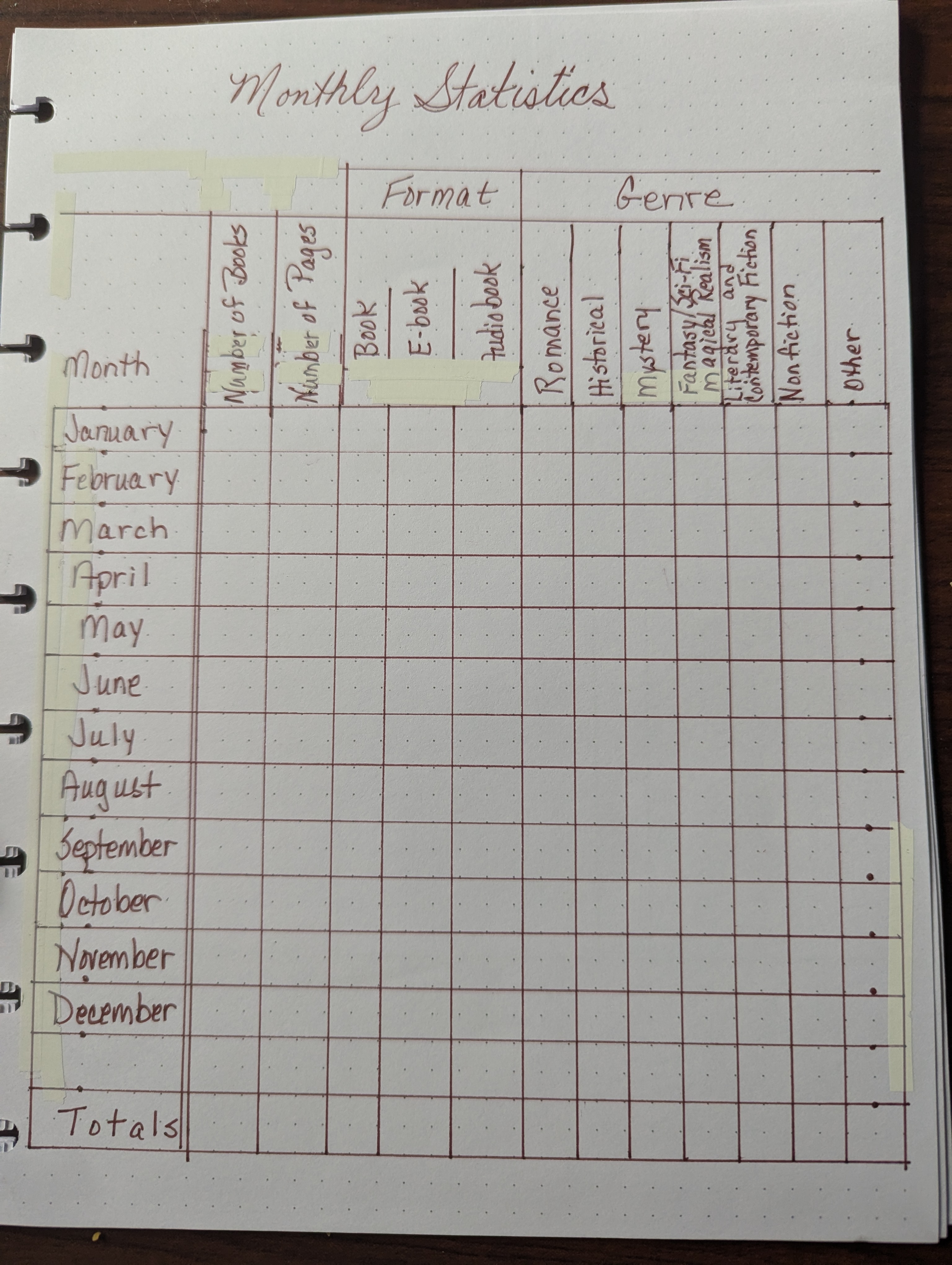
After making individual pages for each month this year, I combined my statistics page into one chart:
It took some “doing” to get it like I wanted it. There is a rather liberal use of the Wite-out correction tape on this page.
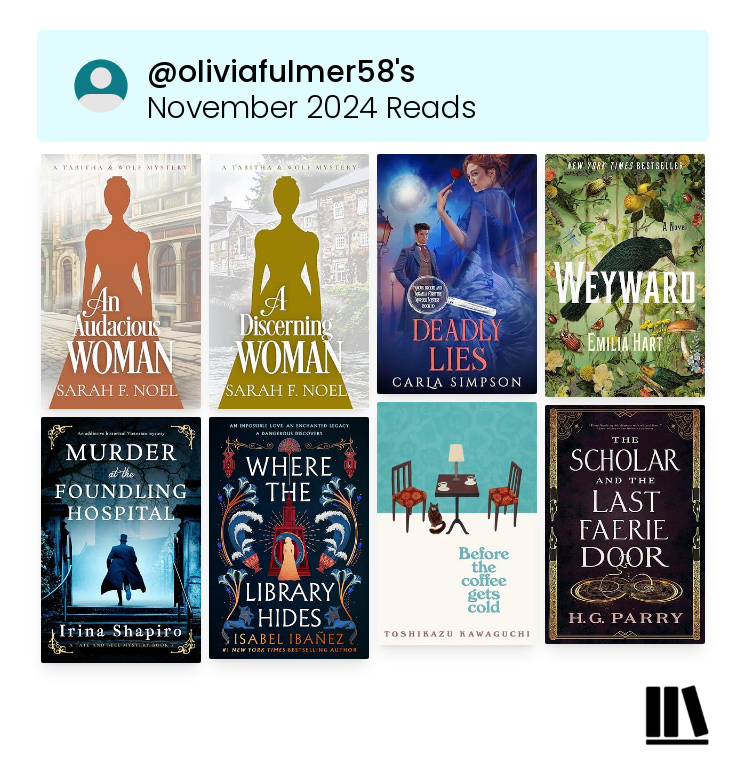
I plan to make a kind of collage of my favorite books for each month. I love the StoryGraph app for creating collages of books read during the month. I can cut out the images I want to use and adhere them to my page.
Finally, I have a page designed for book notes:
I will add pages for reading challenges, should I decide to participate, and a final page for reflection. I am waiting on a composition notebook style cover. I also plan to make dividers for each section, just so I can find my place easier. I imagine I will also embellish some of the pages and add some creative pages as I go.
So–here’s to looking forward to another year of reading!
I really slowed down my reading this month. Perhaps it was because some of the books were longer and “slower” reads. It’s also the beginning of the holiday season, and things get busy.
I seem to be falling back into familiar and comfortable genres this month–historical romances and mysteries as well as some fantasy and magical realism.
An Audacious Woman, A Discerning Woman, Deadly Lies, and Murder at the Foundling Hospital are all historical mysteries set in the 19th century. Sarah F. Noel’s “Tabitha and Wolf” mystery series features the recently widowed Lady Pembroke (Tabitha) and the new Earl of Pembroke (Wolf) as they investigate various murders while navigating a tricky romance. These novels are light and sometimes humorous, especially when Tabitha’s mother-in-law, the Dowager Countess of Pembroke decides she wants to become an investigator. Besides the mystery aspect, the novels are also about finding one’s family and belonging as Tabitha’s family includes not only the new Earl and the Dowager Countess, but a trusted family friend and two street urchins who become her wards.
Deadly Lies is the latest book in the Angus Brodie and Mikaela Forsythe Murder Mystery series by Carla Simpson. Lady Forsythe is an independent woman of the late nineteenth century who becomes involved with the often surely Angus Brodie when her sister goes missing (Book I). In this latest installment, they investigate the murders of two young women found with a red rose. Mikaela narrates the story as it unfolds with occasional glimpses into Brodie’s point of view when he goes off on his own. Mikaela, like her elderly great-aunt who raised her and her sister after her parents’ deaths, is intelligent, witty, and more than a little free-spirited. This series is mostly light-hearted and fun.
Murder at the Foundling Hospital is the third installment of the Tate and Bell series by Irina Shapiro. Set in London in the latter half of the nineteenth century, the novel follows Detective Bell and Nurse Gemma Tate as they investigate the murder of Amanda Tate, a fourteen-year-old foundling. Together, they piece together the clues that eventually bring the killer to justice, but at the expense of Gemma’s job at the Foundling Hospital. Shapiro uses more history in the development of the plot than Noel or Simpson as she draws on the details of the Crimean War for context. This novel is darker in tone and without the humor of Noel’s and Simpson’s novels, but it is no less a good read.
I seem to be choosing more books from the fantasy and magical realism genres. Weyward, Where the Library Hides,Before the Coffee Gets Cold, and The Scholar and the Last Faerie Door all incorporate some measure of paranormal or supernatural elements. Emilie Hart’s Weyward tells the story of three women of the Weyward family from three different time periods: one a 17th century woman accused and tried for witchcraft, a teenager from the 1940s, and a young woman from the present who retreats to her great-aunt’s cottage to escape an abusive marriage. All three women have an affinity with nature that is often called “witchcraft.” All three women have complicated and even dangerous relationships with the men in their lives. However, although bad things happen to these women, they come through their experiences stronger and more independent than ever. Resilience is the key. I enjoyed this book and truly did not want it to end. Perhaps there will be another Weyward book that tells the story of Kate’s daughter named after her ancestors, Altha the 17th century “witch” and Violet the 20th century botanist and scientist.
Where the Library Hides by Isabel Ibanez continues the story begun in What the River Knows. Inez has gone to Egypt at the end of the 19th century to find out what happened to her parents. At the end of the first novel, she discovers that her mother is still alive, and she receives a rather unromantic marriage proposal from her uncle’s assistant Whit. Where the Library Hides has the two, now married, searching for the lost loot from Cleopatra’s tomb and Inez’s mother. Ibanez throws in a plot twist near the end of the novel that I truly did not expect, but it made sense. This sequel ties up all the loose ends and brings the mystery to a very satisfactory close. The epilogue, though, may foreshadow some more books about characters introduced in this novel. I will be following Ibanez for other books.
Before the Coffee Gets Cold was our choice for the November book club. It also falls into the genre of magical realism. Four characters have the opportunity (and the desire) to travel in time. There are several rules, though, that govern their time travels: they can only meet people with whom they have met in the coffee shop; they will not change the present by going to the past or the future; and they can stay away for only as long as the coffee stays warm. Failure to drink the coffee before it gets cold will turn them into a ghost. Three choose to go back in time while one character chooses to go into the future. All three come away from their time travels with new understandings of themselves and others. I had my doubts about this book when I started it. It felt too objective. However, as we followed each character into their pasts, presents, and futures, the reader does get to know them and feel engaged with them. By the end of the first vignette, I was fully engaged and ready to devour the stories. I will certainly be reading the other books in the series.
H. G. Parry’s The Scholar and the Last Faerie Door combines the history of the post-World War I Lost Generation with fantasy. I’m not sure there’s a name for this genre! It’s a combination of historical fiction and fantasy and romance. Clover Hill wants to learn to do magic so that she can release her older brother from a Faerie curse he received at the battle of Amiens during the first world war. She attends Camford University where she becomes friends with three students who come from the class known as the Family, people who have had magic in their blood for generations. What makes Clover different is that she is not from a magical family but is an ordinary farm girl. However, through hard work, study, and research, she does learn magic and eventually obtains the spell to release her brother. However, she had to pay a high cost. This is a heart-breaking story of love and friendships that go awry and of lost trust; it is also a story of restoration, forgiveness, and reconciliation. Even though events become quite dire, there is a thread of hope throughout.
It was hard to pick a best book for the month, but I think I decided on Before the Coffee Gets Cold. It is an easy-to-read novel, even in translation from Japanese. The characters are for the most part likeable and relatable. There are really no villains in this book at all, unless, that is you count death, Alzheimer’s, and loss as villains. There are no murders to solve. In the end, the book is full of love and hope.
As the Christmas season approaches, I know I will have more books to read. I haven’t selected specific holiday books (yet), though I have started Tommy Orange’s book Wandering Stars, which follows a survivor of the Sand Creek Massacre. It’s a heavy way to begin this season of joy.
[from “This Is How They Come Back to Us” by Barbara Kingsolver”, the October 25 Wild Writing prompts]
I think of Daddy when I go to my childhood home, him sitting in the recliner and turning on the TV,
telling stories that may or may not have some embellishment. After all, he came from a family of story-tellers.
I think of him when to go to my old church where he sat on the third pew from the front on the right-hand side, in front of the pastor’s pulpit.
I can hear him singing those old, familiar hymns and smile when I remember how I knew if I was playing loud enough to support the singing: If I could hear Daddy singing, then I wasn’t playing loud enough. It became a kind of competition to see if that little Hammond spinet could drawn out Daddy’s baritone.
I think I Daddy when I drive by or walk through the fields I inherited from him, the hours he spent on his tractor plowing and sowing the seeds, cutting and raking the hay, baling it and loading it on the truck, and drinking ice water from a Mason jar (or a mayonnaise jar) wrapped in a brown paper bag on those hot days.
I think of him during the he was recovering from the surgery, me riding the combine and tying the sacks of oats whle he watched from the front seat of his old blue Ford pickup.
He would read recipes from the State newspaper of the coop’s Living magazine and give them to me to try. We canned tomatoes in the “play house” that summer before I left home to live on my own seventy-five miles away.
I think of him when I stand on the remains of the garage floor he helped my husband pour and spread and smooth.
I remember his voice,
the thin, papery browned from years of working in the sun with the dark bruises.
I think of him when I see my sons and the lessons he taught them about hunting, the land, stewardship, love, and family.
I think of him on Veterans’ Day and V-J Day and how narrowly he escaped being deployed to the Pacific during those last days of World War II.
I think of him when I’m with my brother and hear Daddy’s wisdom coming from that brat who irritated me so when we were chldren.















 Telling Stories