Mid-month Reading Wrap-up

It’s been a while. . . . I had surgery on my hand on May 31, and it’s healing–slowly. Since then, I’ve done some reading and knitting and crocheting, and a bit of traveling to see some state parks, but that’s another post.

Today is about the reading.

I set a reading goal at the beginning of the year of 52 books—a book a week. Well, to say I’m a voracious reader is a bit of an understatement. I reached the 52 books in June. So, I upped my goal to 100, and at the midpoint of July, I’ve read 63. So, I may need to amend my goal once again.

This month has been a bit different in my reading selections. A couple of the books I’ve read are in the genre of magical realism. I had to look it up because I just didn’t teach much in the way of magical realism, and the only other book that qualified as magical realism that I’ve read was Allende’s House of the Spirits, which I thoroughly hated (that was one of the selections I had to read and plan a unit for teaching when I went through National Board Certification in 2000.) However, I loved the three books I’ve read that had a magical realistic bent to them.

Of course, there are my usual picks of purely escapist historical romance and a mystery or two.
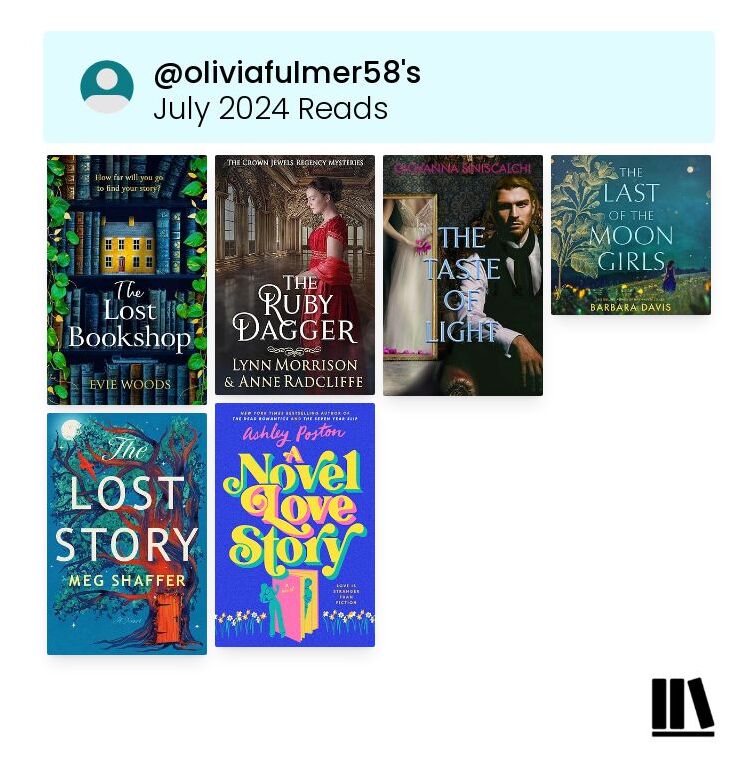
(How cool is this? StoryGraph, a reading tracker app, creates a graphic of book covers! StoryGraph is like Goodreads–sort of.)

Anyway, I can’t pick a favorite from the six books I’ve read so far, but my top two are The Lost Bookshop and A Novel Love Story. The Lost Bookshop is about a “magical” Bookshop in Dublin, Ireland. Martha escapes an abusive marriage and takes a job as a housekeeper for a retired actress, Madame Bowden, in exchange for room and board in a basement room. Henry is a scholar looking for the lost manuscript of Emily Bronte’s second novel. Opaline has escaped an unwanted marriage by going on a “grand tour” of sorts to France where she meets Sylvia Beach ( a real, historical person who opened a Bookshop in Paris and published James Joyce’s novels in the 1920s and hosted a number of American expats, such as Hemingway) and works for her until her brother discovers her whereabouts. She, too, escapes to Dublin where she opens her own bookshop, which somehow just disappears. The novel tells the story of how these three lives, two contemporary and one from the 1920s, intersect and influence each other. It is a book about second chances to find love, self-discover, and the love of books and reading and the way books can impact one’s life.

A Novel Love Story by Ashley Poston also features a bookshop along with a curmudgeonly bookshop owner, a lost traveler, and a town lifted right out of the traveler’s favorite romance series with all its characters in place. Eileen is traveling to a cabin in the Hudson Valley for the annual book club retreat–alone because everyone else has “life” interruptions. A rainstorm sends her in search of a place to wait it out, and she finds her way into Eloraton, the fictional setting of her favorite romance series. She meets the inhabitants, all characters from the novels except for the owner of the bookshop, Anderson Sinclair. Try as she might, she cannot place him in the plots of any of the novels and assumes that he must be a character the author envisioned for the fifth novel, which she never wrote because of her untimely death. Eileen isn’t looking for love after having her heart broken several years ago when her fiance dumped her a week before the wedding. However, with a title like A Novel Love Story, you know there will be romance involved. This book is also about the power of books and reading–and about finding second chances. it is a sweet story, with a glimpse through the open bedroom door but without pages and pages of descriptions of graphic sex. After finishing the book, though, I thought about the story of Brigadoon, that mythic village that appears once every 100 years in the wilds of Scotland. (I may have to find that movie and watch it again!) This is that kind of story.

And my third favorite, or a strong tie for first, is The Lost Story by Meg Shaffer. Two friends go in search of Emilie’s lost sister in the woods of the Red Crow State Forest, the same forest where they went missing for six months nearly fifteen years earlier. The thing is, Shannon has been missing for twenty years. After Emilie’s mother dies of cancer, Emilie discovers she has a half-sister who had been given up for adoption. She hires Jeremy to find her sister, given his success in finding missing girls, but Jeremy can only take on the mission if his best friend from childhood, Rafe, goes with him. However, they have been estranged (and hostilely so) for the last fifteen years. Reluctantly, though, Rafe agrees, since doing so will give him his memories back. This book is more than a book about restored memories; it is about restored relationships, about growing up, and about finding a place to “belong”. It is also about reclaiming the magic and imagination of childhood. I enjoyed getting lost in the world of Shanandoah (yes, that’s how it’s spelled in the novel) and getting to know Jeremy, Rafe, Emilie, and Skya (the queen). There are numerous allusions to C. S. Lewis’s Chronicles of Narnia throughout the novel.

The Last of the Moon Girls also fits into the realm of magical realism and follows many of the same themes as the previous books–self-discovery, restored relationships, finding that place that is home.

The last two books are more traditional historical romances with the happily-ever-after endings.

So, what’s next on my TBR pile? Probably too many to list. I just started Wolf Hall, a traditional historical novel that follows the life of Thomas Cromwell, one of Henry VIII’s advisors. I also have Vera Wong’s Unsoliticited Advice for Murderers, The Wishing Game, The Secret Book of Flora Lea, and Murder on Edisto on the list. That last book is the July book selection for my in-person book club, The Coffee Shelf Readers. I’ll start that book next week.

Now, it’s time to get lost in Tudor English. . . . Happy reading!

Currently in May

Loving the sound of the cicadas in the morning. We had the double emergence of the thirteen- and seventeen-year cicadas. Seeing them has convinced me that there are aliens on earth.

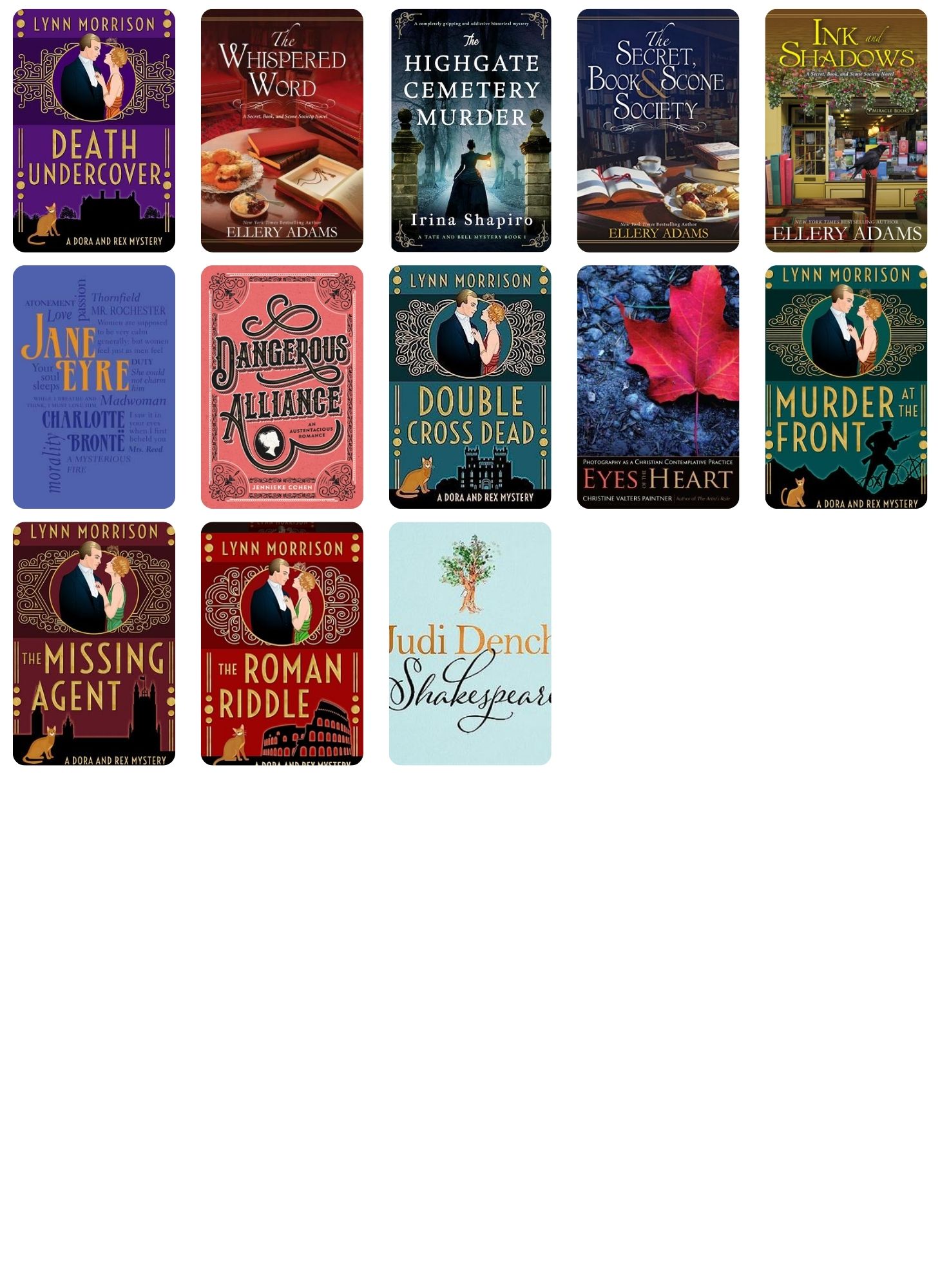
Reading two mystery series by Ellery Adams and Lynn Morrison. The Secret, Book, and Scone Society by Adams is set in contemporary times in North Carolina, and Morrison’s Dora and Rex Mysteries are historical mysteries set in post WWI Britain and Europe. I’m also reading Sarah J. Maas’s Court of Thorns and Roses series.

Watching old John Wayne westerns on GRIT TV and Masterpiece Mysteries/Theatre on PBS.

Eating fresh strawberries from a local farm. So sweet and juicy!

Making crocheted shawls with incredibly soft bamboo yarn.

Celebrating my mother’s eighty-ninth birthday with our family.

Looking forward to touring more state parks and learning more about my state and its history.

Surprised and Delighted

The prompt this month in the One Little Word class is to be “surprised and delighted” by the appearance of my word for the year. This year, I have chosen “manifest” as my word. I probably mentioned that the word came to me during the Advent season. The last line of a hymn goes “God in man made manifest.” That line continues to hum its way into my brain every once and a while.

First of all, the word doesn’t have those “new-age” meanings for me. I think of the word’s meaning as “revelation.” What is being revealed to me? What new things am I becoming aware of? What new “understandings” are coming to me? These are the things that “manifest” means to me.

So, what is surprising and delighting me this month?

Cicadas. Yes, insects! This year, we have a double treat. The thirteen-year and the seventeen-year cicadas are emerging at the same time! We have been treated to their singing or chirping, or whatever you want to call it, for the last three weeks. I have loved waking up to their songs. They have also been accompanied by the chirping of birds. This morning chorus has been a delight and a highlight of my day.

But more than anything else, this emergence of cicadas has occurred during the liturgical season of Easter (from Easter Sunday to the Saturday before the Sunday of the Pentecost). I have been thinking about the idea of resurrection in the religious, spiritual, and physical senses of the word. I believe in the resurrection of Jesus Christ as a Christian. It seems such a physical impossibility. Yet, I think about the cicadas: they have been dormant and hidden (entombed?) for years, and suddenly, they emerge as living, active beings. That is resurrection. That is new life. In a couple of weeks, the cicadas will be gone, and the world will be quieter (I’ll have to get used to that different kind of quiet). When I’m seventy-nine years old, the cicadas will emerge again. That is resurrection. It is tangible proof that it can happen.

I have been tracking the changes in the backyard by taking weekly photos, focusing on the cherry tree in the backyard. It is fully green now in mid-May. The changes are more subtle now than they were in October when I began the project. I have to get closer to the tree to see the changes. The white and pinkish blossoms have turned into little green cherries (hard as rocks!). As I track the changes, the idea of resurrection has manifested more than once–from bare limbs in winter to the pink buds to white blossoms to green leaves and now to the fruit itself. Wildflowers, roses, gladiolas, and other plants have emerged. There is new growth all around me.

Having this word “manifest” is making me aware of life around me. I’m already thinking about my word choices for “next year.” What can follow this word for inspiration and contemplation?

And just delightful is that grandson of mine who is growing and learning and loving. . . .

Reading Roundup–April 2024

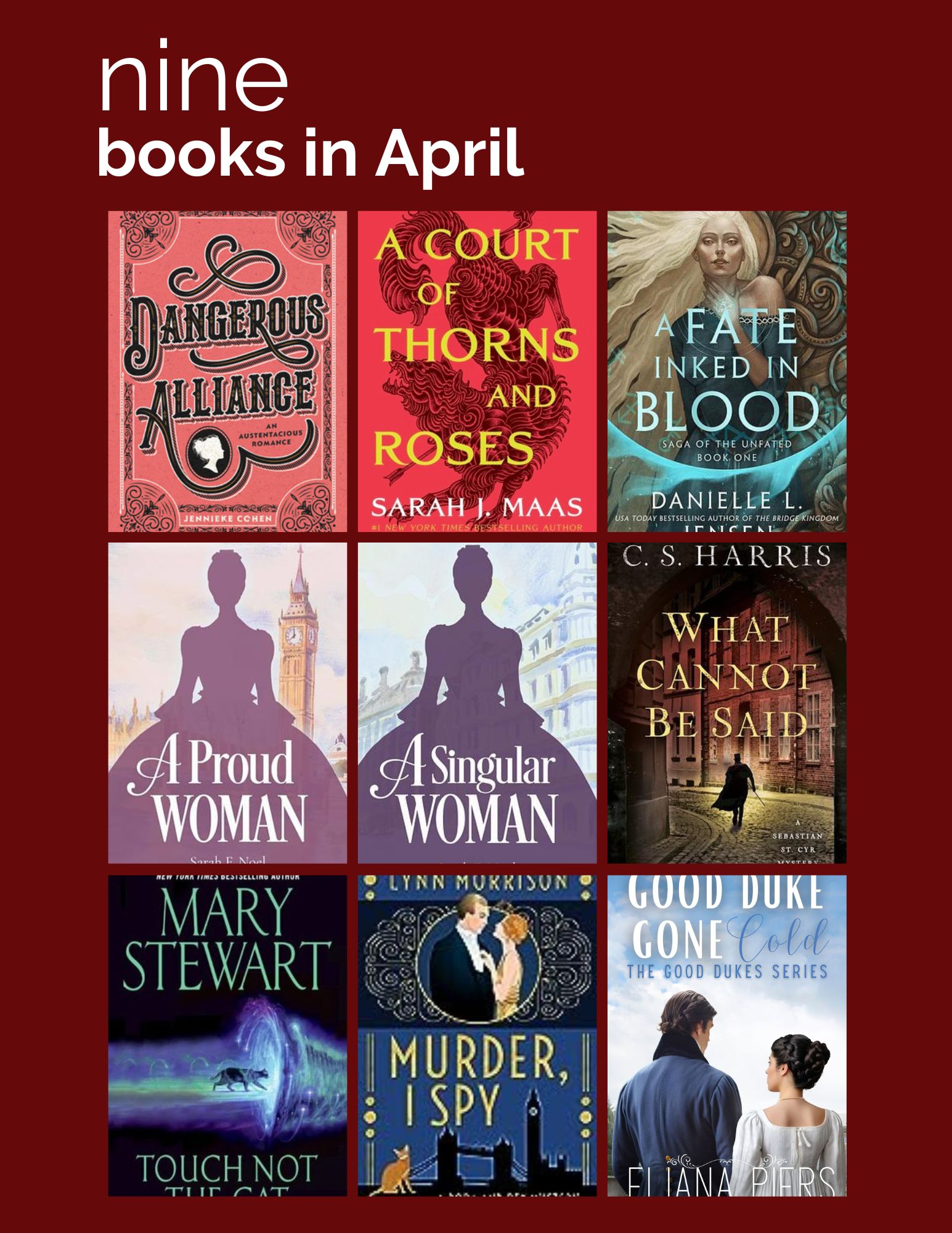
April was a productive month for reading. I read nine books, two of which were audio books, and started two others. Most of the books were “fluff”–easy and escapist reads (yes, they were Regency historical for the most part. Sorry, but those are my guilty pleasures.)

I didn’t read many of the books that came with the two monthly book club boxes; the only one I read was A Fate Inked in Blood, a fantasy novel based on Norse mythology. It is one of several books I read in April featuring strong female characters. I enjoyed this book, but it dealt with some hard issues: father-son relationships; female friendships, loyalty and betrayal; and domestic violence, not to mention war and the threat of war. The novel provided lots to think about while reading it.

Murder, I Spy was advertised as Downton meets Miss Scarlett. I loved the PBS series, The Miss Scarlett Mysteries, and I enjoyed a couple of the books on which the series was based. The lead character is a femme fatale, sort of, who lives a double life as a frivolous socialite and a spy for the British government. When a friend and fellow spy is murdered, she teams up with a British aristocrat to solve his murder. There is mischief and mayhem a-plenty in this novel.

A Proud Woman and A Singular Woman are the first two books in a series by Sarah F. Noel. Lady Tabitha (aka Lady Tabby Cat) is recently widowed. She teams up with the new earl, her husband’s cousin, to solve a variety of mysteries and murders. The novel is partly romance as the recently widowed Tabitha and Jeremy, the new earl (aka Wolf) work together. The Dowager Countess, unfortunately, becomes something of a fly in the ointment for them as she pushes her way into their investigations. I thoroughly enjoyed these books. I wasn’t sure I would like listening to them, but I found that I did! I know I read to my students quite often, and they loved the “read-aloud” days. I think I do, too.

I have read the hype about Sarah Maas’s books, so I gave A Court of Thorns and Roses a read. I “think” I liked it. I know that it kept my interest, and I wanted to see how it ended. It is most certainly a retelling of the Beauty and the Beast fairy tale with a hint of The Hunger Games in the setting of a distant, but oppressive “government” controlling the provinces and districts. I did not find the male lead very appealing, though. I liked his sidekick better. I have not read the other books in the series yet; the second one is waiting in my Kindle library and in my Audible library.

Of the books I started in April, Jane Eyre is a re-read, or maybe it’s a re-re-re-re-re-read (think Aretha Franklin’s refrain in “Respect”). I remember reading Jane Eyre in high school at the recommendation of my English teacher, Norma Richardson, who suggested so many favorite books and led me to so many literary discoveries. I still remember the cover of the first copy of Jane Eyre: a Scholastic book club edition with a white cover and the title is black stylized type face. I couldn’t name the font now if you asked me! Reading at age 66 is quite a bit different from reading at age 16. I see how the character of Jane was rebeling against the societal norms for women in the nineteenth century and how that rebellion created the problems she dealt with. I am savoring this book, making it a slow read.

Another series of books that I read in high school were the books in Mary Stewart’s Arthurian trilogy, beginning with The Crystal Cave and The Hollow Hills. I did not realize that she also wrote mysteries. So, I was pleasantly pleased to discover Touch Not the Cat, published in 1974. I enjoyed this book. Again, it featured a female lead as the investigator into the mysteries surrounding the estate she is trying to save from her cousins who are trying to sell it out from under her to pay off their debts. There is a hint of the supernatural as the main character has a psychic link with another she calls “lover.” In the end there is a romance and a happy, if not completely joyful, ending.

In the midst of these books, I am still reading Les Miserables–another slow read so that I can savor the language, the characters, and the complexities of the plot. I may finish it by the end of summer!

As I write this, I am expecting my next shipment from Book of the Month. In a day or two, the books from the Aardvark Book Club will arrive. In addition, I will be receiving a nonfiction book about the photography of Thomas Merton. Over the weekend, the complete set of Jane Austen novels arrived. I will have plenty to read this month, and I’m looking forward to it!

I Write Because. . . .

Something different on my usual Thankful Thursday. I finished the 21 Days of Wild Writing class from Laura Waggoner’s 27 Powers writing classes. It’s an on-demand class. There is no deadline. In fact, she acknowledges throughout the 21-day course that sometimes, we may skip days because–well, because “life” happens.

Today was my 21st day. The prompt is called “I Write Because,” a piece written by Anele Rubin. The jump-off line for today is “I Write Because”. Here is my first-draft, slightly edited, fifteen-minute piece inspired by that line.

I write because–because I cannot NOT write. I write to get the thoughts running around in my brain on that hamster wheel out and lined up so that they make sense.
I write because if I don’t write it down, I will forget. And forgetting sometimes seems worse than death.
I write because I want to remember how Grandmother took us fishing in the shallow creek under the bridge in Peak, and Elaine caught a gar, and the cars crossing the old wooden bridge rumbled like thunder against the quiet of the day.
I write to remember the night Peak burned–the doctor’s office, the drug store. My cousin Jimmy giving the firemen cold drinks from the ice box in Aunt Mayme’s store, red flames shooting upward in the sky; we could see them from our house two or three miles away.
I write to sort things out, to solve a problem, make a plan.
I write to share my days with old friends from school whom I have seen in forty years.
I write because in February the cherry and apple trees bloom; in March, the jasmine blooms, and the camellia I brought from Gramma’s house is red with blossoms.
I write because the birds are singing between the showers of rain.
I write because my grandson and I had a dinosaur war on his Uncle John’s 35th birthday, and Aaron went back to work after an injury and received a promotion, but he still has to relearn the knots he learned as a Boy Scout twenty years ago.
I write because time is passing and I’m getting older and one day there will be only my words to tell my story.
I write because I have to write. I said it before, I cannot NOT write. I write because I like the feel of the heavy fountain pen in my hand, the feel of the nib moving across the page, the texture of the paper against my palm, the quiet scratching that could almost, but not quiet, drown out the writer’s voice in my head.
I write because it’s raining outside, and the sky wavers between light gray as if the sun wants to break through and the heavy darkness just before the “bottom falls out.”
I write because the dandelions are blooming and turning into puff balls and the false garlic is white bells across the front yard and the honeysuckle will soon bloom and the rose buds are opening.
I write because I have to.

When You Feel Alone

I know there is a difference between being alone and being lonely or feeling alone. A young neighbor brought that sharply to mind this week. I know those feelings well.

First, I’ll reiterate that I am an introvert. I enjoy my time of solitude, aloneness if you will. I like being in the company of others, but it drains me, sometimes to the point of developing migraines, which are no fun at all. Being in large groups, having to be “social”–it takes its toll on introverts. I have to have time, sometimes days, to recharge and “recover.”

However, feeling lonely and isolated is something totally different. Even the most extroverted person can feel lonely and isolated, or even alienated, in the crowd that normally gives him or her energy and joy.

My time with my young friend yesterday made me think about that line of discrimination between solitude and aloneness and loneliness and isolation. What if those feelings of loneliness are brought on by difficult circumstances? What can another person do to help?

The first thing is to listen. Just listen. Let the other person tell you what she is feeling and why.

The second thing is not to try to fix her. Most of the time, the other person does not want you to fix her; she just wants to be heard.

The third thing is to empathize. Most of us have had those times of loneliness. Let her know that she is not the only one. I told my friend that she could always come over to sit on the swing. I would give her a cup of tea and hold her hand while we sat there watching her children run around the yard (It’s been almost 20 years since little ones ran around the backyard). If she wanted to, we’d gather a handful of rocks and throw them in the pond. I must admit that there is something very satisfying about chunking that rock into the pond with all the force I can muster; the same goes for slamming a door! If you have your own story, sometimes it’s helpful to share that story–not what you did to fix the situation, but enough to let her know that she is not the only person who has felt that way.

This is pretty simplistic. I’m sure psychologists have much more insightful advice. But these are things that we can do right now. I also believe in the power of prayer. Certainly, my young friend is now on my prayer list. I can’t fix her situation or give her the one solution to remedy it. I can pray, though, that a solution or remedy is forthcoming. Sometimes, just sharing your burden with another person is enough.

Our conversation brought me to another point that is important to me. For whatever reason, mental and emotional health issues are just not talked about openly, and therein, at least to me, is the reason why we often feel isolated and lonely. My friend told me that once others said, “I feel or have felt that way, too,” to her, she felt better. She still struggles, but she knows she is no longer alone. We need to have these discussions openly with each other. We need to take away the stigma that often accompanies discussions of mental health. It is still another way to relieve the isolation of loneliness.

And I will be checking up on her in the coming weeks. She will know she is not alone.

A Thankful Thursday

It’s been a couple of weeks since I’ve written a “Thankful” post for Thursday. Today is the day.

After yesterday’s storms and rain, I am thankful for the sun, blue skies, and white, wispy clouds of this afternoon.

I am thankful that there are still full-service gas stations! Yes, there is one in the nearby small town. The owner and head mechanic is my neighbor. They put four new tires on my car this afternoon.

I am thankful for the ministry of my church and our pastor.

I am thankful for the friendships in my community.

I am thankful for the time to have quiet afternoons and days of “leisure” in my retirement (and, no, I don’t think “retirement” is a bad word. I have retired from teaching, but not from living).

I am especially thankful for allergy medications. The pollen is getting to me this year. NIghtly doses of Xyzol and morning “shots” of AsterPro are getting me through the season.

I am thankful that I can sit in the rocking chair and enjoy a small patch of sunshine and the beauty of the orchids blooming in the living room window. I think it’s time to find another pot to add to the window sill!

“When I Was Seven”–Wild Writing, Day 13

Last winter, I signed up for Laurie Wagner’s self-paced class, A Wild Writing Practice, 21 Days of Pen to Page”. Each Day, Laurie reads a poem, usually by a contemporary poet, and provides some “jump-off lines” to get us started. Then, we set a time for fifteen minutes and write, keeping the pen to page without stopping. It’s like Peter Elbow’s freewriting. When I engage in this practice, I never quite know where I will end up.

Today, is Day 13 of the practice. The poem is “Twelve, Twelve, Twelve” by Aimee Nezhukumatathi. The jump-off is to use numbers and/or the alphabet to organize the details of the story. Today, I began thinking about the old song, “When I Was Seventeen” and the next line in the lyric, “It was a very good year”–except for me, my teen years were not all that great. I didn’t have the language or the knowledge to understand that I am my nature an introvert, and I just thought I was an odd-ball and a misfit. So, today I wrote about “when I was seven” and used the letters, not as an acrostic, but as an organizing principle. Here is the result:

When I Was Seven

  • A–When I as seven, we moved from the “Old House,” a simple “shot gun” farm house with white clapboard siding and a front porch with green chairs and a faded yellow and white glider, where we lived with Grandmother and Granddaddy while the new house on the hill was being built.
  • B–We moved in the spring after Grandmother died of leukemia and a cerebral hemmorhage. I didn’t know what that was then, but I knew she went to the hospital one day and did not come home. I remember the huge purple-black bruises on the underside of her arms.
  • C–When I was seven, we had a whole new place to explore. There was the fort in the woods across the driveway next to the road to Peak where my sister and I could hide from our brother and the cow path across the GP land betwen our new house and the Old House.
  • D–Before we moved to the new house, Mama and Grandmother would carry us from our bedroom to the kitchen to dress for school because the floor was so cold in winter. The Old House had no insulation in the floor or underpinning to keep out the cold.
  • E–We learned to pop open crepe myrtle buds from Grandmother. She picked the buds from the crepe myrtle tree that grew in the corner at the back porch. We squeezed the buds until the pink petals opened between our fingers.
  • F–That back porch corner was a good place to play, especially after a rain storm. There was a puddle of clear water that ran down the corner of the roof where the porch intersected with the rest of the house. The puddle was filled with tiny brown and tan pebbles that sifted through our small fingers.
  • G–It wasn’t long after we moved before Granddaddy sold the Old House and moved in with us. Strangers moved into the Old House, and it lost its magic; it was no longer my home with its wood and linoleum floors, dim lights, kitchen and pantry filled with the wonders of home-canned vegetables, staple goods, and the pies and cakes Grandmother and Mama baked.
  • H–And yet, it is the Old House that reminds me of childhood, of exploring the outdoors with Grandmother who introduced me to the little critters of the world–lizards and glass snakes, bugs and beetles, and salamanders in the spring box; to fishing in the creek at Peak where the rumble of cars over the wooden bridge above us sounded like thunder.

The Simple Things

It’s the smallest things

the petals of the apple and cherry blossoms littering the ground like so many snowflakes;

tiny purple flowers like stars that have fallen between the blades of grass;

jasmine trumpets hanging in the tree branches.

It’s simple things

the sweet burn of the hot cinnamon spiced tea at breakfast.

It’s as simple as

the turtles sunning themselves on the water-soaked logs in the lake;

pollen-swollen pinecones in the making;

the rumble of thunder before the rain.

It’s the simple smell of bread baking and the taste of butter melting over hot-cross buns during the Lenten season.

It’s the glitter of sunlight on the water and the shadow of trees on the pavement.

It’s the sound–or rather the silence–of my steps along the straw-covered path through the woods.

My Reading Goal–an Update

I just finished putting in the last book I finished toward my reading goal. As of today, I’ve read 16 books toward my modest goal of 52 for the year. I think my Story Graph app says I’m six ahead for the year. I do have a few that I’ve started but am reading slowly over time. And there is one book that I’m not sure I’m going to finish.

My StoryGraph chart reveals that I am certainly partial to mysterious and adventurous novels, but to be realistic, most of those are historical mysteries.

I joined two book clubs: Book of the Month and Aardvark Book Club. I wanted to read more physical books this year although I still read quite a few ebooks on my Kindle. And I do order the occasional book from Amazon still.

Currently, I’m reading Les Miserables–all 1,500 pages. It’s sitting here on the arm of the chair. I have to admit that this is a very slow read in part because the font is small, but also because Hugo goes into so much detail about character and place. I honestly have not tried to look up all the allusions he includes to people and places. I’d never make progress through the story if I did. And even though it is a long book, it isn’t boring. I love the cover of this soft-bound book–leather cover with a word cloud embossed in it–characters’ names, descriptions, quotes. . . . It is a recent translation by Isabel Hapgood (2009). As a result, I think it is relatively readable.

I took a break, though, this week to read one of the books I received from the Aardvark Book Club, A Spinster’s Guide to Danger and Dukes by Manda Collins. It is a historical romance/murder mystery with many of the usual tropes of Victorian gothic novels–except the “things that go bump in the night” (although one of the characters does say that the duke has not mentioned any hauntings of the family estate but there could be one). It also makes use of the “enemies-to-lovers” trope. I enjoyed it. It was a fun read. The protagonists are very likeable. Manda Collins avoids most of the stereotypes of historical romance, such as the “knight-in-shining armor” and “damsel in distress,” although the femaile protagonist does have a problem which which the male protagonist assists. And in one scene, it is the female protagonist who “rescues” her duke when he has a panic attack when they are locked in the chapel folly; the duke is clautrophobic.

The one book I have not been able to finish is The Tainted Cup by Robert Jackson Bennett. This book is also a mystery whose primary detective is patterned on Nero Wolf. It is somewhat dystopian nature, which usually doesn’t bother me, but the world-building and characterization in this novel did not suit me–at this time. I may go back and finish it, but for now, it will be on my did not finish list.

I could stay up all night reading, but my eyes won’t let me. Look for a another post at another time with more of my picks of books worth mentioning.