January Reading Wrap-up

I lost my momentum for posting my reading wrap-up entries last year. This year, I’ll try again. I set a modest reading goal this year of four to six books a month. The first year that I set a reading goal, I started at 100 books and read 120. Last year, I forgot to keep a count. I recorded my reading faithfully in my reading journals–three different journals, and now I can’t find all three. I tried different formats. I found that I prefer to make my own layouts rather than use the expensive preprinted, predesigned journals.

I read five books this month.

And I even recorded them in Story Graph! As usual, I have my share of 19th century mysteries. I enjoy Carla Simpson’s Angus Brodie and Mikaela Forsythe Mysteries. I thought I had read all of them and was up-to-date. However, Deadly Ghost popped up in my Kindle Unlimited library this month, and, of course, I had to read it. This is the eleventh book in the series, and I am way past number 11! Anyway, I enjoyed it. This book seemed a little more personal than other books in the series, mainly because Mikaela becomes the target of no good when a “long lost” half sister come to London to get to know her extended family, or so she says. Mikaela and Brodie, though, are suspicious and investigate.

The Cursed Divination and The London Seance Society have a creepy Gothic feel to them, and that appealed to me. I liked Sara Penner’s London Seance Society, but I thought it was a little flatter than her other two books, The Lost Apothecary and The Amalfi Curse. I enjoyed these two books.

The Author’s Guide to Murder was so much fun to read. The three authors made so much fun of the tropes of women’s romance, historical fiction, and mysteries, especially the cozy mysteries. The writers turned the tropes on their heads. Instead of the enemies-to-lovers trope, the authors changed it to rivals-to-friends. I hope this book begins a series with the three protagonists as writer-detectives.

My book club “assignment” was Surprised by Oxford. I enjoyed this book a lot, and our book club had a really good discussion inspired by the novel. Carolyn Weber’s book is a memoir of her first year as a graduate student at Oxford. During that year, she becomes a practicing Christian after being somewhat agnostic for most of her life. She explores the intersection of academia and Christianity, the role of friendship and mentorship. This book is definitely a coming of age book of the best kind.

I started An Arcane Inheritance this month, but I haven’t finished it. I have about 100 pages left. I also have to finish Jane Austen’s Northanger Abbey.

In addition to my four to six books a month goal, my other goals include: read a classic, read a new-to-me author or genre, and meet two reading challenges. I definitely met the four-to-six goal with five books and the new-to-me author with Carolyn Weber’s memoir and the three authors of An Author’s Guide to Murder. I could claim Northanger Abbey as my classic even if I didn’t finish it.

In all, I had a good month with good books.

Reading in October and Other Things

In some ways, I feel like I haven’t read a whole lot this month, yet, looking at my book journal, I’ve ticked off eight books this month.

My book club read Fiona Davis’s The Magnolia Palace, which tells the story of Lilian Carter and Helen Clay Frick. When Lillian escapes from the police, who want to question her in the murder of her neighbor, she finds herself being hired as Helen Frick’s personal secretary. There, she discovers that she is more than a model for sculpture, but quite capable as an organizer. When Henry Clay Frick dies under suspicious circumstances and a valuable piece of jewelry turns up missing, Lillian escapes again. In 1966, another model comes to the Frick mansion for a fashion photo shoot and ends up getting locked in the museum while a blizzard closes down the city. Veronica and Joshua, an intern who also finds himself snowed in the museum, follow clues to a treasure hunt Helen Frick left behind fifty years earlier, and find the missing jewel–and the solution to an unsolved murder. I truly enjoyed this book, and now I want to visit the Frick Collection to see the art myself.

I read one nonfiction book this month, Church in the Wild, about how to “do church” beyond the brick and mortar buildings that often define church. Victoria Loors makes a case that the outdoors and the wilderness are places where we, as Christians, can encounter the voice of Christ speaking the gospel to us. Loors is not arguing for a “New Age” or pantheistic religious practices at all. She invites us, though, to look at the Scriptures through a new lens to see how God speaks to us through the natural world. This book definitely provides me with much to think about.

As usual, I read quite a few historical mysteries set in the nineteenth century, most of which are continuations of series of novels I’ve been reading over the last couple of years. Irina Shapiro’s Murder of a Vampire brings together James Redmond, an American surgeon who inherits a title and estate from his British grandfather, and Daniel Haze, a Scotland Yard detective, to solve the murder of a young immigrant who has been murdered and given a “deviant burial” as if she were a vampire. As usual, Shapiro captures the atmosphere of the Victorian era in this novel.

Word of the Wicked by Mary Lancaster is the fifth book in the Silver and Grey series. They are hired to investigate a series of anonymous letters sent to various citizens accusing them of injustice or mistreatment of others. While there are no murders involved in the case they are hired to investigate, the return of Solomon’s twin brother complicates things. David is a suspect in a murder, and Solomon must divide his time between investigating the letters and clearing his brother of murder charges.

In Mary Lancaster’s Vengeance in Venice, Constance Silver and Solomon Grey go to Venice on their honeymoon. While Solomon intervenes in a street fight, Constance is kidnapped after being mistaken for the mistress of the man who is being attacked. Later, the kidnapper’s employer is murdered, and Solomon becomes a suspect. Together, Constance and Solomon investigate to clear his name and solve the mystery of the murder. They get embroiled in the politics of the conflict between Italy and Austria during the investigation.

Andrea Penrose brings back Charlotte Sloane, her wards Raven, Hawk, and Peregrine, and her husband, Lord Wrexford in another twisty mystery that involves murder and mayhem. Set in London at the end of the war with Napoleon, Wrexford is asked to investigate the possibility that the French have developed an electromagnetic telegraph machine after a controversial scientist is murdered. The case takes a twist when there is a threat to the London Stock Exchange. Andrea Penrose is able to blend historical figures and events into her fictional world seamlessly. I learned more about the stock market in this novel. This is the kind of historical mystery I truly enjoy.

I have read James Patterson’s Alex Cross novels before, but I was delighted to find his collaboration with Brian Sitts, Holmes, Marple, and Poe. Brendan Holmes, Margaret Marple, and Auguste Poe join forces to form a private investigation agency and buy an abandoned bakery where a young woman was murdered early in the 20th century. Together, they work on four cases, including the theft of priceless books, a murder, a kidnapping, and bribery at the highest levels of New York City government. The biggest mystery, though, is the identities of the three PIs. Each of the three PIs has unique gifts that combine to solve the crimes, often showing up the police. I will be reading the second book, Holmes Is Missing.

My least favorite book of the month is The Venice Murders by Merwyn Allington. Set in 1958, Flora and her new husband, Jack, celebrate their delayed honeymoon in Venice. The concierge of their hotel turns up dead in a canal. Flora cannot help but investigate. While Jack tries to control Flora’s “intervention,” his stepfather asks him to investigate the theft of a religious painting. Jack reluctantly agrees when there is a tenuous connection between the two crimes. Allington does not capture the atmosphere of Venice as successfully as Lancaster.

I am using my book journal to keep track of my reading. I’m working on revamping the organization, but that’s a post for another day.

H, I, and J–A Day to Catch Up

I am behind by three letters. My husband had to have a medical procedure this week, which threw off my schedule and routines for writing. We did get a very positive result from the procedure, and all is well.

The letters this time around are H for harmony, I for inspiration, and J for joy. Ho boy, what letters!

When I think of harmony, naturally, I think of music and the pleasing blend of notes into chords and melodies. I think of the old, traditional hymns I grew up singing in the Lutheran church, of old-time gospel music, and a capella groups like Home Free and Straight No Chaser and Pentatonix. But then, I also think of harmony among people, that quality of “getting along” and how that kind of harmony seems to be a thing of the past, and I wonder how we can get that notion back. I just know that I will do what I can to live my truth and seek that sweet place of harmony with others as I do.

What inspires me? And who inspires me? I am inspired by beautiful writing–John Donne’s poetry, especially the love poetry written to his wife. “A Valediction: Forbidding Mourning” is one of my favorites. Emily Dickinson’s playfulness: can’t you just see the “narrow fellow in the grass”?; Mary Oliver and her poetry of nature. Who cannot be inspired? After a six-week Bible study combining the art of Vincent van Gogh and the Gospel lessons for the six Sundays in Lent, Maundy Thursday, and Good Friday, I am inspired to see the world through the eyes of the artist. And there are people–living–who inspire me to be better and to speak out. One such person is Anne Lamott. Though not a writer of religion per se, she calls me to see the world through the eyes of the Christian and to be an activist in whatever small way I can.

What is more joyful that watching a three-year-old run around his backyard with a bubble blower, making a bubble trail behind him? I gave my grandson a Bluey bubble “machine” on Sunday as an early Easter gift, and he had to go outside to make bubbles. And it was a joyful sight! There is joy in the crop of yellow dandelion flowers in the yard. (I don’t care that they are considered weeds!) The birds chirping in the holly tree by the house or flitting away from the feeders when I go outside, the wind blowing ripples across the pond, bunnies hopping away when I drive up in the yard–all of these bring joy, and that’s just the beginning.

By not starting on April 1, I honestly don’t know if I am at the half-way point in this 30 day challenge, but I’m close. I just have to stick with it for a couple more weeks! For the rest of the day, I will think about these three letters and their words: harmony, inspiration, and joy. Maybe they are more connected than I thought when I started writing this afternoon.

D is for Dreams–Day 4

Imagine that! It’s day four of the A-Z challenge, and I’m still in it. While I have a daily writing practice more or less following the guidelines set forth by Julia Camera (The Artist’s Way), daily blogging is not part of my routines. I’ve managed to post once or twice a month over the last year or so, mainly documenting my reading with short book reviews and overviews. Yet i’ve had this dream of being a writer since high school.

I wrote a story that I gave to my high school English teacher at the end of my junior year. It was the last year I would have her as my teacher. Mrs. Richardson taught ninth, tenth, and eleventh grade English; Miss Bedenbaugh would teach twelfth grade English. Back then, we weren’t separated into college prep, honors, or AP classes; we were all treated as college prep students. She like my story, but I wasn’t encouraged to pursue creative writing. After all, creative writing wasn’t necessarily an academic pursuit. It wasn’t until I was in graduate school that I knew that people could major in creative writing! But I was on track for Masters degree in English literature and did not even consider a creative track.

And then came the children, two boys four years apart in age, and a career as a full-time high school English teacher myself. There was no possibility of thinking about creative writing, not with small boys, soccer practice and games, then baseball, and marching band, not to mention Cub Scouts and Boy Scouts and church. . . . Did I mention lesson plans and grading and reading for my classes? The dream to be a writer had been deferred once again.

And then came retirement and a free class (though not exactly) with guidance to write that first novel. I did it. I wrote the novel, and. . . . well, it’s still written; it’s just not published. Dream deferred again? I don’t know. Sometimes, writing–or any art–just has to sit for a while before it goes public. The same is true about my photography. I “dream” one day that I will be able to create those fine art photographs in the vein of Ansel Adams and others. And yet. . . dream deferred. I use the excuse that I don’t know enough about photography as art to make those kinds of photos. Still, I dream. Maybe one day. . .

Langston Hughes wrote, “What happens to a dream deferred?” Something’s absolutely nothing happens; sometimes it does explode. I will just have to wait and see what happens to my deferred dreams.

Blogging Challenge the April A-Z Challenge

Okay. I’m late to the party. That’s nothing new. I had forgotten about the A-Z Challenge until this morning as I wrote my almost daily morning pages. I say “almost daily” because I don’t always write on the weekends. My Monday to Friday routines are thrown off because my husband usually has the TV on before I emerge from the bedroom in the mornings. I have trouble concentrating on writing when the TV is on (but not so much when I’m listening to music).

So, on April 8, I will begin the A to Z challenge. This year’s theme is gratitude for the community, specifically the blogging community. I have a few folks who “like” my reading updates when I post them monthly. But I don’t really blog for an audience (though it’s nice to have readers!); I write for myself.

Today, the letter is A.

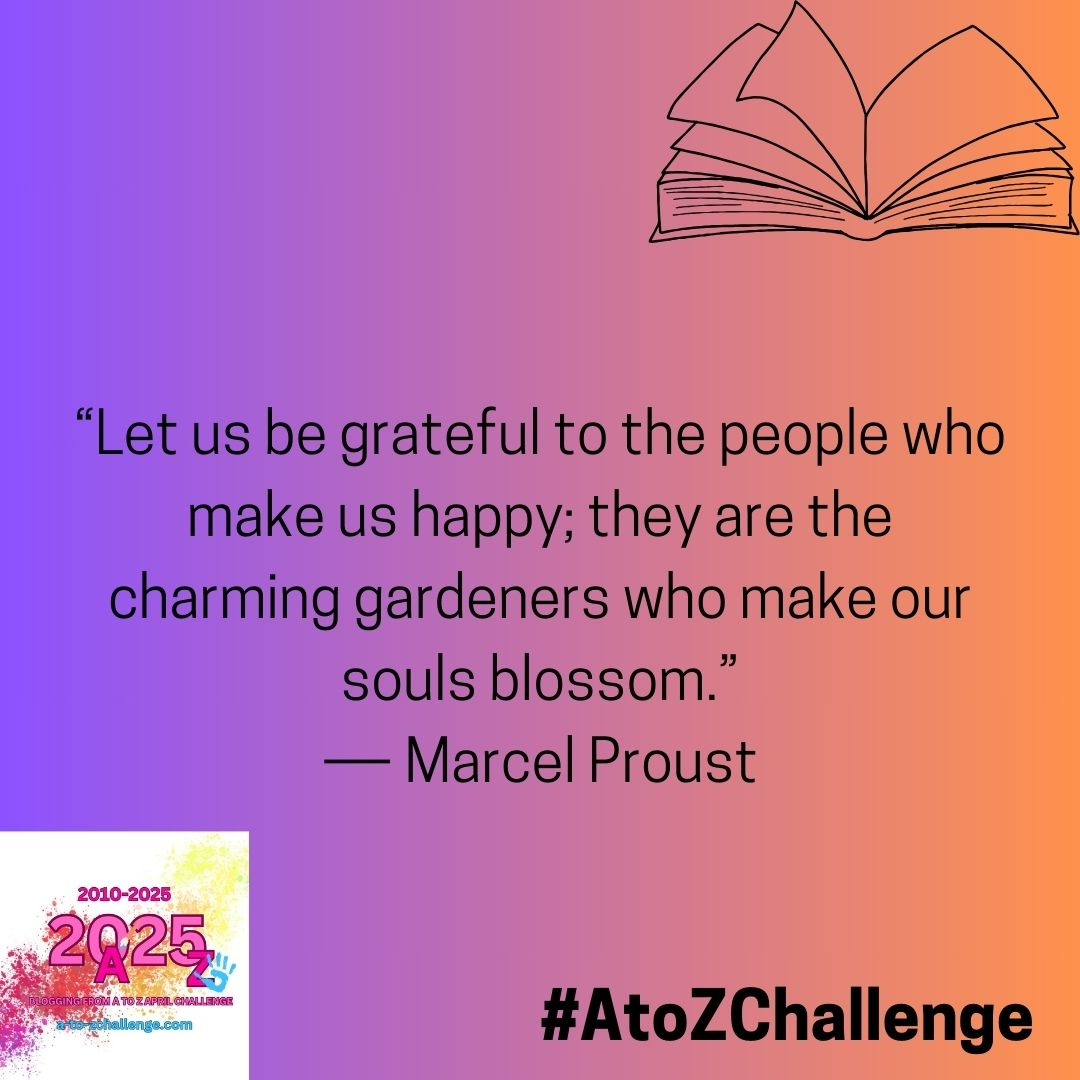
The quote for the first challenge day is a really good one, and to begin the April challenge, the focus is on the people who make us happy. I am grateful for some special people in my life. There is my husband of 41 years this June and our two adult sons. The older son is a musician and a middle school band director; the younger–the adrenalin junkie–is a full-time firefighter and EMT. I am proud of them. John always gives me something to think about and challenges my brain. Aaron makes me smile at his actions. Then there is my daughter-in-law, who makes me so proud that she is willing to stand up for the marginalized people in our society. And my grandson, Sully, just makes me smile! He is three years old (he turns four in October). He is almost always happy.

Last spring, I started a very small book club. These ladies are so special. We share a love of books and good conversation. Our little group ranges in age from 18 to 80+ (I’m not sure how old Ms. Biba is). I look forward to our monthly meetings at the local coffee shop. Isabelle, the 18-year-old, gives us so much joy in her enthusiasm for books and the way she just fits in with our group of women who are old enough to be her grandmothers!

Ms. Biba and Shana have been my support group over the last couple of months as our church goes through some changes that are not necessarily the “best,” if I am to be honest. They have had my back, as it were, when I feel afraid to speak my truth. I am so thankful for them. Shana makes me laugh with her zaniness.

And so the April challenge begins.

March Reading Roundup

This has been a strange month for reading. It seems I have started a lot of books, but didn’t finish them for some reason or another: Persuasion by Jane Austin, Women of the Word by Jen Wilkin (almost finished–I’m on the last chapter), The Let Them Theory (just started, so I can’ complain too much about not finishing that one). . . . I put The Covenant of Water on pause, but do plan to get back to it in April. It is such a beautifully written book that I do not want to abandon it. So, what did I read? A lot of “fluff”!

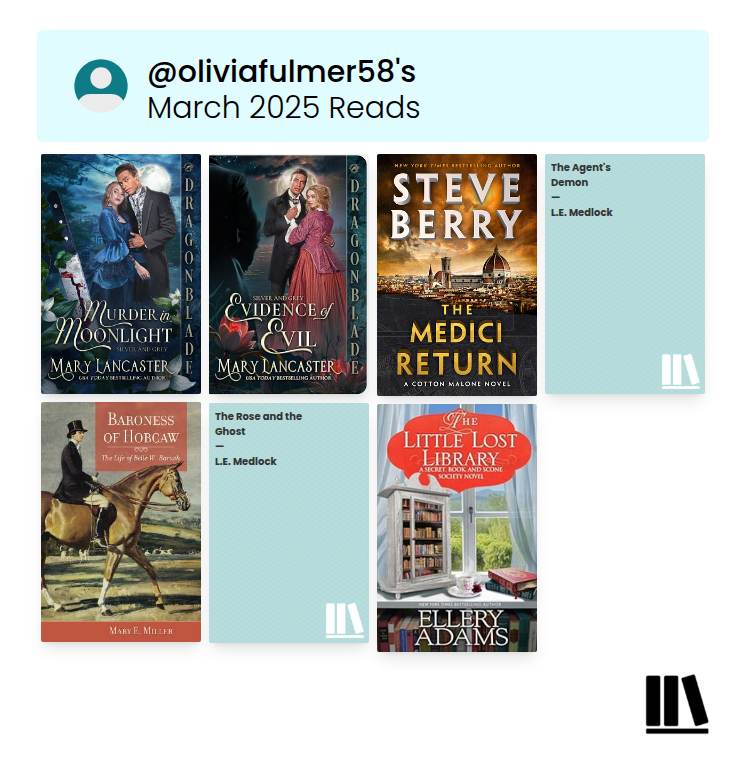
I started the Locke and Steele series with The Agent’s Demon and The Rose and the Ghost. The Agent’s Demon has paranormal investigator Agent Hazel Locke and her demon partner investigating the Whitechapel Murders of Jack the Ripper. When they discover the identity of the Ripper, they must flee England to Paris to save their lives. While in Paris, they plan to investigate the murder of Steele’s family. The Rose and the Ghost tells the story of the search for the identity of the murderer of Steele’s family, but also includes a retelling of The Phantom of the Opera. Reading the latter book has prompted me to read the classic Phantom although I may be singing the songs from the musical in my head while I read. These were enjoyable paranormal mysteries with a bit of history thrown in, but I’m not likely to reread either of them although I will read the next installment when it comes out.

Ellery Adams is a “local” author from North Carolina. I thoroughly enjoyed her Book Retreat mystery series and started the The Secret, Book, and Scone Society series last year. The Lost Little Library was another fun read that kept me guessing until the end. Nora, Grant McCabe (the sheriff and Nora’s lover), and the women of her book club have two mysteries to solve: the mysterious death of Lucille Wynter, who leaves Nora a book that takes her on a scavenger hunt for various items that will uncover a family secret and the theft of YA books from her book store. What I love about Adams’s two series is the allusions to all kinds of books, so much so that I regret not writing down the titles as I read so that I can read them as well! This is another series I look forward to the next installment.

Another mystery series that held my interest was Mary Lancaster’s Silver and Grey mysteries. Constance Silver and Solomon Grey team up to solve a couple of murders in this series. They work well together, and there are the beginnings of a potential romance. I will be looking forward to continuing this series as well.

I can’t lose when there is a Steve Berry book. The Medici Return is the latest book in the Cotton Mather novels. Mather is a retired agent from the Magellan Billet, a top secret intelligence organization in the U. S. government. In this installment, Mather is sent to Italy to investigate the possible criminal activities of an archbishop. However, things get complicated when a businessman and member of the Italian legislative body claims to be a direct descendant of the Medici family, to whom the Vatican owes a great deal of money. I love all the history and “local color” that Berry infuses into his novels–and the fact that he can keep me guessing about the outcome until the very end.

I am well on my way to meeting my goal of six nonfiction books. So far, I’ve read Maya Angelou’s The Heart of a Woman in her series of autobiographies and Mary Miller’s biography of Belle Baruch, who is responsible for a true South Carolina treasure, Hobcaw Barony, which she set up with the state to be an educational and research facility in the Low Country. This book was interesting in so many ways. First, Belle Baruch was an interesting woman, a feminist and women’s libber before there were such things. Second, she was a paradox, known for her generosity and kindness but also somewhat bigoted and prejudiced. It was her love of nature, though, that stands out. As I read the book, I kept thinking, “Why haven’t I learned about this?” There was so much South Carolina history, as well as U. S. history in the biography. I didn’t know there were U-boats off the coast of South Carolina or that German spies actually made landfall in the Low County. I didn’t even know about Bernard Baruch’s role in history as advisors to seven presidents. It was an eye opening experience reading this book, and we had a lively discussion during the book club meeting.

I will probably finish Women of the Word this week. This book describes a method of Bible study that goes deep into the Word of God. Although the target audience is women, the method of study outlined by Jen Wilkin is applicable to anyone who wants to study Scripture in a meaningful way. I have tried several study methods over the years, but Women of the Word brings them all together. I am also using another method, the James Method, which incorporates many of the same elements (but with different names) as Wilkin’s method.

This morning before I began this post, the Book of the Month Club posted its April selections. I’ve chosen Six Days in Bombay, a historical novel; Famous Last Words (a BOTM exclusive), and The God of Woods (I’m late to the party for this book). Hopefully, I will be able to get into the books more in April.

Oh, by the way, April is National Poetry Month, and my “practice” for this month will be to collect quotes from poems every day of the month into a handmade commonplace book. I am starting with Mary Oliver’s collection, Devotion.

Jumping on the Empyrean Bandwagon

Time flies when you’re having fun, right? January certainly flew by. Maybe it just seems that the months go by faster because I’m getting older.

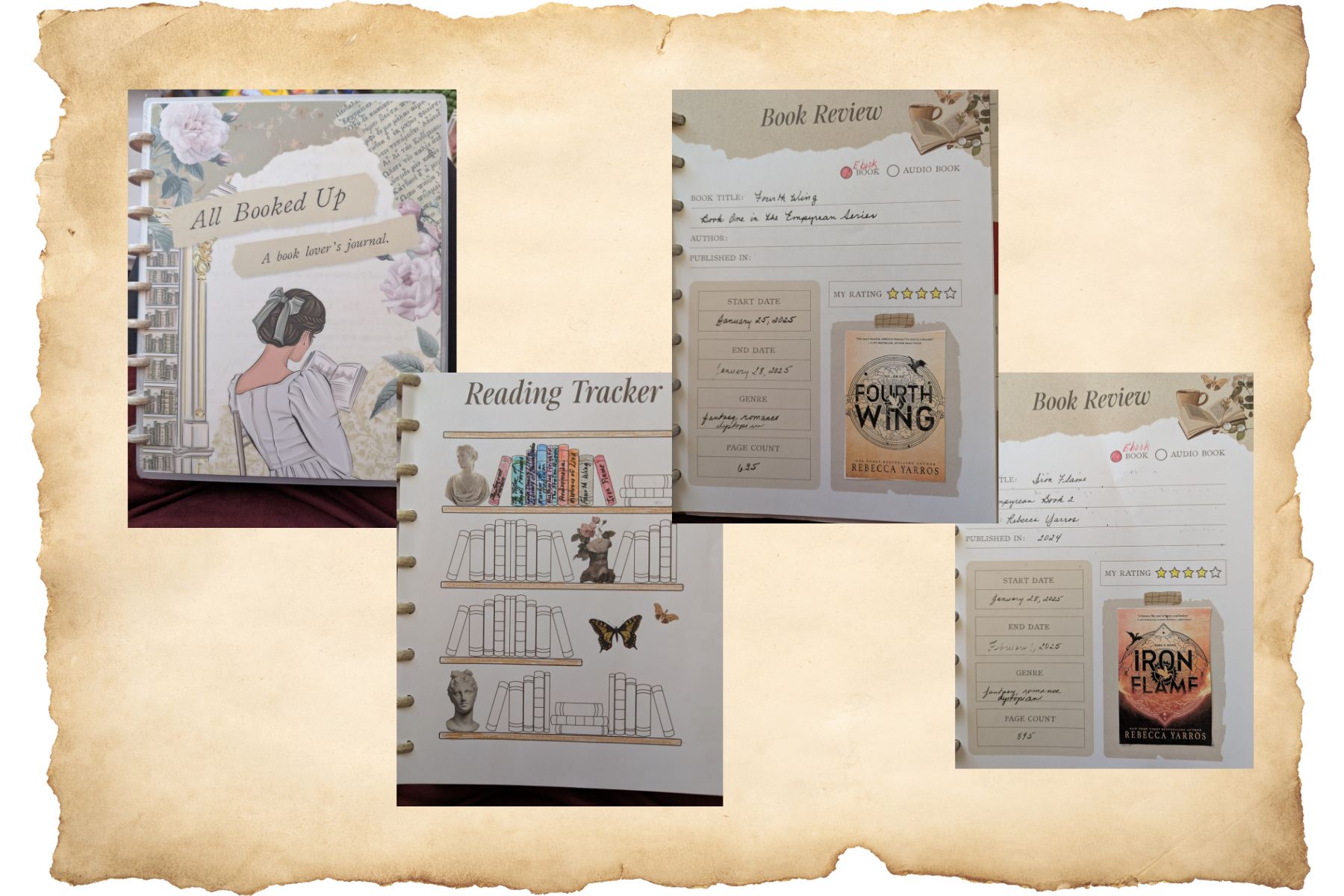
So, I jumped on the Fourth Wing/Empyrean series flights this week. I just finished the second in the series this morning after two days of almost marathon reading sessions, thanks to my Kindle Unlimited subscription. And because I didn’t want to wait until the third book went to KU, I bought it and will probably start it this afternoon (after I do some laundry and eat lunch).

My take on the series: First, I enjoyed the story. I enjoyed the “enemies to lovers” subplot. I thought Rebecca Yarros created a believable fantasy world that allowed me willingly to “[suspend] disbelief,” as Samuel Taylor Coleridge says we have to do in order to engage our imaginations. I was able to buy into the world of the “war” college, the use of dragons, and magic and all that. My major criticism has to do with the language in the book. I am not really a prude; I do not pepper my own language with four-letter words because that’s not how I was brought up. I found the graphic language excessive. In fact, I found it distracted from what the characters were saying. Perhaps because I expected it in the second book, it was not as distracting, but I don’t think it was as prevalent.

Of the first two books, I actually liked Iron Flame better even though it seemed longer. I liked the twist at the very end (no spoilers, other than to say, there is a very interesting twist in the cliffhanger ending). I can’t help it; I’m a retired English teacher, so I do look for themes and foreshadowing and the like, and one of the themes that strikes me is the “power corrupts, and absolute power corrupts absolutely” theme. This theme is especially strong at the end of Iron Flame. Other motifs that appear throughout the series are “coming of age,” even though the characters are adults in their twenties (the characterization, though, makes them seem more like adolescents than adults), loyalty and betrayal, family/sibling/parent-child relationships, and the “found” family.

Last year, I began keeping a book journal/reading log, and I am continuing the practice this year. One of the things I do is list the genre of the books I’m reading because I will get into a rut if I am not making conscience decisions about what I’m reading. Sometimes, making those classifications is not easy. Fourth Wing and Iron Flame are definitely in the fantasy genre with its use of talking dragons and magic, and it is a romance as it traces the development of the relationship between Violet and Xaden. (The new term is romantasy), and I think it falls in the YA classification with the young protagonists. That being said, I would not recommend this novel for younger teen readers. I also classify this book as dystopian in many ways. It has the autocratic leadership with a secret agenda hidden from the citizens in the name of protecting them as well as the use of fear to control the characters. Fourth Wing reminded me of The Hunger Games in the way the cadets were allowed to kill each other off in order to secure their places as riders.

After I finish Onyx Storm, I will return to By Another Name. I do have a tendency to binge-read when I start a series in progress. Unfortunately, I will have to wait a couple of years before the fourth book in the Empyrean series is published. Rebecca Yarros has stated that she is not committing to the one-year turn around for this next book due to the mental and physical stresses that schedule puts on her. And there are some new books coming from the Book of the Month Club and the Aardvark Book Club in the next couple of weeks as well. February will be a busy reading month, too.

January Reading

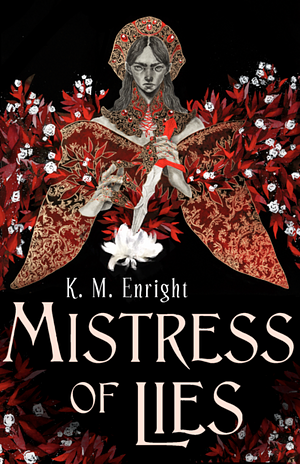
My tally for the month of January is probably nine books (unless I finish Iron Flame by Rebecca Yarros in the next day or two). I finished Mistress of Lies by K. M. Enright last week and Fourth Wing by Rebecca Yarros yesterday.

Both books are fantasy; Both books have some questionable characters, meaning I’m not sure I like them. However, I did like the books. Mistress of Lies addresses the question of what to do about a leader and government that are oppressive. Questions of class and gender are also at play in the novel. Politics and deception are the tools of survival in this dystopian-like novel.

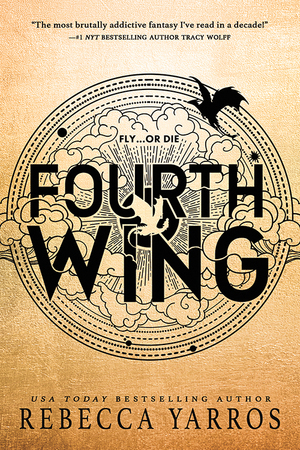
Fourth Wing is a faster read. It relies on action to tell the story. My jury is still out on how many stars I would rate this book (if I were the rating type). I found the profanity and graphic language excessive; the use of the f-bombs and s-words did nothing to develop characterization or the atmosphere or tone of the novel. They were more annoying to me than anything else. The setting of the riders’ quadrant and the “fly or die” and the weeding out of the weak through death reminded me of The Hunger Games where the only way to win is to survive. While some of the characters do form alliances–and romances, the overall attitude of “every rider for him/herself” is prevalent as is the spirit of distrust among the characters. While there are some genuine loyalties formed, there are not many.

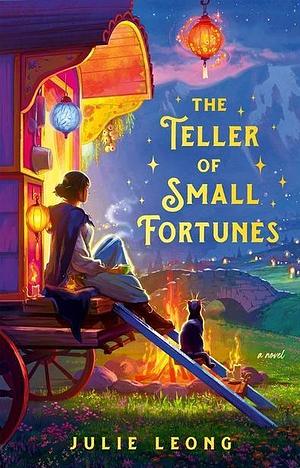
My pick of the month, though, is The Teller of Small Fortunes by Julie Leong, the story of a seer who must travel across two regions to find her family of a former thief, an apprentice baker, and a mercenary in search of his missing daughter, and a reconciliation with her mother. It is a “feel-good” story in the end.

Now, I have to finish By Another Other Name by Jodi Picoult and Yarros’s Iron Flame. Also in my TBR stack is the latest installment of the Makaela Forsythe and Angus Brodie mysteries, Deadly Curse, a fun mystery with a feisty protagonist and her broody Scots “side kick” (although Brodie would definitely bristle and make that uniquely Scottish noise if he knew I called him a sidekick!).

Mid-month Reading Round-up

For the second year in a row, I have set a reading goal of 100 books. I managed to read and/or listen to 119 books. I have always been a voracious reader, resorting to reading cereal boxes when there was nothing else handy to read. I will probably exceed the 100 books again this year at the rate I’m going. So far, I’ve read seven books. I’ve broken down my goal into smaller ones as well: to read a classic a month, to read six nonfiction books this year, and to complete a formal reading challenge.

My reading challenges come from two sources: The Book Girls, who host several challenges such as the Book Lover’s year-long challenge with a different book related theme each month, a decades challenge, a “lifetime” challenge, and an In-case-you-missed-it challenge. Read with Allison also has a challenge list that inspires me to push out of my comfort zones. I also subscribe to the Book of the Month Club and the Aardvark Book Club as a source of books.

So far in January, I have finished seven books already.

I actually started two books in December of last year, The Secret Garden and The Teller of Small Fortunes. I had never read The Secret Garden as a child, but I had seen the movie with Gary Oldman several years ago and enjoyed it. I was entranced by the book and the way Mary and Colin grew as characters.

The Teller of Small Fortunes was a slow starter for me, and I put it aside during the holidays. However, once I picked it up again, I was hooked. This is the story of a fortune-teller who finds a family as she travels from town to town telling “small fortunes,” hoping to avoid the attention of the guild of magicians and seers. It is also a story of reconciliation and second chances.

Lula Dean’s Little Library of Banned Books caught me by surprise. I expected it to be more humorous, and there are some comic moments. But the subject is all too serious–and timely. Lula Dean sets out to clean up her town by getting rid of books that she believed would corrupt the young people. Strange things begin to happen, though, when she sets up her own Little Library in her front yard, stocked with “safe” titles, she thinks. People start getting books and adding their own. Then Lula decides to run for mayor after her rival runs on a plank to remove the statue of a Civil War general, who just happens to be Lula’s great-great-great grandfather. That’s when all you-know-what breaks out and the truth about the popularity of Lula Dean’s library comes to light. The novel is so timely because it mirrors what is happening throughout the country today as more and more communities face questions of censorship.

Every so often I have to reread a favorite classic. I have had a love-hate relationship with Wuthering Heights since I was in high school and my English teacher wanted me to read it. It was one of those books that I was not quite ready for at sixteen, but ten years later, it became MY book and the basis for my master’s thesis. On StoryGraph, Wuthering Heights is classified as a romance, but it is unlike the typical romance. If Cathy and Heathcliff are in love, it is a dangerously obsessive love. What I love about this novel now is the language Emily Bronte uses. It is clear that she is heavily influenced by the first generation Romantic poets Wordsworth and Coleridge as well as by Byron and other later Romantic writers. The final paragraph of the novel has to be my all-time favorite passage in literature:

“I lingered round them, under that benign sky; watched the moths fluttering among the heath, and hare-bells; listened to the soft wind breathing through the grass; and wondered how any one could ever imagine unquiet slumbers for the sleepers in that quiet earth.”

Lord Redmond and Daniel Haze return in Irina Shapiro’s latest mystery in the Redmond and Haze Mystery series. This time, they investigate the murder of a medium who had helped them in a previous case locate Daniel’s missing daughter. They also grapple with their trust of those who claim to communicate with the dead. Daniel uses his expertise as a police officer working for Scotland Yard while Lord Redmond uses the medical sciences to provide important clues to solve the crime. I’ve already pre-ordered the next book in the series.

The Stolen Queen is a historical mystery/thriller, according to StoryGraph. When an important artifact, a fragment of a statue of a little known female Egyptian pharaoh is stolen during the annual Met Gala, a curator must face a tragedy in her past to recover the stolen piece. She must also return to Egypt, the place where she faced that tragedy. With the help of Annie, Charlotte not only recovers the stolen artifact, but she also recovers her family. I enjoyed the dual time periods. The novel starts slowly; however, the last third of the book moves very quickly, and I was hard pressed to put it down. (I may or may not have stayed awake until the wee hours of the morning reading.)

I’m not sure what to say about Therese Bohman’s Andromeda. It is a very short novel, just under 200 pages. It is beautifully written, the language often poetic. Bohman creates some beautiful metaphors about reading and the importance it can have. There are two narrators: Sofie, a young intern hired to become an editor for the publisher’s Andromeda imprint, and Gunnar, the editor-in-chief, who mentors and grooms Sofie with the idea that she would take his place when he retired. The book is roughly divided into two halves with each narrator telling his or her story. Sofie focuses on her relationship with Gunnar and the publishing business whereas Gunnar narrates his “life story.” The thread that runs through both parts is the importance reading and books had in their lives and in their relationship. I have to admit, though, that I’m not sure I can say I liked the book, but I will say that I’m glad I read it.

Now, I’m ready to start book number eight from a pile of books I bought last year. That’s another one of my goals: to read last year’s purchases. I think I’m going to read Mistress of Lies by K. M. Enright next. I’ve seen it come up on several “best of 2024” lists recently. It’s been collecting dust for a while.

Year-end Reading Wrap-up

I did it. I set a reading goal of reading at least 52 books this year, and I met that goal before June. Then I set a new goal of 100 books and met that goal in October. As of today, I have read 119 books, and will probably read and finish one more before December 31. I started The Teller of Small Fortunes earlier this month but have not finished it.

In some ways, this was a slow month; I finished seven books. It was also a busy crafting month to get ready for Christmas as well as the other busy-ness that comes with the holiday season. I have to admit that I started a few and put them away or they are still in progress.

Five of the books I read this month fall into the category of historical novels, some with more romance than others. I read the latest installment of the Tabitha and Wolf novels, An Intrepid Woman, and enjoyed it. It is an easy read with a story that is more plot driven than character driven. Actually, the same can be said for the first five books. Of those books, I especially liked the Victorian mystery An Exhibition of Malice by Emily L. Finch, which is set against the background of the Industrial Revolution and the Great Exhibition of 1862, ten or so years after the exhibition sponsored by Prince Albert in the middle of the 19th century. If we think industrial espionage is only a modern thing, this novel suggests that stealing plans for inventions has been around for a whole lot longer.

The two contemporary novels, The Most Wonderful Crime of the Year and The Last Love Note were both good reads. The Most Wonderful Crime of the Year was a lot of fun. It is light-hearted and funny as well as a good mystery. It makes use of the “enemies to lovers” trope even though the enemy part is one-sided. And, of course, there is the happily ever after ending. This novel makes use of the Agatha Christie country-house mystery and a locked-room disappearance. Ally Carter also uses Agatha Christie’s own mysterious disappearance for inspiration in this novel.

When I began The Last Love Note, I thought I was going to read a rom-com. The first couple of chapters made me laugh out loud; however, the novel started getting pretty heavy as it developed into the story of a forty-year-old widow’s coming to terms with the death of her husband from early onset and rapid Alzheimer’s and single-parenthood. Yet, in spite of the heaviness of these plot threads, there is a lightness and at times some comic relief as she slowly learns that she can have a new life (and love) and a second chance at happiness. I admit that I did the ugly cry through the last ten chapters of the book.

As I finished this book, I thought back over the books I have read this year and looked at my list of best books of each month:

January–The Fury

  • January–The Fury
  • February–The First Ladies
  • March–The Lost Apothecary
  • April–Touch Not the Cat
  • May–Shakespeare: The Man Who Paid the Rent
  • June–The Women
  • July–The Lost Story
  • August–The Cliffs
  • September–Emily Wilde’s Encyclopedia of Faeries
  • October–Lady Macbeth
  • November–Before the Coffee Gets Cold
  • December–The Last Love Note

All of these books were such good ones, and it is hard to pick my favorite. I am going to go with The First Ladies, though. It is a novel about the friendship between Mary McLeod Bethune and First Lady Eleanor Roosevelt. These two women are often footnotes in the history books, and their roles in the civil rights movement are overshadowed by likes of Martin Luther King, Jr., Malcolm X, and other men. Yet this novel showed how important their work was. Moreover, it also showed how difficult interracial friendships can be, even today, when we are supposedly more enlightened. I often learn more history from the historical novels I read than from the history books, and this one certainly played into my interest in history.

I tried to read more nonfiction this year and actually finished three really wonderful books: Judi Dench’s autobiographical Shakespeare: The Man Who Pays the Rent, Killers of the Flower Moon, and The Boys in the Boat about the 1936 US Olympic eight-man rowing team. It would be hard to choose which is the better book, but I will admit that Shakespeare:The Man Who Pays the Rent is my favorite. Dame Judi Dench gave me such insight into the characters from the plays she performed, and I almost wished I were teaching again so I could share those insights with my students. I listened to both of the books on Audible and realized that I loved listening to nonfiction more than fiction. Killers of the Flower Moon is a difficult book to read and listen to because of its subject, the exploitation of Native Americans out of greed. I highly recommend this last book.

I am already lining up my books for the coming year. I can’t wait to see what selections will be offered in the Book of the Month and the Aardvark Book clubs. My book group that meets monthly at the local coffee shop will be reading Wuthering Heights as our first book of the year. I am looking forward to reading that one again. I wonder how much it has changed since I read it as a sixteen year old, a twenty-six year old, a thirty-something, and now as a sixty-six year old. And I wonder how my reading will compare to our high school senior’s reading. (Imagine a book club with three sixty-something women and one seventeen-year-old! We do love our girl, though. She has been a wonderful addition to our group!)