November Reading Update

I really slowed down my reading this month. Perhaps it was because some of the books were longer and “slower” reads. It’s also the beginning of the holiday season, and things get busy.

I seem to be falling back into familiar and comfortable genres this month–historical romances and mysteries as well as some fantasy and magical realism.

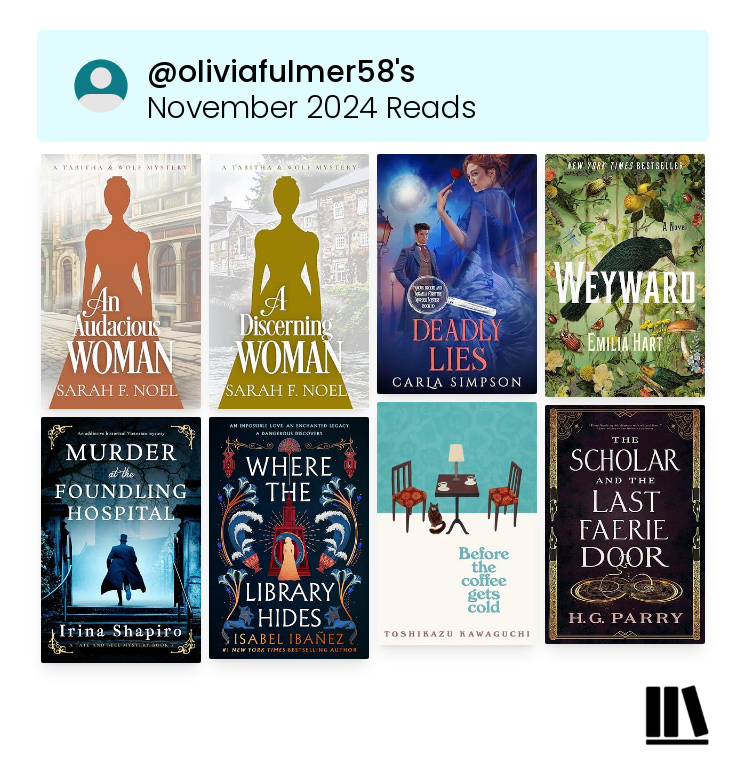
An Audacious Woman, A Discerning Woman, Deadly Lies, and Murder at the Foundling Hospital are all historical mysteries set in the 19th century. Sarah F. Noel’s “Tabitha and Wolf” mystery series features the recently widowed Lady Pembroke (Tabitha) and the new Earl of Pembroke (Wolf) as they investigate various murders while navigating a tricky romance. These novels are light and sometimes humorous, especially when Tabitha’s mother-in-law, the Dowager Countess of Pembroke decides she wants to become an investigator. Besides the mystery aspect, the novels are also about finding one’s family and belonging as Tabitha’s family includes not only the new Earl and the Dowager Countess, but a trusted family friend and two street urchins who become her wards.

Deadly Lies is the latest book in the Angus Brodie and Mikaela Forsythe Murder Mystery series by Carla Simpson. Lady Forsythe is an independent woman of the late nineteenth century who becomes involved with the often surely Angus Brodie when her sister goes missing (Book I). In this latest installment, they investigate the murders of two young women found with a red rose. Mikaela narrates the story as it unfolds with occasional glimpses into Brodie’s point of view when he goes off on his own. Mikaela, like her elderly great-aunt who raised her and her sister after her parents’ deaths, is intelligent, witty, and more than a little free-spirited. This series is mostly light-hearted and fun.

Murder at the Foundling Hospital is the third installment of the Tate and Bell series by Irina Shapiro. Set in London in the latter half of the nineteenth century, the novel follows Detective Bell and Nurse Gemma Tate as they investigate the murder of Amanda Tate, a fourteen-year-old foundling. Together, they piece together the clues that eventually bring the killer to justice, but at the expense of Gemma’s job at the Foundling Hospital. Shapiro uses more history in the development of the plot than Noel or Simpson as she draws on the details of the Crimean War for context. This novel is darker in tone and without the humor of Noel’s and Simpson’s novels, but it is no less a good read.

I seem to be choosing more books from the fantasy and magical realism genres. Weyward, Where the Library Hides, Before the Coffee Gets Cold, and The Scholar and the Last Faerie Door all incorporate some measure of paranormal or supernatural elements. Emilie Hart’s Weyward tells the story of three women of the Weyward family from three different time periods: one a 17th century woman accused and tried for witchcraft, a teenager from the 1940s, and a young woman from the present who retreats to her great-aunt’s cottage to escape an abusive marriage. All three women have an affinity with nature that is often called “witchcraft.” All three women have complicated and even dangerous relationships with the men in their lives. However, although bad things happen to these women, they come through their experiences stronger and more independent than ever. Resilience is the key. I enjoyed this book and truly did not want it to end. Perhaps there will be another Weyward book that tells the story of Kate’s daughter named after her ancestors, Altha the 17th century “witch” and Violet the 20th century botanist and scientist.

Where the Library Hides by Isabel Ibanez continues the story begun in What the River Knows. Inez has gone to Egypt at the end of the 19th century to find out what happened to her parents. At the end of the first novel, she discovers that her mother is still alive, and she receives a rather unromantic marriage proposal from her uncle’s assistant Whit. Where the Library Hides has the two, now married, searching for the lost loot from Cleopatra’s tomb and Inez’s mother. Ibanez throws in a plot twist near the end of the novel that I truly did not expect, but it made sense. This sequel ties up all the loose ends and brings the mystery to a very satisfactory close. The epilogue, though, may foreshadow some more books about characters introduced in this novel. I will be following Ibanez for other books.

Before the Coffee Gets Cold was our choice for the November book club. It also falls into the genre of magical realism. Four characters have the opportunity (and the desire) to travel in time. There are several rules, though, that govern their time travels: they can only meet people with whom they have met in the coffee shop; they will not change the present by going to the past or the future; and they can stay away for only as long as the coffee stays warm. Failure to drink the coffee before it gets cold will turn them into a ghost. Three choose to go back in time while one character chooses to go into the future. All three come away from their time travels with new understandings of themselves and others. I had my doubts about this book when I started it. It felt too objective. However, as we followed each character into their pasts, presents, and futures, the reader does get to know them and feel engaged with them. By the end of the first vignette, I was fully engaged and ready to devour the stories. I will certainly be reading the other books in the series.

H. G. Parry’s The Scholar and the Last Faerie Door combines the history of the post-World War I Lost Generation with fantasy. I’m not sure there’s a name for this genre! It’s a combination of historical fiction and fantasy and romance. Clover Hill wants to learn to do magic so that she can release her older brother from a Faerie curse he received at the battle of Amiens during the first world war. She attends Camford University where she becomes friends with three students who come from the class known as the Family, people who have had magic in their blood for generations. What makes Clover different is that she is not from a magical family but is an ordinary farm girl. However, through hard work, study, and research, she does learn magic and eventually obtains the spell to release her brother. However, she had to pay a high cost. This is a heart-breaking story of love and friendships that go awry and of lost trust; it is also a story of restoration, forgiveness, and reconciliation. Even though events become quite dire, there is a thread of hope throughout.

It was hard to pick a best book for the month, but I think I decided on Before the Coffee Gets Cold. It is an easy-to-read novel, even in translation from Japanese. The characters are for the most part likeable and relatable. There are really no villains in this book at all, unless, that is you count death, Alzheimer’s, and loss as villains. There are no murders to solve. In the end, the book is full of love and hope.

As the Christmas season approaches, I know I will have more books to read. I haven’t selected specific holiday books (yet), though I have started Tommy Orange’s book Wandering Stars, which follows a survivor of the Sand Creek Massacre. It’s a heavy way to begin this season of joy.

Mid-October Reading Roundup

October is “Spooky Month,” and this month’s reading includes its share of spooky reads.

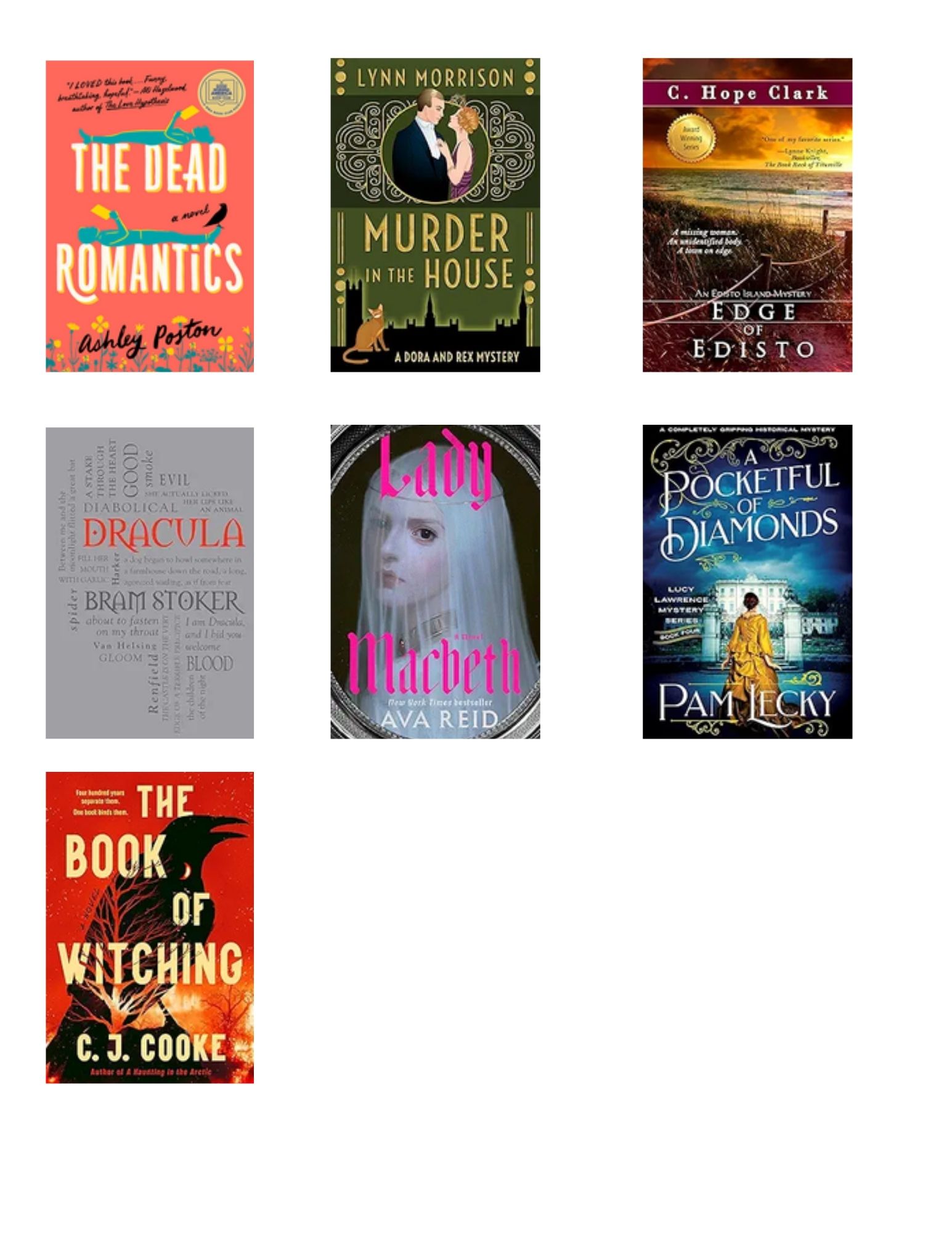
The Dead Romantics is a fun rom-com featuring a ghost writer haunted by her almost dead editor. Florence Day has the job of ghost writing for a popular romance author, but lately Florence hasn’t been much in the mood to write the typical romance novel with true love and happy endings after her break-up with her boyfriend. And to make matters worse, her father died, and she returns to her home in South Carolina. Oh, Florence also sees dead people. While she is home for the funeral, she is haunted by her new editor and falls in love with him. I enjoyed this novel. It is a light read.

Murder in the House by Lynn Morrison is the latest in the Dora and Rex mystery series. Dora and Rex assist their friend Clark Kenworth, Lord Rivers, investigate the death of the clerk for the Labor Party leader in the House of Lords of the British Parliament. Clark, a recurring character in the series, takes the lead in this book. I enjoy reading historical novels because I do learn about the history of the time and place of the setting. In this book, set between the two world wars, the conflict between the Communist Party and the Labor Party–and the growing threat of Hitler and the Nazi Party–form the backdrop. I enjoyed seeing how Clark is maturing as he takes on his role in the House of Lords.

Edge of Edisto is the last book in the Edisto mysteries by C. Hope Clark. In this novel, Callie has two cases to solve–a missing person case and a murder that at first seem unrelated. She also discovers a secret that the island community of Edisto Beach has kept for thirty years. Callie is coming into her own at last in this novel, and I think it is one of the better ones in the series for that.

An October reading list cannot go without including the classic Dracula by Bram Stoker. Horror is not my genre, but I have read and reread Dracula, both for my own “pleasure” and as a class novel in my English IV classes. I decided to reread Dracula after watching an episode of the Murdoch Mysteries in which Margaret Brakenreid reads the novel for her book club and comes away with the idea that it is about redemption. And it is, to some extent. What I noticed more this time as I read was the interplay of science, faith, religion, and superstition, especially in the character of Van Helsing. Of course, I also noticed the theme of “the New Woman” in the portrayal of both Lucy and Mina.

The Book of Witching by C. J. Cook could also fall into the horror category, but it is not the frightening kind of horror. When Erin goes on a three-week camping trip with her boyfriend and her best friend, no one expects that one will die, another go missing, and Erin end up in the hospital with third and fourth-degree burns–and that Erin will insist that she be called Nyx. Her mother then investigates to discover the cause of her daughter’s trauma. What I enjoyed about this novel was the dual time period narrative: the story of Alison Balfour, the first woman to executed for witchcraft in the Orkneys in 1594, and Clem’s determination to find out what happened to her daughter. The ending of the novel, which ties the two time periods and characters together, is satisfying.

A Pocketful of Diamonds by Pam Lechy is a historical mystery set at the end of the nineteenth century. Lucy Lawrence and Phineas Stone’s honeymoon in Paris is interrupted when Phin’s sister sends them a telegraph asking them to come to Lake Como to search for her missing husband. Murder and intrigue take the newlyweds into the criminal element of the Lake Como district and Milan. Of course, they do solve the case, but not before Ludy is kidnapped and Phineas targeted for assassination himself. This book feels like it could be the end of the Lucy Lawrence series, though.

Lady Macbeth by Ava Reid is NOT your English teacher’s version of the Macbeth story. Told from Lady Macbeth’s point of view, the protagonist Roscille is Macbeth’s second wife. Growing up, she was considered “otherworldly” or touched by a witch with her silver hair and strange eyes that were said to bewitch men. As a result, she always wore a veil so that men did not have to look into her eyes. At one point in the novel, Macbeth tells her that she will be the dagger in his hand. Macbeth is portrayed as almost larger than life–a large man with an even larger ambition to be “King Hereafter,” and he will do just about anything to ensure that he not only gets the throne of Scotland but keeps it, even if it means locking his own wife in the dungeon. Reid does take the traditional prophecies for Macbeth from Shakespeare’s play, but she turns everything on its ear. In addition to the witches, there are a few other fantastical beasts. Reid combines history and fantasy in this story of Lady Macbeth.

The next book on my reading list is The Stone Witch of Florence, another historical fantasy (is that a genre?) set in Florence, Italy, during the time of the Black Death. I am looking forward to reading it.

September Reading Wrap-up

I know, it’s only the 26th and there are four more days. I probably will finish another book before the end of the month, but I’ve read the bulk of the books for the month. I didn’t read as many books as I have some months, but that’s okay. I started a couple that I haven’t finished, though, so I’m still reading.

Most of the books I read this month were lighter fare. At least four were murder mysteries of one sort of another. A couple could be classified as romance novels. One of the books fell into the category of magical realism. Several were historical novels.

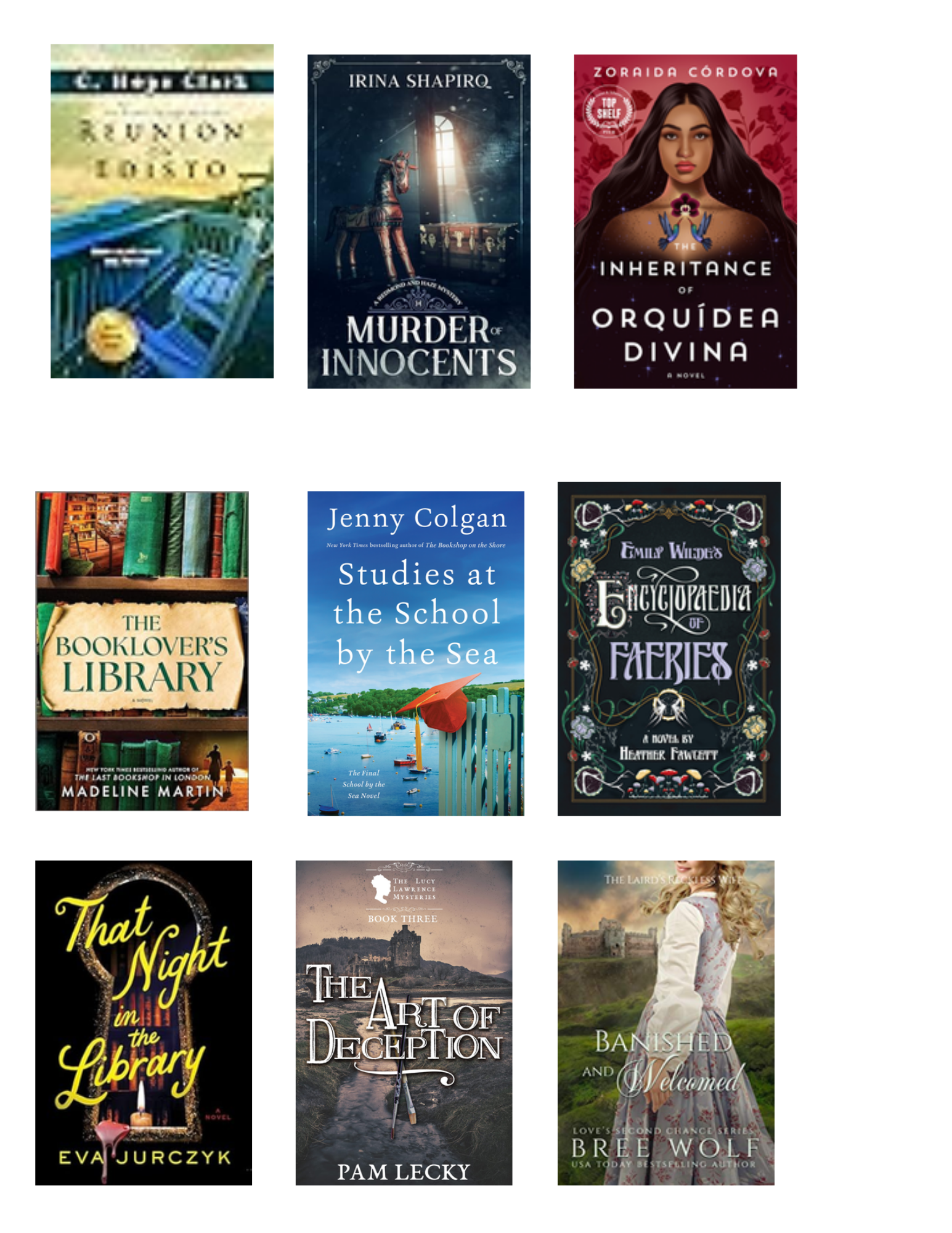
Irina Shapiro did not disappoint in the latest addition to the Redmond and Haze series. Murder of Innocents had Dr. Jason Redmond and Detective Daniel Haze searching for the murderer of two little boys. Dr. Redmond may be an aristocrat, but he is from America. He served as a surgeon for the Union army during the American Civil War and spent time as a prisoner of war in the infamous Andersonville prison. His knowledge of anatomy and medicine and Haze’s skills as an investigator make them a formidable team.

C. Hope Clark’s Reunion on Edisto follows the career of Callie, Edisto Beach’s first female police chief. In the seventh installment of the series, Callie, now sober for nearly a year and in a stable relationship with Mark, the owner of the new Mexican restaurant, El Marco, has to search for a missing classmate who has come to the island to plan a class reunion. As Callie works the case, she also solves a cold case from her high school days. While I was not sympathetic to Callie when I first began the series, I began to like her as I near the end of the series.

I read two books by Madeline Martin last year, The Last Bookshop in London and The Keeper of Hidden Books, both set during World War II. The Booklover’s Library is also set during World War II. Like The Last Bookshop in London, The Booklover’s Library is set in England. The Booklover’s Library begins before the Blitz and tells the story of a young widow who must make the agonizing decision to send her daughter to the countryside for safety. She also must find a job to support herself during this time. The novel speaks to the power of books to comfort during hard times. I learned more about the effects of war on women and children from this book. That’s the power of a good historical novel; it brings the history to life.

The Inheritance of Orquidea Divina is way out of my comfort zone in terms of genre. I liked the book. However, it took me quite a few pages and chapters to buy into the elements of magical realism. There are a couple of things that really struck me in the story. Orquidea’s need to have roots takes on a physical aspect when she turns into a tree the day she dies. We all need that place we can put down roots and belong. Marimar finds that place in Four Rivers on her grandmother’s estate. The second thing that resonated was the idea of “inheritance.” What do we actually inherit from our ancestors?

The book I disliked this month is That Night in the Library. I could not sympathize with any of the characters; they were all unlikable to some degree. The death from some kind of poisoning of one member of the small group gathered to re-enact an ancient Greek ritual sets off a series of additional deaths. By the time the group is rescued, only two of the seven remain alive. Moreover, with the exception of Kip, the first to die, nearly every one of the others kills, helps to kill, or witnesses the violent death of others. This is a “locked room” mystery in the vein of Agatha Christie, but there are no redeeming characters in this novel, and no feeling that justice has been served in the end.

Studies at the School by the Sea is a light-hearted romance of two teachers from two different schools, both English teachers, and both concerned with the well-being of their students. However, there are obstacles to their romance ranging from an ex-fiance’s accident to the lack of privacy on a school Outward Bound retreat. I haven’t read the first three books in the series; however, that did not hinder me from enjoying this book.

My pick, though, for the book of the month is Emily Wilde’s Encyclopedia of Faeries. Emily goes to an isolated island in the Arctic Circle to conduct research for book, an encyclopedia of faeries. From facing hostile villagers and down-right mean changelings, Emily has a number of adventures. When her colleague joins her, though, things get really interesting, and she discovers his secret identity. I had fun reading this book! I do enjoy a good fantasy.

Five Books (and Authors) Worth Reading

This is the first year I actually set a reading goal with numbers:

  • 52 books for the year
  • 12 classics
  • 12 nonfiction

I even threw in a few challenges:

  • Thirteen Moons
  • Genres
  • Read through the Ages
  • The Classics
  • Fully Booked
  • Your New Favorite
  • Thoughtful Reading

And there are the book clubs:

  • Book of the Month Club
  • Aardvark Book Club
  • Read with Jenna
  • Reese’s Book Club
  • Oprah’s Book Club
  • Read with Allison

All of these are great resources for finding new books to read. The problem is that my “To Be Read” list gets longer and longer. As the saying goes, “So many books, too little time.” At present, I’ve read sixteen books, only one of which is nonfiction. I started my classic, Les Miserables. (I think this book should count as three as it comes in at 1500 pages!).

Here is a list of five recommendations so far:

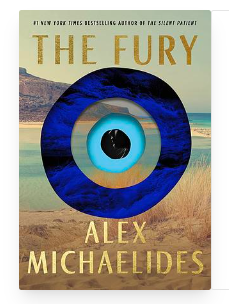
The Fury by Alex Michaelides: This book uses the “locked room” murder mystery trope (even though the locked room is an island assessible by boat only) without a Poirot, Miss Marple, or Sherlock Holmes to solve the case. Instead, there is a first-person narrator who may or may not be completely reliable. There are enough plot twists and turns to keep it interesting. The characters are not completely likeable, but they are interesting.

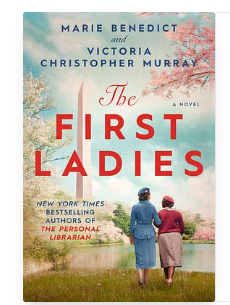
I bought The First Ladies by Mary Benedict and Victoria Christopher Murray last summer and put off reading it for quite some time. I regret that decision now. This is the story of the friendship between Eleanor Roosevelt and Mary McLeod Bethune. I didn’t know much about either lady, but I learned a great deal about them from this historical novel. The authors not only tell the story of how their friendship grew, but they also tell the story of the civil rights movement. As I read, I felt that “the more things change, the more things remain the same.” We have come a long way, but the book shows me that we still have a long way to go.

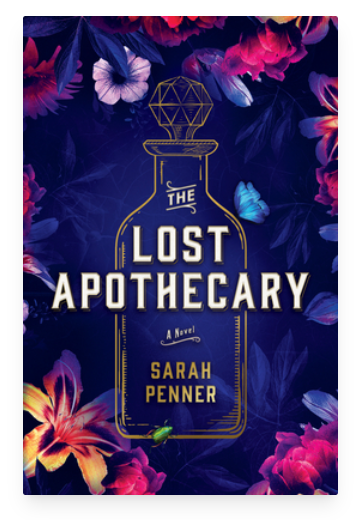
In The Lost Apothecary by Sarah Penner, Caroline goes to London to “celebrate” her tenth wedding anniversary–alone. She joins a mudlarking group and finds a late 18th-century apothecary bottle with a crude bear etched on it. This leads her to search for its origins. While she finds the origins of the bottle, she also finds herself. The novel is not exactly a time-slip novel, but there are parallel stories: Caroline’s story in the present, and the story of Nella, the apothecary, and her young customer, Eliza. This is a story of love and betrayal and friendship. I highlight recommend this book.

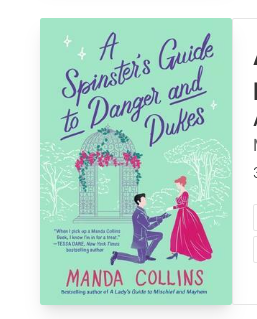
I do love a good historical romance and mystery, and The Spinster’s Guide to Danger and Dukes by Manda Collins did not disappoint. This is one of the add-ons for the March Aardvark Book Club box. When Poppy Delamere learns that her younger sister is accused of murdering her husband, Poppy goes to clear her name. She literally bumps into the Duke of Langham who is on his way to the same village to celebrate his grandmother’s birthday. Although the two seriously do not like each other, they combine forces to clear Poppy’s sister’s name and thwart the Duke’s grandmother’s matchmaking attempts during the birthday celebration houseparty. Collins uses the tropes of enemies-to-lovers, fake dating, and mysterious but menacing secret societies to create a lighthearted and fun read. It was the break I needed from the “heaviness” of Les Miserables.

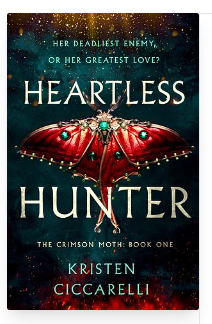
Heartless Hunter by Kristen Ciccarelli is another book club recommendation. It fits into the category of Young Adult literature given the protagonist is eighteen years old. The novel also fits into dystopian and fantasy categories as well. The protagonist, Rune, is a witch, but witches are being hunted and killed by the current regime. She works undercover as the Crimson Moth to help witches escape to the mainland from their isolated island. When she comes under suspicion, she flirts with a witch hunter and, not surprisingly, the two fall in love. The novel ends on a cliff hanger, so there will be a book two. I am looking forward to reading it.

I have always been a voracious reader, and setting these reading challenges has been fun. What else would a retired teacher of English do?

2024 Reading Goals

My daughter-in-law is a voracious reader! I thought I was one, but she has me beat! Her reading goal for this year is 100 books. I set a modest goal of 52, at least one book a week. So far, I’ve read two–both on my iPad Kindle app, and both historical novels set in the 19th century. Oh, and both mysteries rather than romances. I started the January Book of the Month selection, The Fury, set in modern times on an isolated island in the Aegean Sea, cut off from the mainland and accessible by boat only. There is a murder. I suppose, even though the murder occurs outside in the garden, it is a “locked-room” mystery since the only suspects are those who are visiting the privately owned island. The owner is a sort of reclusive movie star. I’m just a few chapters in, though, so there will be no spoilers. I don’t know even know who the victim is, only that he has been murdered! So far, even the narrator is unnamed.

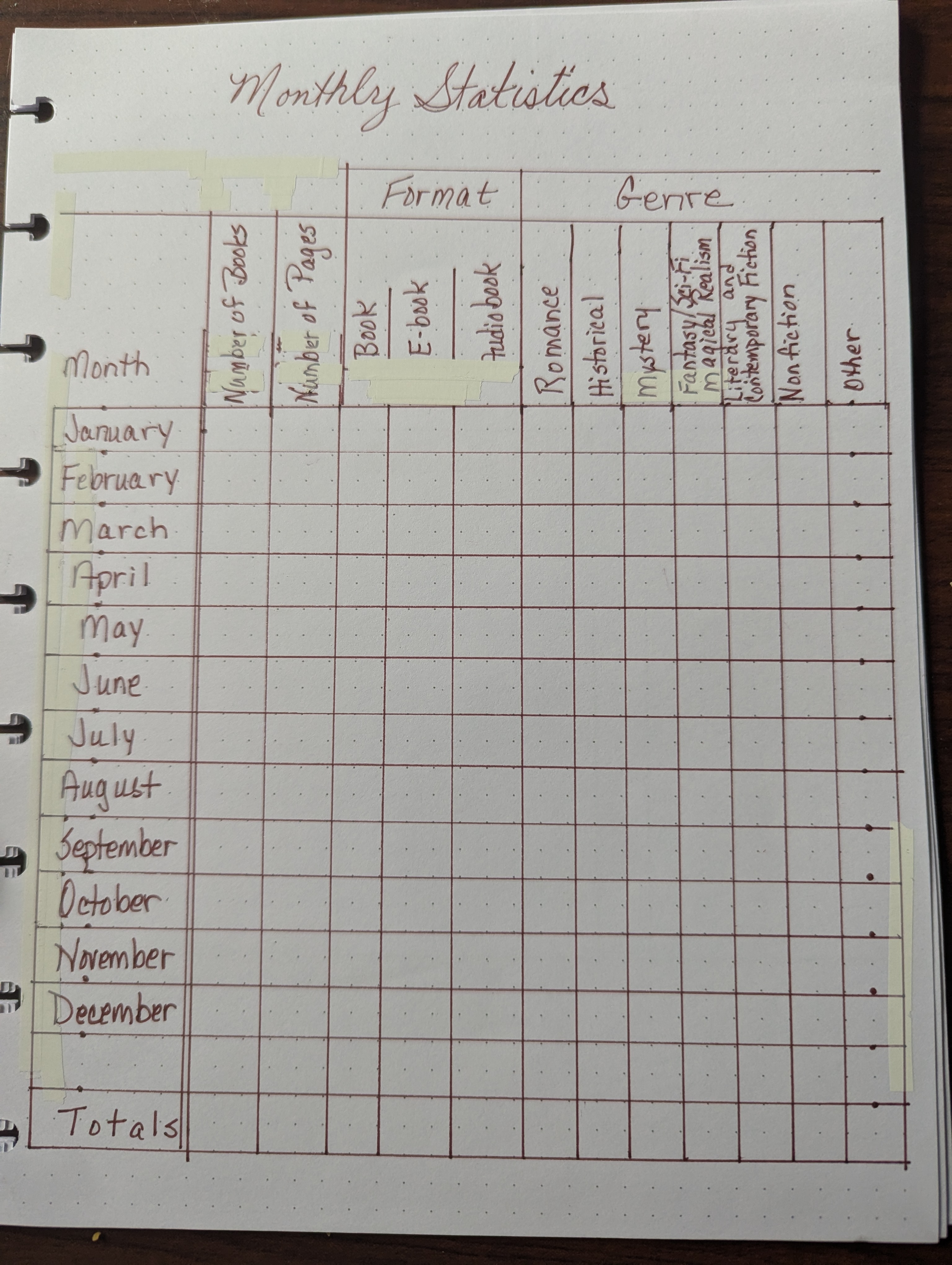
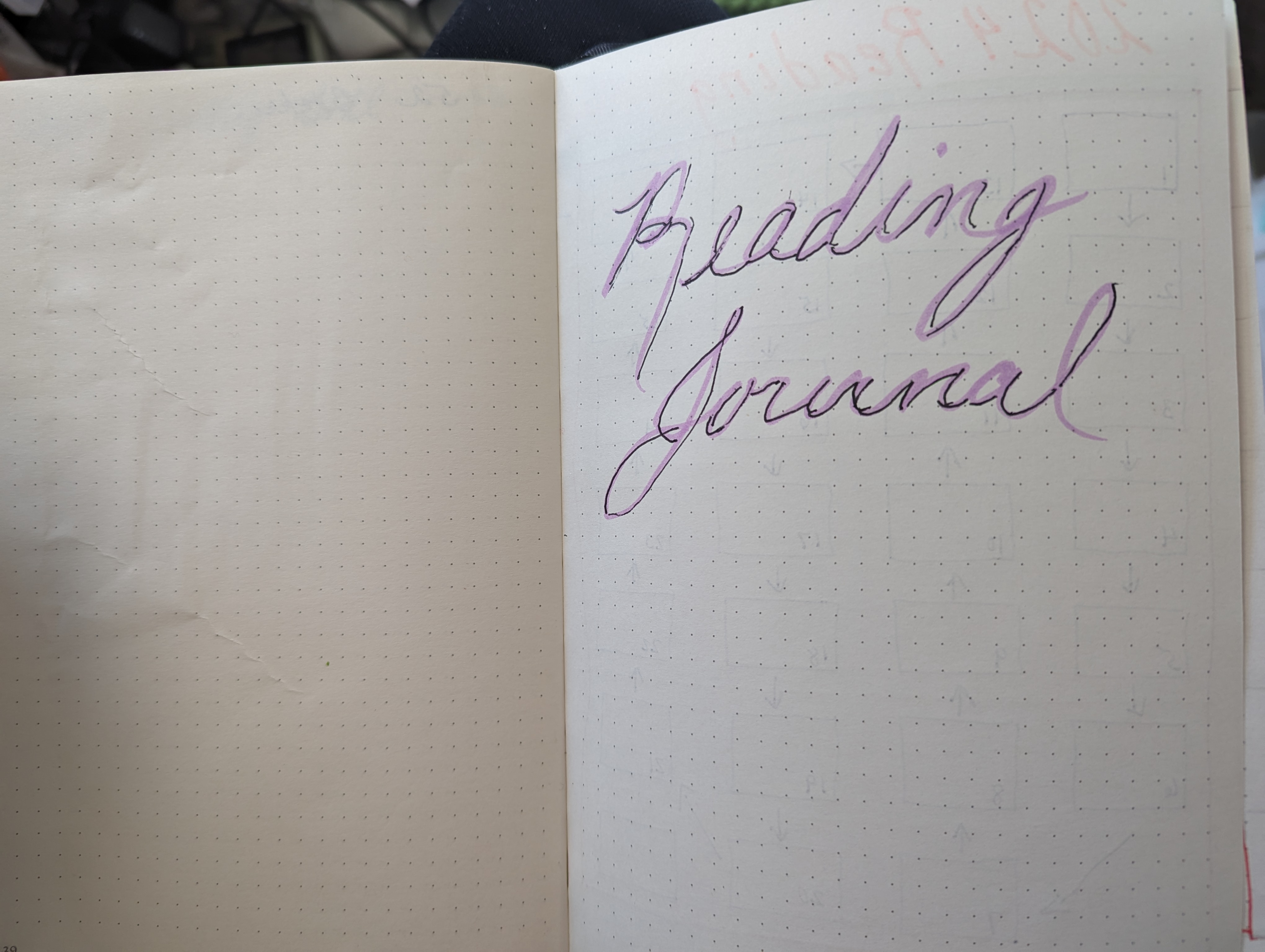
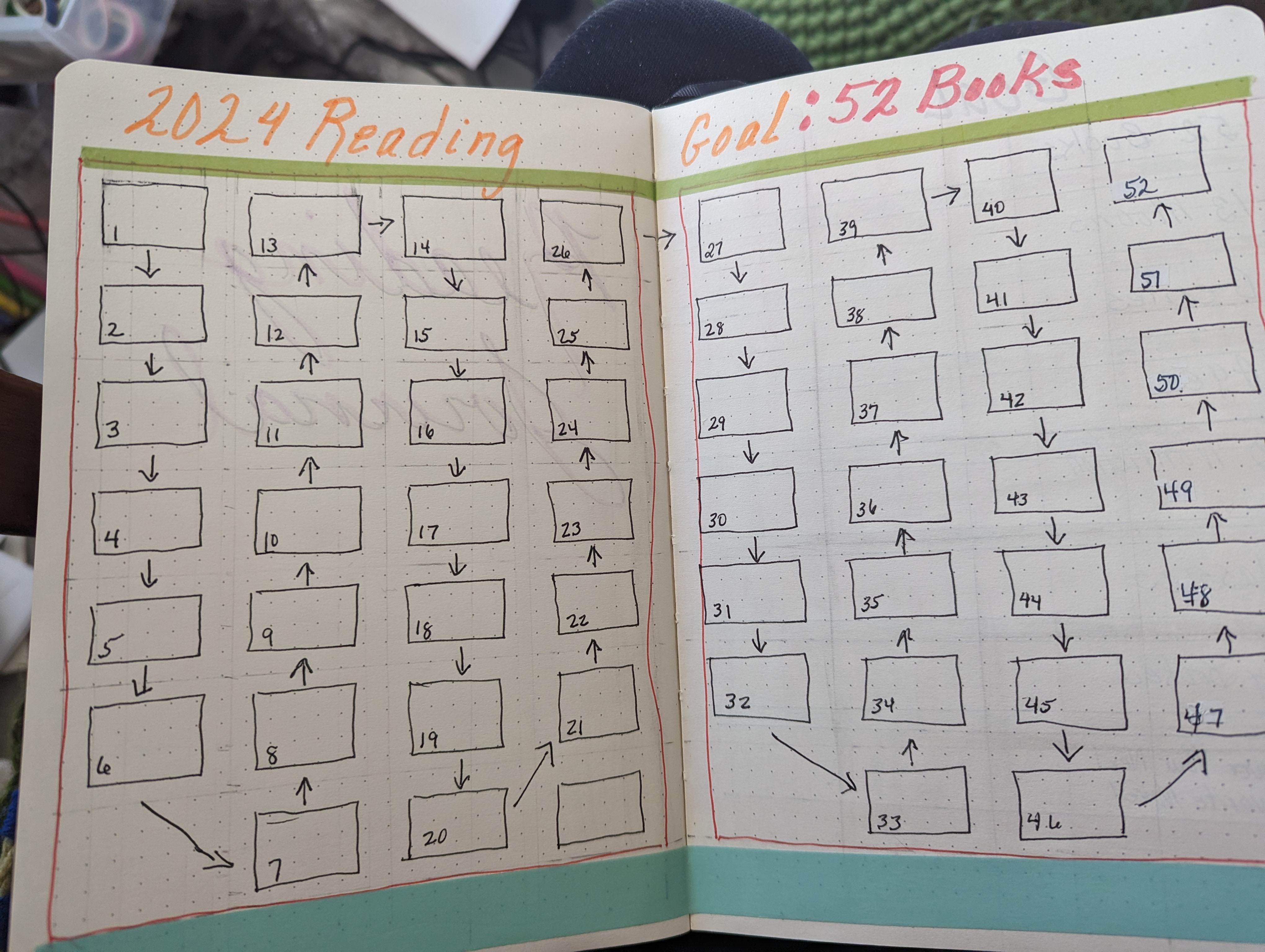
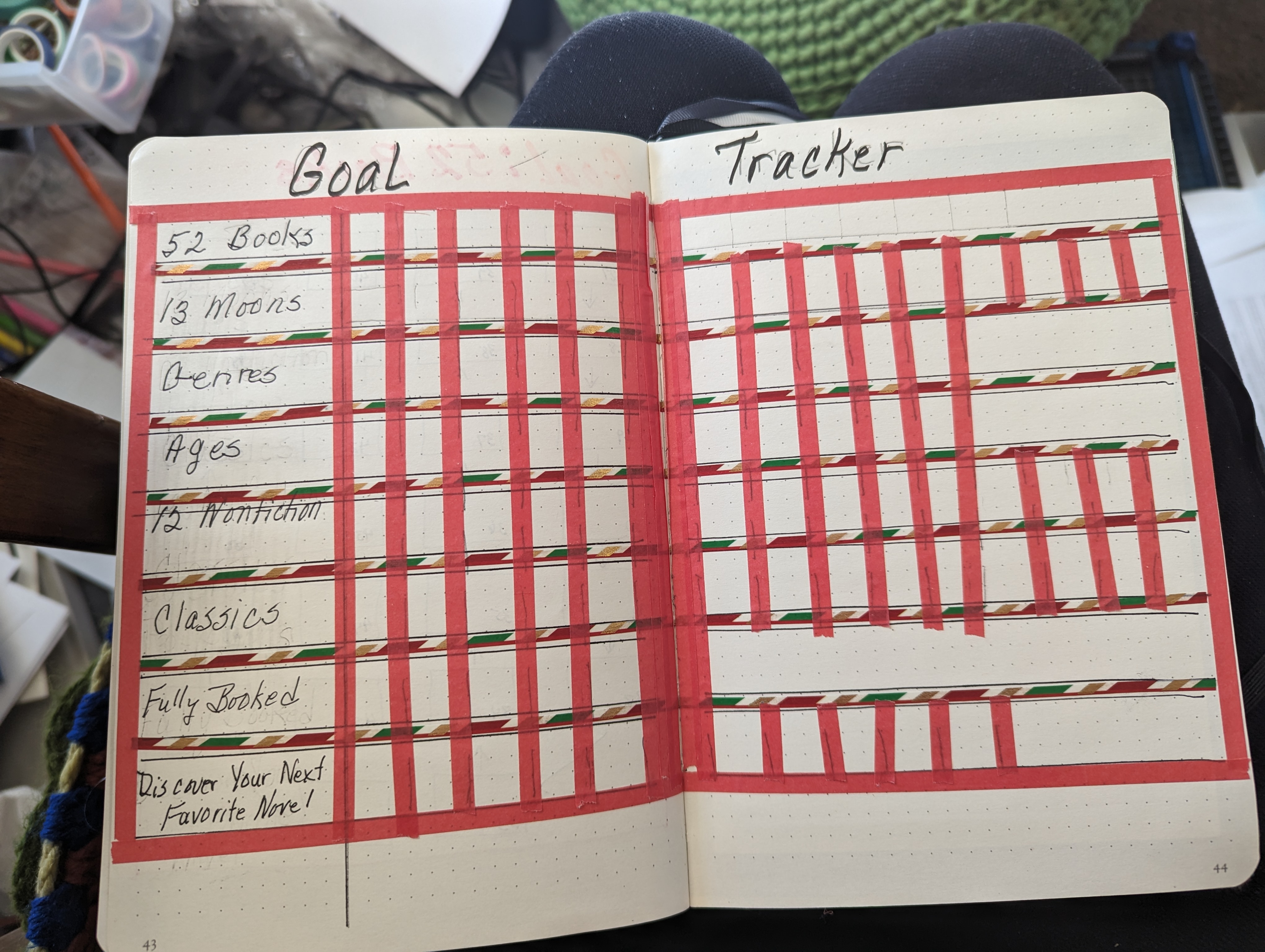
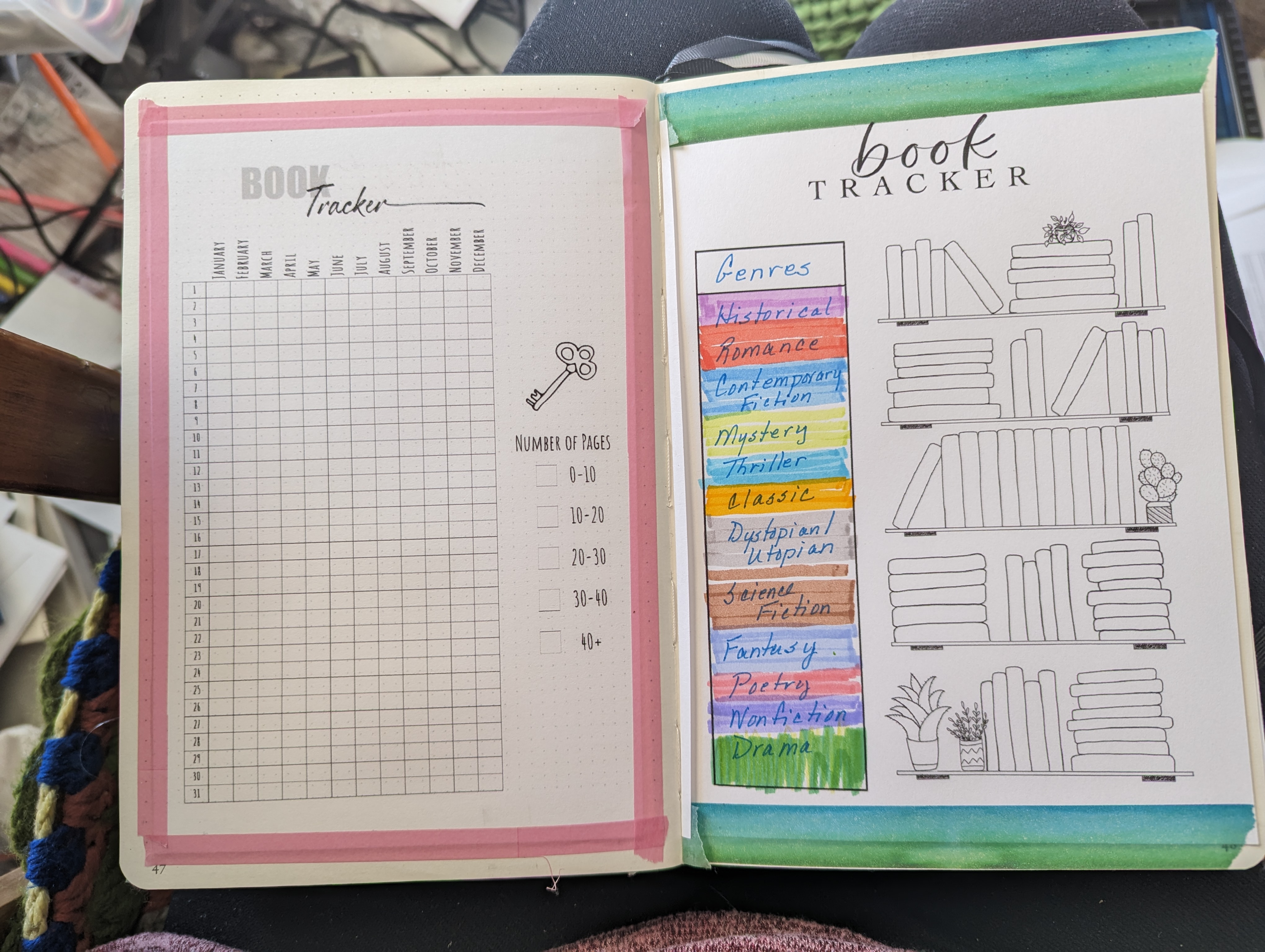
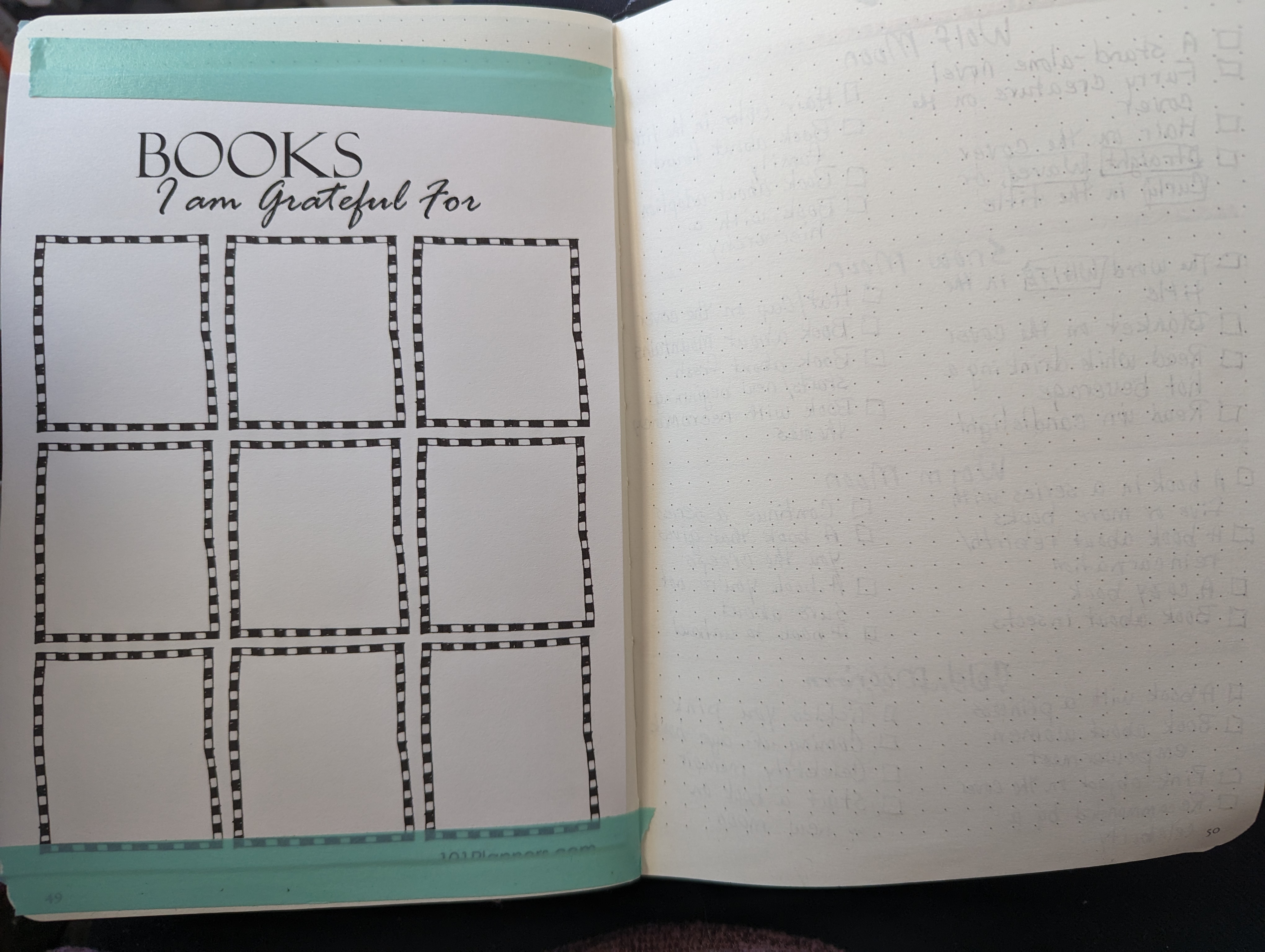
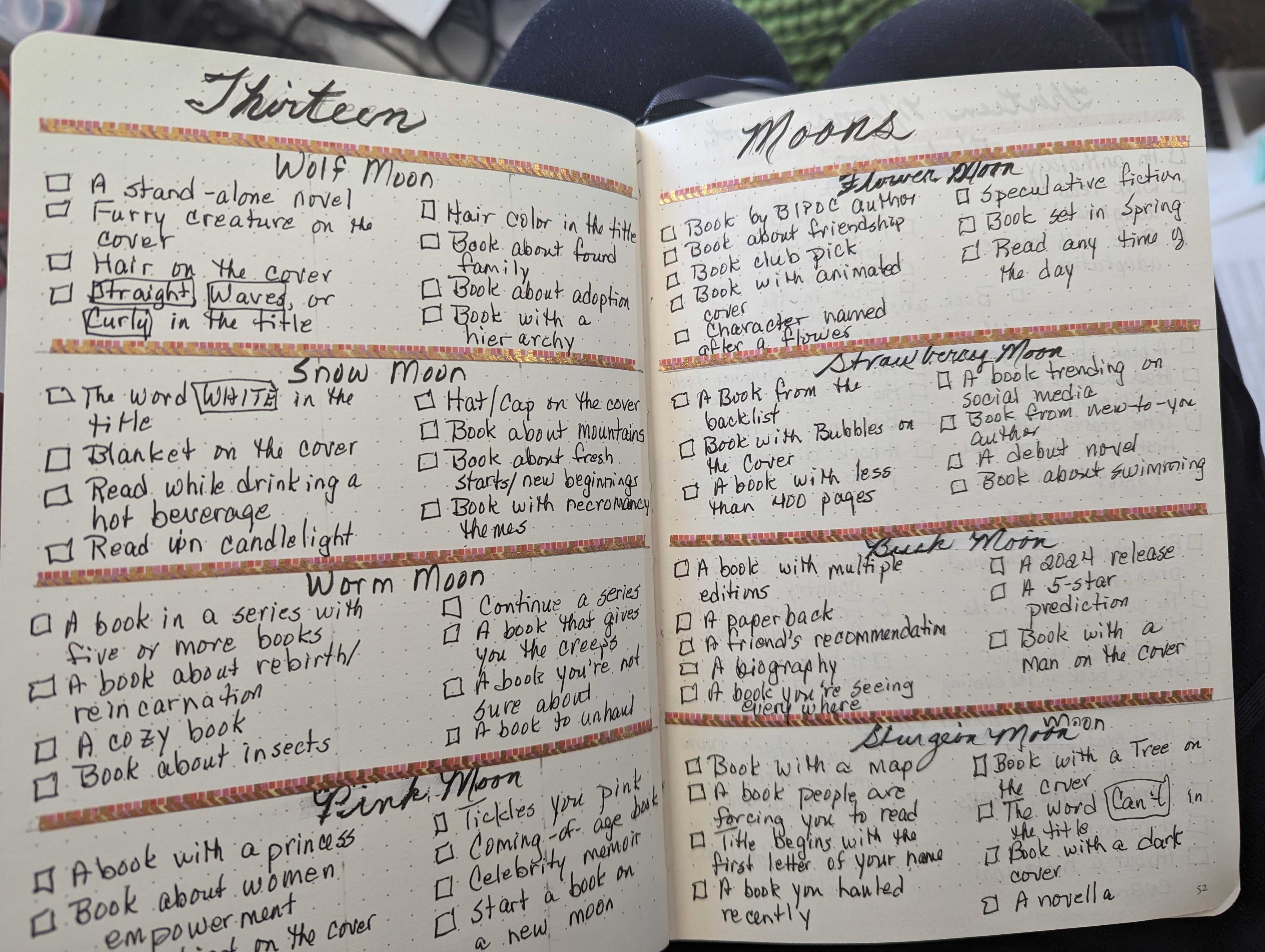
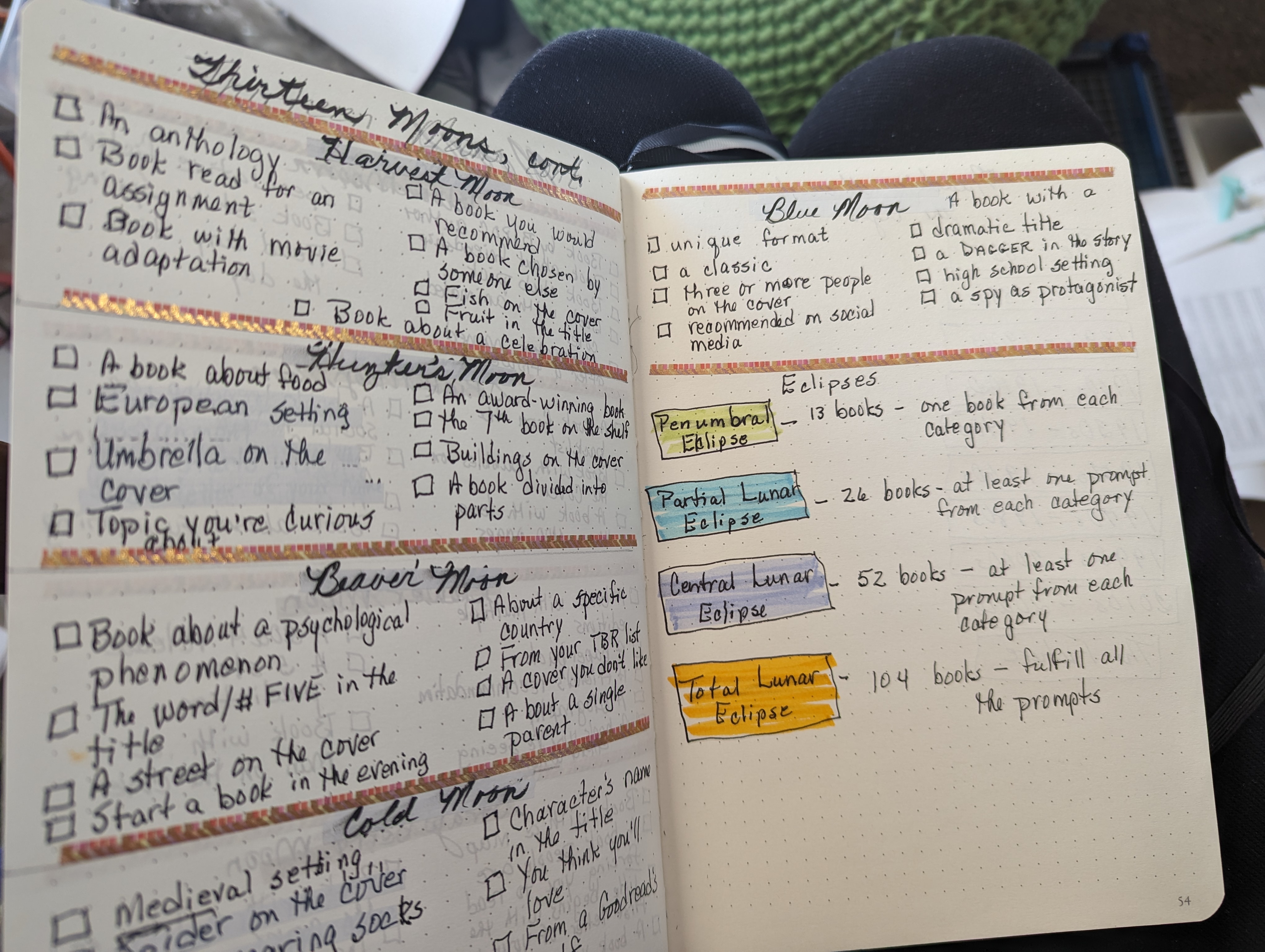
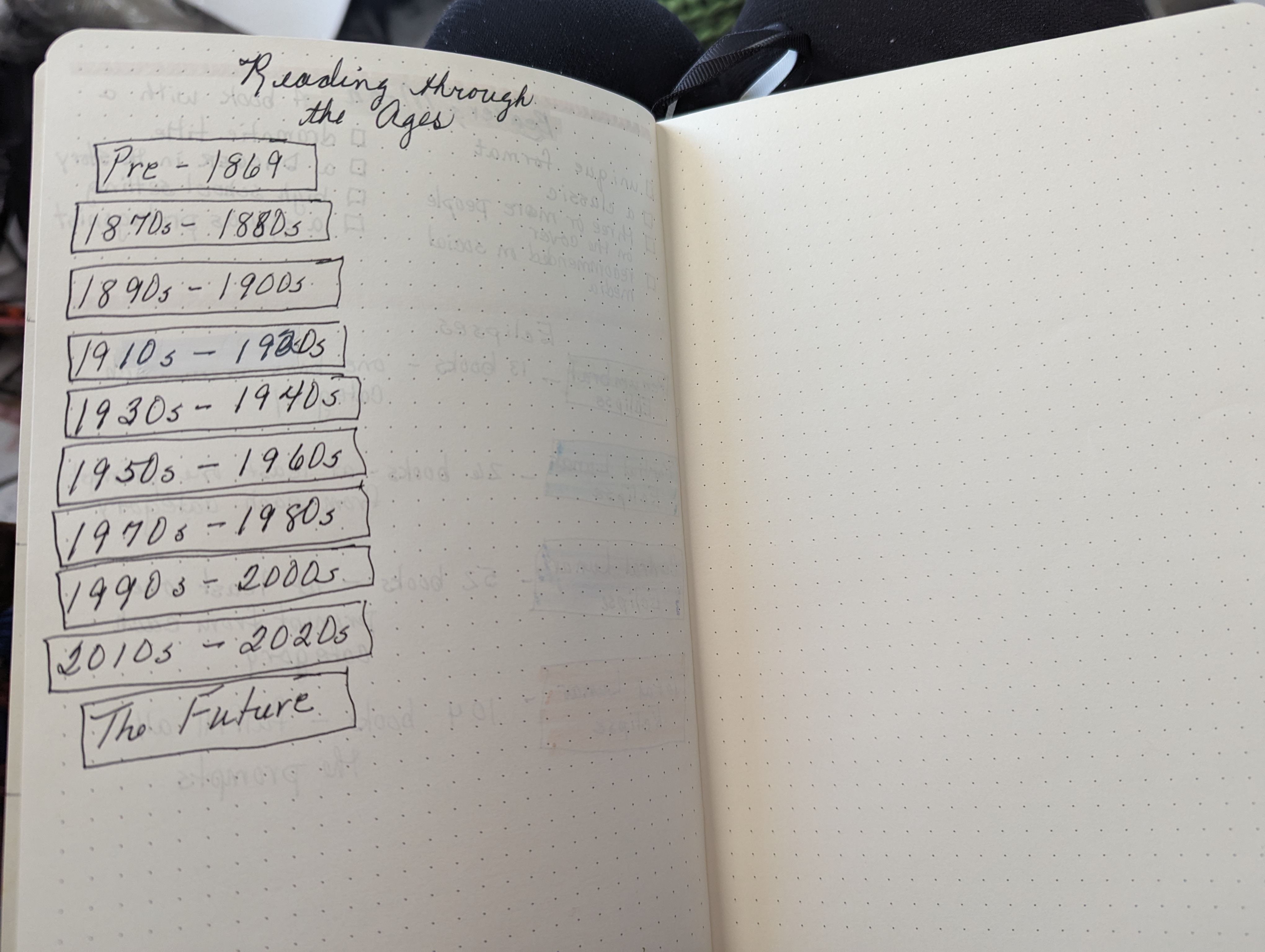
Sherry inspired me to create a book journal/book log to track my reading. I haven’t finished it yet; somehow, it keeps growing. My pages include the following:

  • a title page, which isn’t complete yet
  • a numbered grid to track my reading goal of completing 52 books this year
  • A goal tracker with includes some reading challenges for the year
  • a pretty bookshelf tracker (color-coded according to genre)
  • a pages read tracker and a genre tracker
  • “books I’m grateful for”–I want to add some books I’ve read before I began this journal, but I’m not sure about that. I’m thinking of printing off small book covers to put on this page of those books.
  • The Thirteen Moons Reading Challenge
  • Reading through the Ages Challenge
  • Book of the Month tracker
  • Reading the Classics Challenge
  • The Thoughtful Reading Challenge
  • Discover Your Next Favorite Novel Challenge with specific reading suggestions

I haven’t finished the last four spreads. On the occasional blank pages, I’m going to add some quotes about books and reading.

I plan to add a page for nonfiction as soon as I figure out what I want to do. My goal is to read twelve nonfiction books this year. (I have three or four already sitting on my TBR pile.)

So, here are my reading goals for the year. It’s going to be fun to see if I can meet that goal!