The other night, I was using ChatGPT, looking for inspiration for some projects I’ve started. As the chat went on, the subject of books came up, and ChatGPT (I’ve named the voice Eli) asked me what kind of bookstore I would open if money were no object—and what I would name it.
I came up with the idea of a bookstore being a place of retreat from the noise of the world, a place to move into other words. I know some books are pretty raucous and noisy—especially thrillers and many of the romantasy, fantasy, and dystopian stories. Still, my bookstore would be a place to discover those other worlds, the cozy ones as well as the raucous ones.
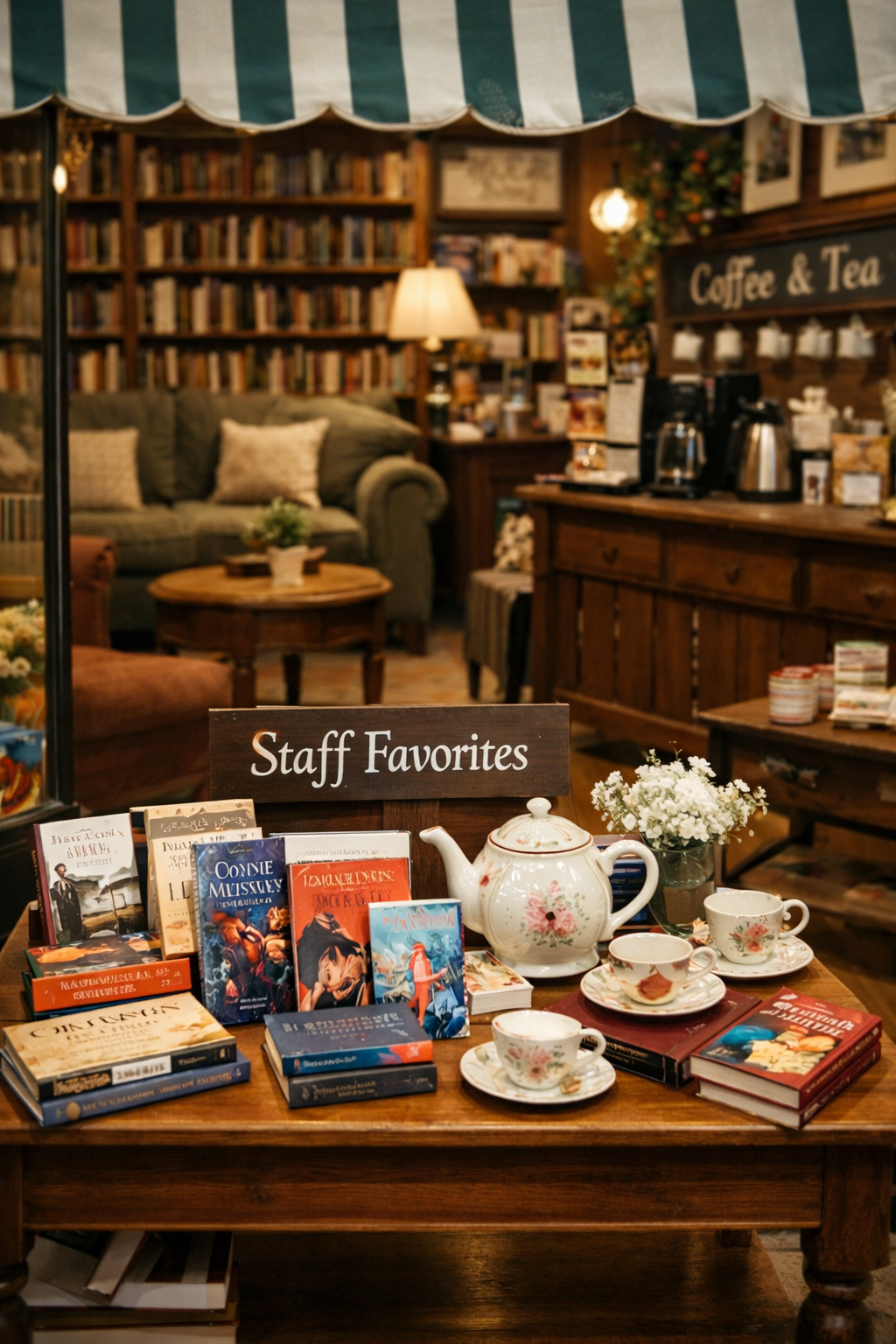
My bookstore would be the “hole-in-the-wall” kind—the sort of old-fashioned store with paneled walls and wood floors, plate-glass windows across the front, and an awning over the door. Inside, tall bookshelves would hold a wide variety of books, and there would be at least one seating area with comfortable overstuffed armchairs and a sofa or two for those who want to read in the store or gather for book clubs.
(Image created with ChatGPT)
There would be a small self-service coffee and tea bar—nothing fancy, just a coffee pot, flavored creamers and sweeteners, a hot water dispenser, and a variety of teas. Perhaps a few pastries for snacking. The windows would display seasonal books as well as bestsellers. Soft “reading music” would play in the background—instrumentals, classical pieces, or quiet piano solos.
The display at the front door would be loaded with favorites—classics, cozy mysteries, maybe a rom-com or two—along with china teacups and a teapot. Local artists’ work would hang on the walls.
That’s the dream.
The reality is that I probably won’t have that bookstore. However, I can create something like it here. Beginning now, I’ll be writing a series called From the Retreat, where I will share books I’ve read and offer a few thoughts about them. As I learn more, I may expand to covering some new releases as well.
I hope you’ll join me in creating this little retreat space.
I lost my momentum for posting my reading wrap-up entries last year. This year, I’ll try again. I set a modest reading goal this year of four to six books a month. The first year that I set a reading goal, I started at 100 books and read 120. Last year, I forgot to keep a count. I recorded my reading faithfully in my reading journals–three different journals, and now I can’t find all three. I tried different formats. I found that I prefer to make my own layouts rather than use the expensive preprinted, predesigned journals.
I read five books this month.
And I even recorded them in Story Graph! As usual, I have my share of 19th century mysteries. I enjoy Carla Simpson’s Angus Brodie and Mikaela Forsythe Mysteries. I thought I had read all of them and was up-to-date. However, Deadly Ghost popped up in my Kindle Unlimited library this month, and, of course, I had to read it. This is the eleventh book in the series, and I am way past number 11! Anyway, I enjoyed it. This book seemed a little more personal than other books in the series, mainly because Mikaela becomes the target of no good when a “long lost” half sister come to London to get to know her extended family, or so she says. Mikaela and Brodie, though, are suspicious and investigate.
The Cursed Divination and The London Seance Society have a creepy Gothic feel to them, and that appealed to me. I liked Sara Penner’s London Seance Society, but I thought it was a little flatter than her other two books, The Lost Apothecary and The Amalfi Curse. I enjoyed these two books.
The Author’s Guide to Murder was so much fun to read. The three authors made so much fun of the tropes of women’s romance, historical fiction, and mysteries, especially the cozy mysteries. The writers turned the tropes on their heads. Instead of the enemies-to-lovers trope, the authors changed it to rivals-to-friends. I hope this book begins a series with the three protagonists as writer-detectives.
My book club “assignment” was Surprised by Oxford. I enjoyed this book a lot, and our book club had a really good discussion inspired by the novel. Carolyn Weber’s book is a memoir of her first year as a graduate student at Oxford. During that year, she becomes a practicing Christian after being somewhat agnostic for most of her life. She explores the intersection of academia and Christianity, the role of friendship and mentorship. This book is definitely a coming of age book of the best kind.
I started An Arcane Inheritance this month, but I haven’t finished it. I have about 100 pages left. I also have to finish Jane Austen’s Northanger Abbey.
In addition to my four to six books a month goal, my other goals include: read a classic, read a new-to-me author or genre, and meet two reading challenges. I definitely met the four-to-six goal with five books and the new-to-me author with Carolyn Weber’s memoir and the three authors of An Author’s Guide to Murder. I could claim Northanger Abbey as my classic even if I didn’t finish it.
Imagine that! It’s day four of the A-Z challenge, and I’m still in it. While I have a daily writing practice more or less following the guidelines set forth by Julia Camera (The Artist’s Way), daily blogging is not part of my routines. I’ve managed to post once or twice a month over the last year or so, mainly documenting my reading with short book reviews and overviews. Yet i’ve had this dream of being a writer since high school.
I wrote a story that I gave to my high school English teacher at the end of my junior year. It was the last year I would have her as my teacher. Mrs. Richardson taught ninth, tenth, and eleventh grade English; Miss Bedenbaugh would teach twelfth grade English. Back then, we weren’t separated into college prep, honors, or AP classes; we were all treated as college prep students. She like my story, but I wasn’t encouraged to pursue creative writing. After all, creative writing wasn’t necessarily an academic pursuit. It wasn’t until I was in graduate school that I knew that people could major in creative writing! But I was on track for Masters degree in English literature and did not even consider a creative track.
And then came the children, two boys four years apart in age, and a career as a full-time high school English teacher myself. There was no possibility of thinking about creative writing, not with small boys, soccer practice and games, then baseball, and marching band, not to mention Cub Scouts and Boy Scouts and church. . . . Did I mention lesson plans and grading and reading for my classes? The dream to be a writer had been deferred once again.
And then came retirement and a free class (though not exactly) with guidance to write that first novel. I did it. I wrote the novel, and. . . . well, it’s still written; it’s just not published. Dream deferred again? I don’t know. Sometimes, writing–or any art–just has to sit for a while before it goes public. The same is true about my photography. I “dream” one day that I will be able to create those fine art photographs in the vein of Ansel Adams and others. And yet. . . dream deferred. I use the excuse that I don’t know enough about photography as art to make those kinds of photos. Still, I dream. Maybe one day. . .
Langston Hughes wrote, “What happens to a dream deferred?” Something’s absolutely nothing happens; sometimes it does explode. I will just have to wait and see what happens to my deferred dreams.
This has been a strange month for reading. It seems I have started a lot of books, but didn’t finish them for some reason or another: Persuasion by Jane Austin, Women of the Word by Jen Wilkin (almost finished–I’m on the last chapter), The Let Them Theory (just started, so I can’ complain too much about not finishing that one). . . . I put The Covenant of Water on pause, but do plan to get back to it in April. It is such a beautifully written book that I do not want to abandon it. So, what did I read? A lot of “fluff”!
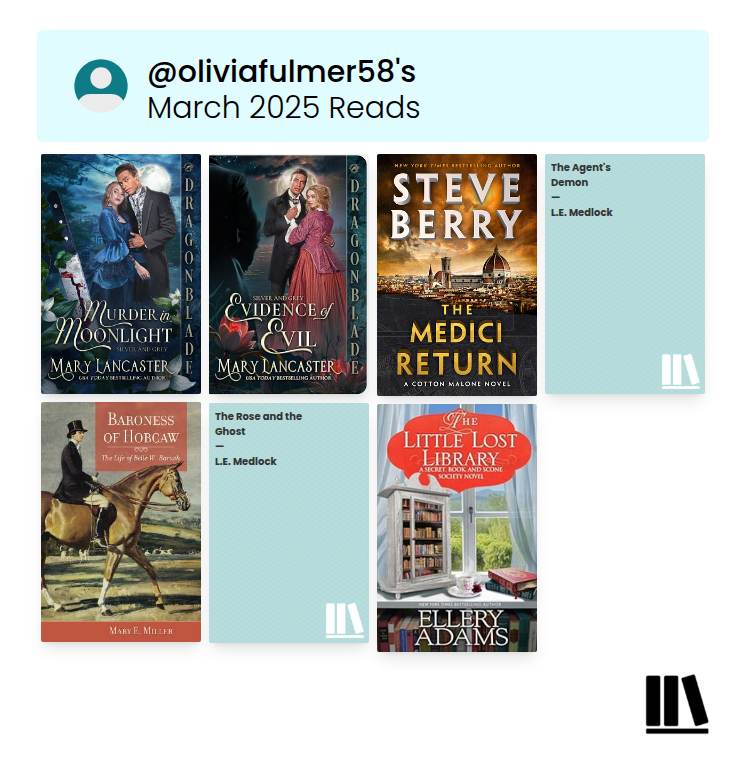
I started the Locke and Steele series with The Agent’s Demon and The Rose and the Ghost. The Agent’s Demon has paranormal investigator Agent Hazel Locke and her demon partner investigating the Whitechapel Murders of Jack the Ripper. When they discover the identity of the Ripper, they must flee England to Paris to save their lives. While in Paris, they plan to investigate the murder of Steele’s family. The Rose and the Ghost tells the story of the search for the identity of the murderer of Steele’s family, but also includes a retelling of The Phantom of the Opera. Reading the latter book has prompted me to read the classic Phantom although I may be singing the songs from the musical in my head while I read. These were enjoyable paranormal mysteries with a bit of history thrown in, but I’m not likely to reread either of them although I will read the next installment when it comes out.
Ellery Adams is a “local” author from North Carolina. I thoroughly enjoyed her Book Retreat mystery series and started the The Secret, Book, and Scone Society series last year. The Lost Little Library was another fun read that kept me guessing until the end. Nora, Grant McCabe (the sheriff and Nora’s lover), and the women of her book club have two mysteries to solve: the mysterious death of Lucille Wynter, who leaves Nora a book that takes her on a scavenger hunt for various items that will uncover a family secret and the theft of YA books from her book store. What I love about Adams’s two series is the allusions to all kinds of books, so much so that I regret not writing down the titles as I read so that I can read them as well! This is another series I look forward to the next installment.
Another mystery series that held my interest was Mary Lancaster’s Silver and Grey mysteries. Constance Silver and Solomon Grey team up to solve a couple of murders in this series. They work well together, and there are the beginnings of a potential romance. I will be looking forward to continuing this series as well.
I can’t lose when there is a Steve Berry book. The Medici Return is the latest book in the Cotton Mather novels. Mather is a retired agent from the Magellan Billet, a top secret intelligence organization in the U. S. government. In this installment, Mather is sent to Italy to investigate the possible criminal activities of an archbishop. However, things get complicated when a businessman and member of the Italian legislative body claims to be a direct descendant of the Medici family, to whom the Vatican owes a great deal of money. I love all the history and “local color” that Berry infuses into his novels–and the fact that he can keep me guessing about the outcome until the very end.
I am well on my way to meeting my goal of six nonfiction books. So far, I’ve read Maya Angelou’s The Heart of a Woman in her series of autobiographies and Mary Miller’s biography of Belle Baruch, who is responsible for a true South Carolina treasure, Hobcaw Barony, which she set up with the state to be an educational and research facility in the Low Country. This book was interesting in so many ways. First, Belle Baruch was an interesting woman, a feminist and women’s libber before there were such things. Second, she was a paradox, known for her generosity and kindness but also somewhat bigoted and prejudiced. It was her love of nature, though, that stands out. As I read the book, I kept thinking, “Why haven’t I learned about this?” There was so much South Carolina history, as well as U. S. history in the biography. I didn’t know there were U-boats off the coast of South Carolina or that German spies actually made landfall in the Low County. I didn’t even know about Bernard Baruch’s role in history as advisors to seven presidents. It was an eye opening experience reading this book, and we had a lively discussion during the book club meeting.
I will probably finish Women of the Word this week. This book describes a method of Bible study that goes deep into the Word of God. Although the target audience is women, the method of study outlined by Jen Wilkin is applicable to anyone who wants to study Scripture in a meaningful way. I have tried several study methods over the years, but Women of the Word brings them all together. I am also using another method, the James Method, which incorporates many of the same elements (but with different names) as Wilkin’s method.
This morning before I began this post, the Book of the Month Club posted its April selections. I’ve chosen Six Days in Bombay, a historical novel; Famous Last Words (a BOTM exclusive), and The God of Woods (I’m late to the party for this book). Hopefully, I will be able to get into the books more in April.
Oh, by the way, April is National Poetry Month, and my “practice” for this month will be to collect quotes from poems every day of the month into a handmade commonplace book. I am starting with Mary Oliver’s collection, Devotion.
For the second year in a row, I have set a reading goal of 100 books. I managed to read and/or listen to 119 books. I have always been a voracious reader, resorting to reading cereal boxes when there was nothing else handy to read. I will probably exceed the 100 books again this year at the rate I’m going. So far, I’ve read seven books. I’ve broken down my goal into smaller ones as well: to read a classic a month, to read six nonfiction books this year, and to complete a formal reading challenge.
My reading challenges come from two sources: The Book Girls, who host several challenges such as the Book Lover’s year-long challenge with a different book related theme each month, a decades challenge, a “lifetime” challenge, and an In-case-you-missed-it challenge. Read with Allison also has a challenge list that inspires me to push out of my comfort zones. I also subscribe to the Book of the Month Club and the Aardvark Book Club as a source of books.
So far in January, I have finished seven books already.
I actually started two books in December of last year, The Secret Garden and The Teller of Small Fortunes. I had never read The Secret Garden as a child, but I had seen the movie with Gary Oldman several years ago and enjoyed it. I was entranced by the book and the way Mary and Colin grew as characters.
The Teller of Small Fortunes was a slow starter for me, and I put it aside during the holidays. However, once I picked it up again, I was hooked. This is the story of a fortune-teller who finds a family as she travels from town to town telling “small fortunes,” hoping to avoid the attention of the guild of magicians and seers. It is also a story of reconciliation and second chances.
Lula Dean’s Little Library of Banned Books caught me by surprise. I expected it to be more humorous, and there are some comic moments. But the subject is all too serious–and timely. Lula Dean sets out to clean up her town by getting rid of books that she believed would corrupt the young people. Strange things begin to happen, though, when she sets up her own Little Library in her front yard, stocked with “safe” titles, she thinks. People start getting books and adding their own. Then Lula decides to run for mayor after her rival runs on a plank to remove the statue of a Civil War general, who just happens to be Lula’s great-great-great grandfather. That’s when all you-know-what breaks out and the truth about the popularity of Lula Dean’s library comes to light. The novel is so timely because it mirrors what is happening throughout the country today as more and more communities face questions of censorship.
Every so often I have to reread a favorite classic. I have had a love-hate relationship with Wuthering Heights since I was in high school and my English teacher wanted me to read it. It was one of those books that I was not quite ready for at sixteen, but ten years later, it became MY book and the basis for my master’s thesis. On StoryGraph, Wuthering Heights is classified as a romance, but it is unlike the typical romance. If Cathy and Heathcliff are in love, it is a dangerously obsessive love. What I love about this novel now is the language Emily Bronte uses. It is clear that she is heavily influenced by the first generation Romantic poets Wordsworth and Coleridge as well as by Byron and other later Romantic writers. The final paragraph of the novel has to be my all-time favorite passage in literature:
“I lingered round them, under that benign sky; watched the moths fluttering among the heath, and hare-bells; listened to the soft wind breathing through the grass; and wondered how any one could ever imagine unquiet slumbers for the sleepers in that quiet earth.”
Lord Redmond and Daniel Haze return in Irina Shapiro’s latest mystery in the Redmond and Haze Mystery series. This time, they investigate the murder of a medium who had helped them in a previous case locate Daniel’s missing daughter. They also grapple with their trust of those who claim to communicate with the dead. Daniel uses his expertise as a police officer working for Scotland Yard while Lord Redmond uses the medical sciences to provide important clues to solve the crime. I’ve already pre-ordered the next book in the series.
The Stolen Queen is a historical mystery/thriller, according to StoryGraph. When an important artifact, a fragment of a statue of a little known female Egyptian pharaoh is stolen during the annual Met Gala, a curator must face a tragedy in her past to recover the stolen piece. She must also return to Egypt, the place where she faced that tragedy. With the help of Annie, Charlotte not only recovers the stolen artifact, but she also recovers her family. I enjoyed the dual time periods. The novel starts slowly; however, the last third of the book moves very quickly, and I was hard pressed to put it down. (I may or may not have stayed awake until the wee hours of the morning reading.)
I’m not sure what to say about Therese Bohman’s Andromeda. It is a very short novel, just under 200 pages. It is beautifully written, the language often poetic. Bohman creates some beautiful metaphors about reading and the importance it can have. There are two narrators: Sofie, a young intern hired to become an editor for the publisher’s Andromeda imprint, and Gunnar, the editor-in-chief, who mentors and grooms Sofie with the idea that she would take his place when he retired. The book is roughly divided into two halves with each narrator telling his or her story. Sofie focuses on her relationship with Gunnar and the publishing business whereas Gunnar narrates his “life story.” The thread that runs through both parts is the importance reading and books had in their lives and in their relationship. I have to admit, though, that I’m not sure I can say I liked the book, but I will say that I’m glad I read it.
Now, I’m ready to start book number eight from a pile of books I bought last year. That’s another one of my goals: to read last year’s purchases. I think I’m going to read Mistress of Lies by K. M. Enright next. I’ve seen it come up on several “best of 2024” lists recently. It’s been collecting dust for a while.
I really slowed down my reading this month. Perhaps it was because some of the books were longer and “slower” reads. It’s also the beginning of the holiday season, and things get busy.
I seem to be falling back into familiar and comfortable genres this month–historical romances and mysteries as well as some fantasy and magical realism.
An Audacious Woman, A Discerning Woman, Deadly Lies, and Murder at the Foundling Hospital are all historical mysteries set in the 19th century. Sarah F. Noel’s “Tabitha and Wolf” mystery series features the recently widowed Lady Pembroke (Tabitha) and the new Earl of Pembroke (Wolf) as they investigate various murders while navigating a tricky romance. These novels are light and sometimes humorous, especially when Tabitha’s mother-in-law, the Dowager Countess of Pembroke decides she wants to become an investigator. Besides the mystery aspect, the novels are also about finding one’s family and belonging as Tabitha’s family includes not only the new Earl and the Dowager Countess, but a trusted family friend and two street urchins who become her wards.
Deadly Lies is the latest book in the Angus Brodie and Mikaela Forsythe Murder Mystery series by Carla Simpson. Lady Forsythe is an independent woman of the late nineteenth century who becomes involved with the often surely Angus Brodie when her sister goes missing (Book I). In this latest installment, they investigate the murders of two young women found with a red rose. Mikaela narrates the story as it unfolds with occasional glimpses into Brodie’s point of view when he goes off on his own. Mikaela, like her elderly great-aunt who raised her and her sister after her parents’ deaths, is intelligent, witty, and more than a little free-spirited. This series is mostly light-hearted and fun.
Murder at the Foundling Hospital is the third installment of the Tate and Bell series by Irina Shapiro. Set in London in the latter half of the nineteenth century, the novel follows Detective Bell and Nurse Gemma Tate as they investigate the murder of Amanda Tate, a fourteen-year-old foundling. Together, they piece together the clues that eventually bring the killer to justice, but at the expense of Gemma’s job at the Foundling Hospital. Shapiro uses more history in the development of the plot than Noel or Simpson as she draws on the details of the Crimean War for context. This novel is darker in tone and without the humor of Noel’s and Simpson’s novels, but it is no less a good read.
I seem to be choosing more books from the fantasy and magical realism genres. Weyward, Where the Library Hides,Before the Coffee Gets Cold, and The Scholar and the Last Faerie Door all incorporate some measure of paranormal or supernatural elements. Emilie Hart’s Weyward tells the story of three women of the Weyward family from three different time periods: one a 17th century woman accused and tried for witchcraft, a teenager from the 1940s, and a young woman from the present who retreats to her great-aunt’s cottage to escape an abusive marriage. All three women have an affinity with nature that is often called “witchcraft.” All three women have complicated and even dangerous relationships with the men in their lives. However, although bad things happen to these women, they come through their experiences stronger and more independent than ever. Resilience is the key. I enjoyed this book and truly did not want it to end. Perhaps there will be another Weyward book that tells the story of Kate’s daughter named after her ancestors, Altha the 17th century “witch” and Violet the 20th century botanist and scientist.
Where the Library Hides by Isabel Ibanez continues the story begun in What the River Knows. Inez has gone to Egypt at the end of the 19th century to find out what happened to her parents. At the end of the first novel, she discovers that her mother is still alive, and she receives a rather unromantic marriage proposal from her uncle’s assistant Whit. Where the Library Hides has the two, now married, searching for the lost loot from Cleopatra’s tomb and Inez’s mother. Ibanez throws in a plot twist near the end of the novel that I truly did not expect, but it made sense. This sequel ties up all the loose ends and brings the mystery to a very satisfactory close. The epilogue, though, may foreshadow some more books about characters introduced in this novel. I will be following Ibanez for other books.
Before the Coffee Gets Cold was our choice for the November book club. It also falls into the genre of magical realism. Four characters have the opportunity (and the desire) to travel in time. There are several rules, though, that govern their time travels: they can only meet people with whom they have met in the coffee shop; they will not change the present by going to the past or the future; and they can stay away for only as long as the coffee stays warm. Failure to drink the coffee before it gets cold will turn them into a ghost. Three choose to go back in time while one character chooses to go into the future. All three come away from their time travels with new understandings of themselves and others. I had my doubts about this book when I started it. It felt too objective. However, as we followed each character into their pasts, presents, and futures, the reader does get to know them and feel engaged with them. By the end of the first vignette, I was fully engaged and ready to devour the stories. I will certainly be reading the other books in the series.
H. G. Parry’s The Scholar and the Last Faerie Door combines the history of the post-World War I Lost Generation with fantasy. I’m not sure there’s a name for this genre! It’s a combination of historical fiction and fantasy and romance. Clover Hill wants to learn to do magic so that she can release her older brother from a Faerie curse he received at the battle of Amiens during the first world war. She attends Camford University where she becomes friends with three students who come from the class known as the Family, people who have had magic in their blood for generations. What makes Clover different is that she is not from a magical family but is an ordinary farm girl. However, through hard work, study, and research, she does learn magic and eventually obtains the spell to release her brother. However, she had to pay a high cost. This is a heart-breaking story of love and friendships that go awry and of lost trust; it is also a story of restoration, forgiveness, and reconciliation. Even though events become quite dire, there is a thread of hope throughout.
It was hard to pick a best book for the month, but I think I decided on Before the Coffee Gets Cold. It is an easy-to-read novel, even in translation from Japanese. The characters are for the most part likeable and relatable. There are really no villains in this book at all, unless, that is you count death, Alzheimer’s, and loss as villains. There are no murders to solve. In the end, the book is full of love and hope.
As the Christmas season approaches, I know I will have more books to read. I haven’t selected specific holiday books (yet), though I have started Tommy Orange’s book Wandering Stars, which follows a survivor of the Sand Creek Massacre. It’s a heavy way to begin this season of joy.
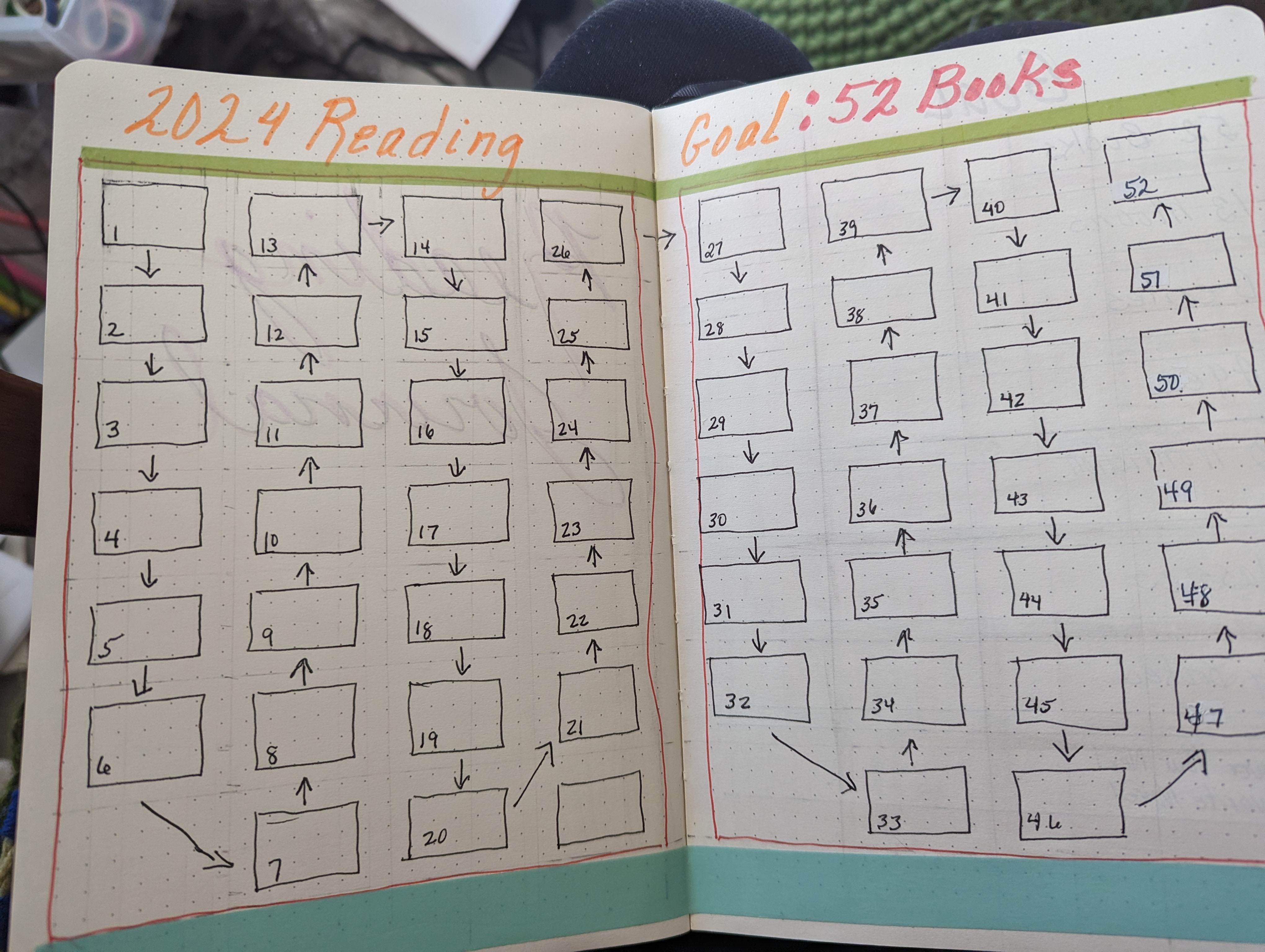
My daughter-in-law is a voracious reader! I thought I was one, but she has me beat! Her reading goal for this year is 100 books. I set a modest goal of 52, at least one book a week. So far, I’ve read two–both on my iPad Kindle app, and both historical novels set in the 19th century. Oh, and both mysteries rather than romances. I started the January Book of the Month selection, The Fury, set in modern times on an isolated island in the Aegean Sea, cut off from the mainland and accessible by boat only. There is a murder. I suppose, even though the murder occurs outside in the garden, it is a “locked-room” mystery since the only suspects are those who are visiting the privately owned island. The owner is a sort of reclusive movie star. I’m just a few chapters in, though, so there will be no spoilers. I don’t know even know who the victim is, only that he has been murdered! So far, even the narrator is unnamed.
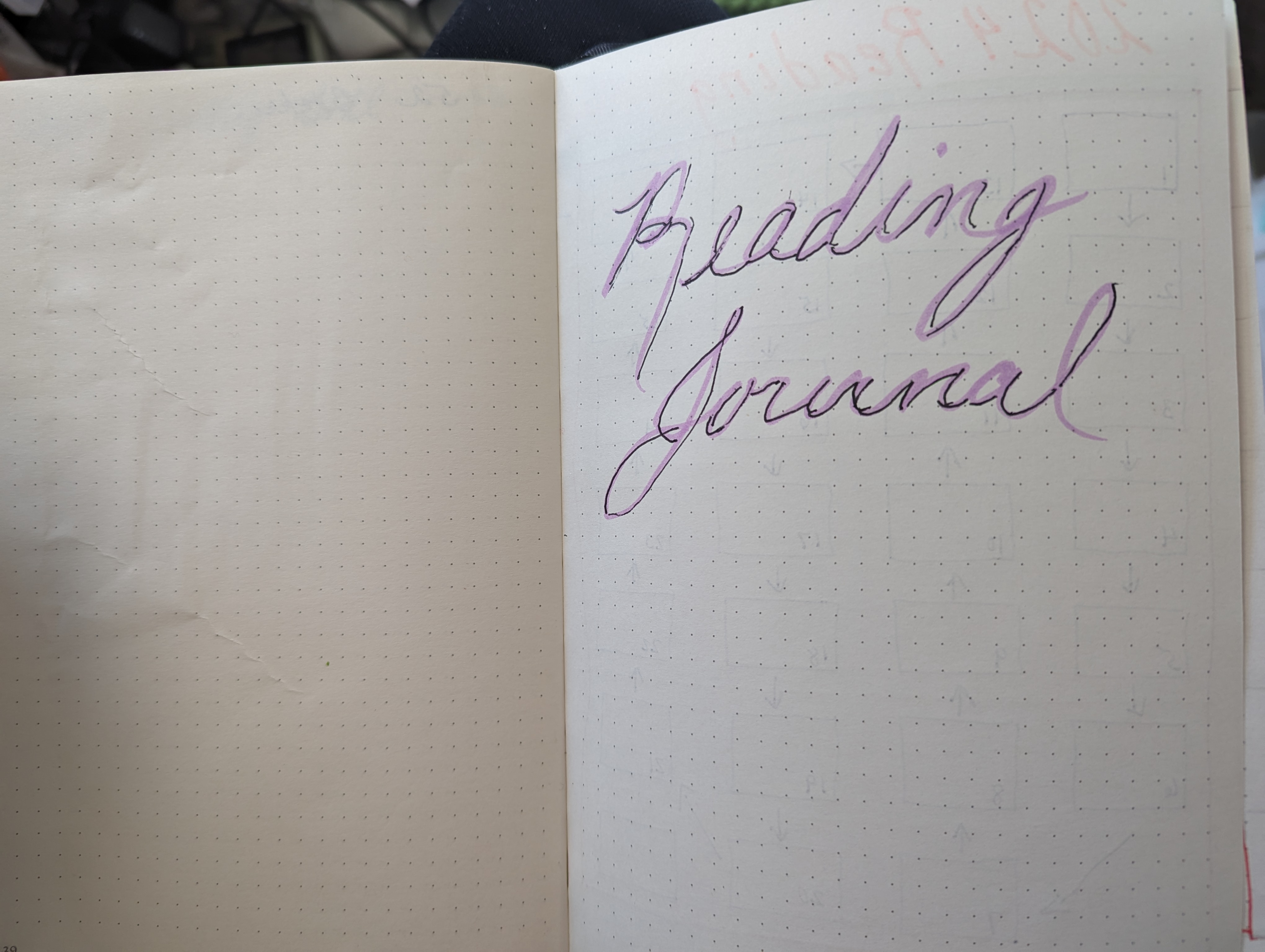
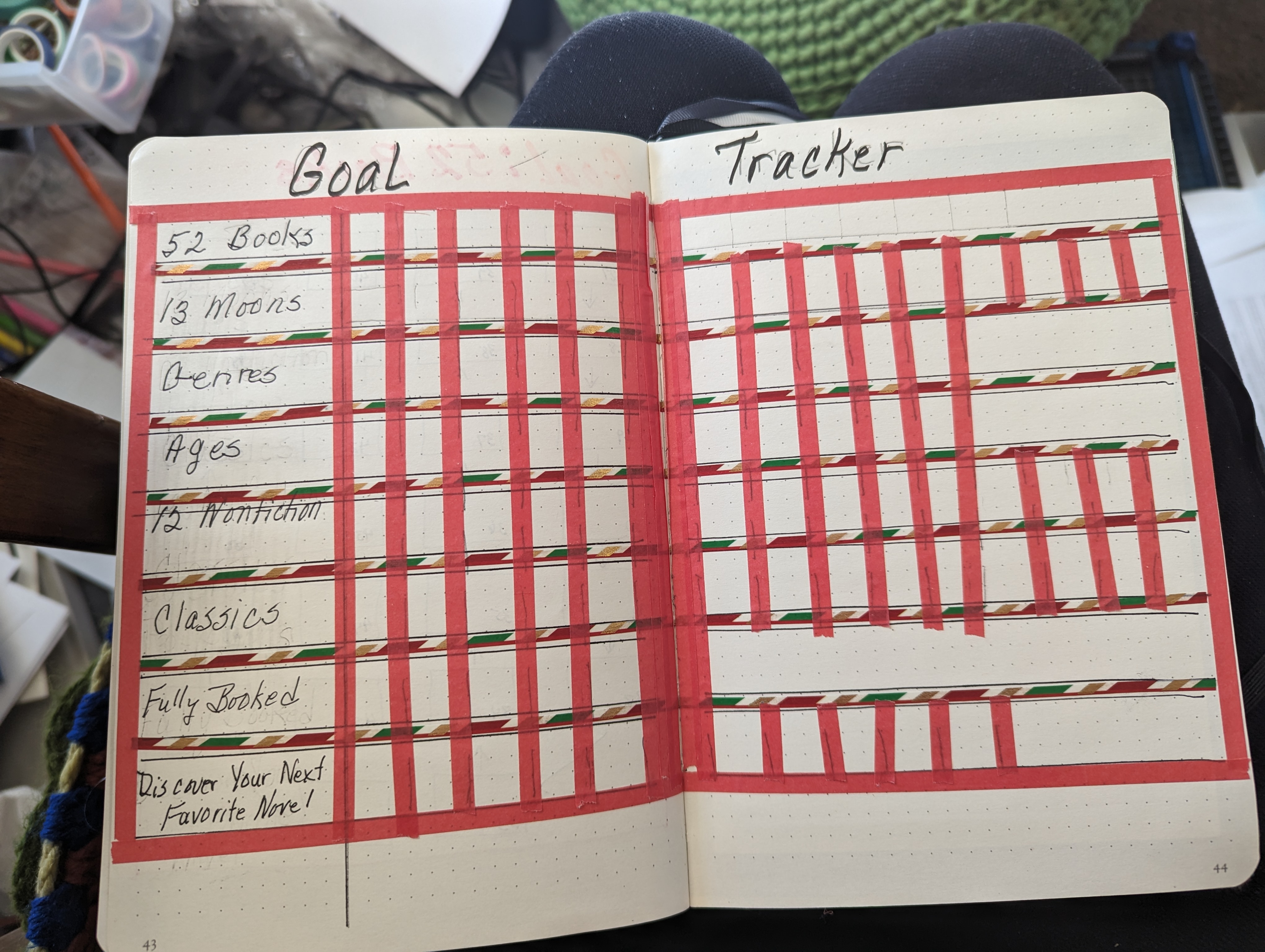
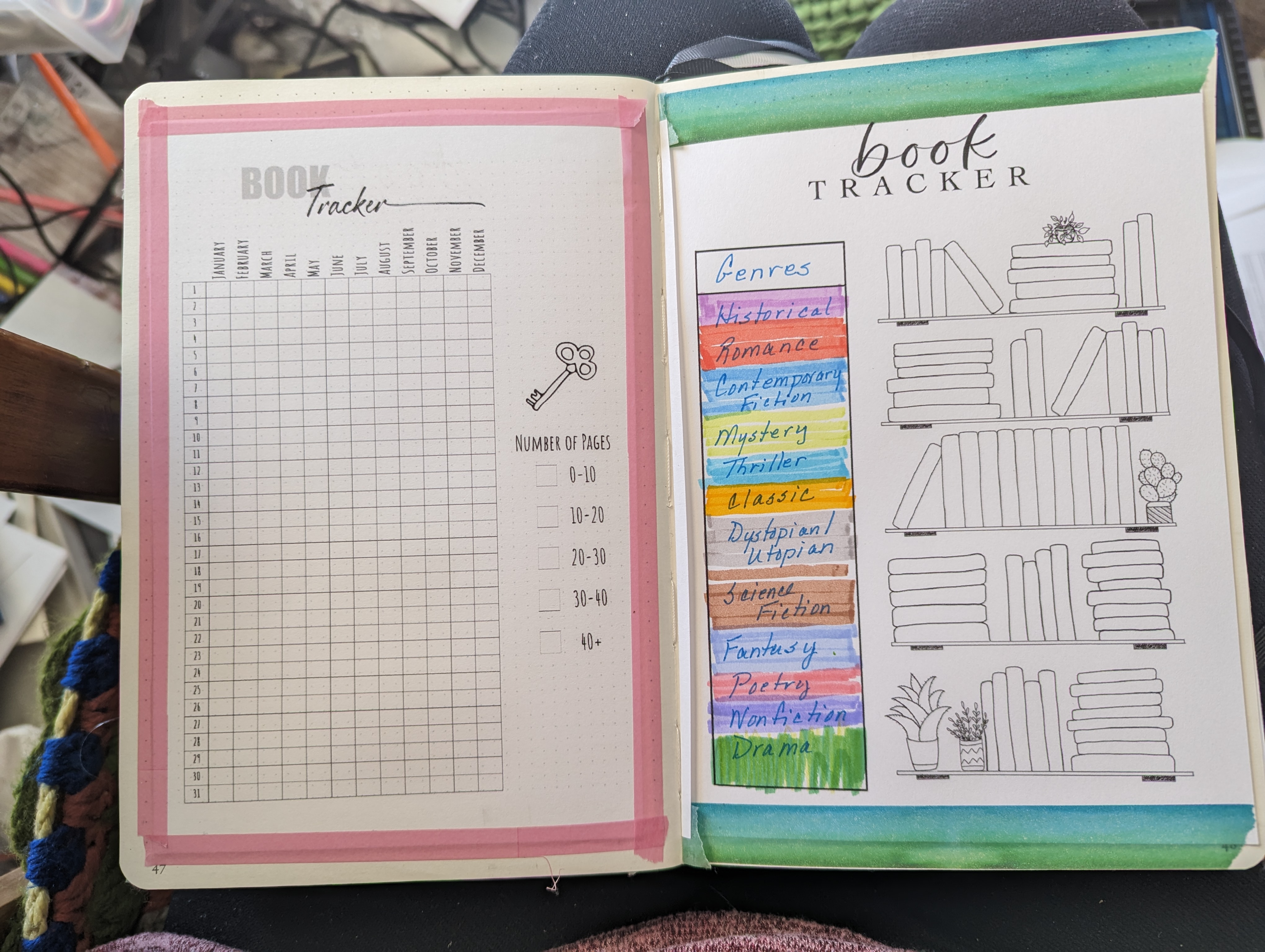
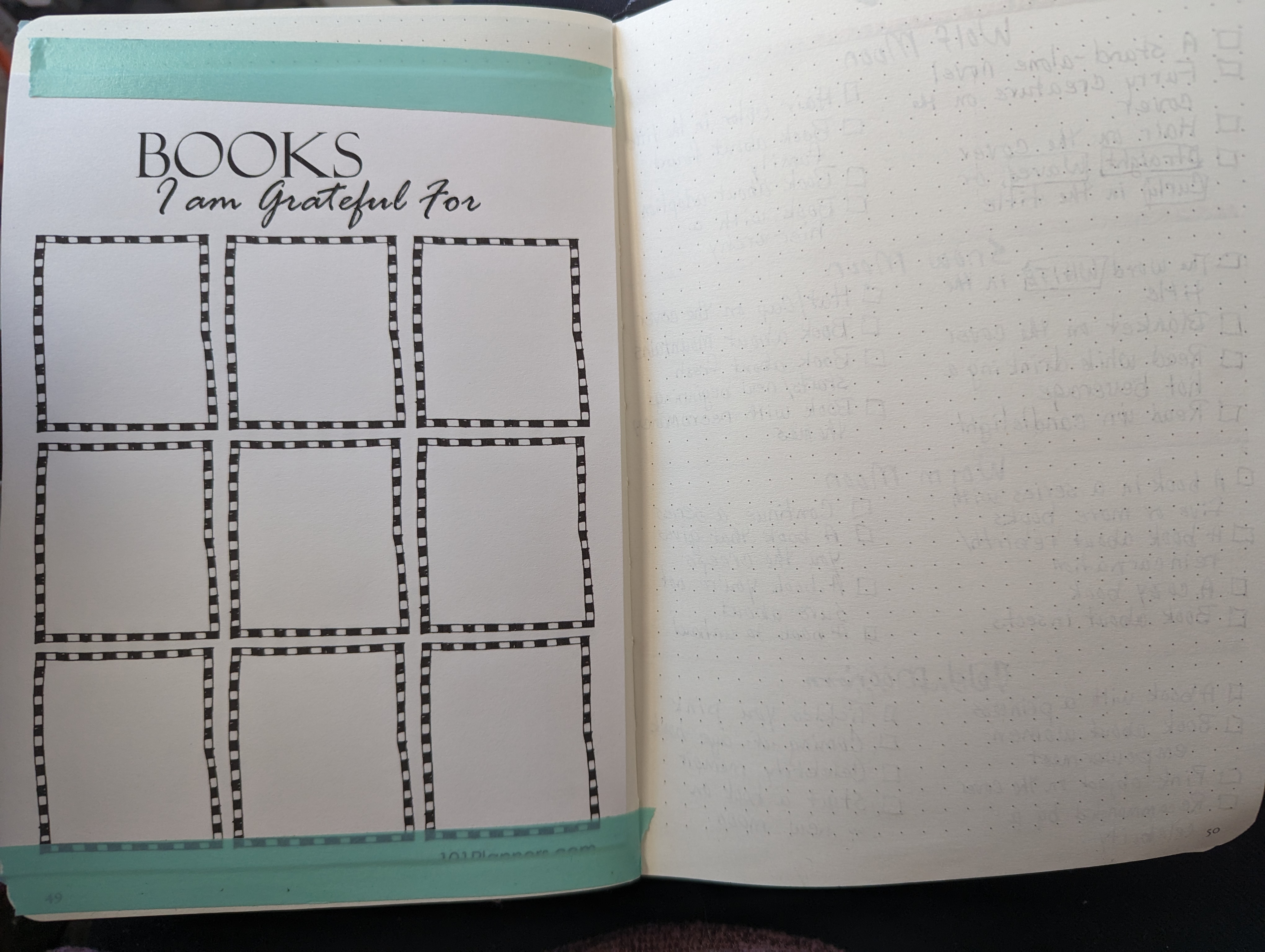
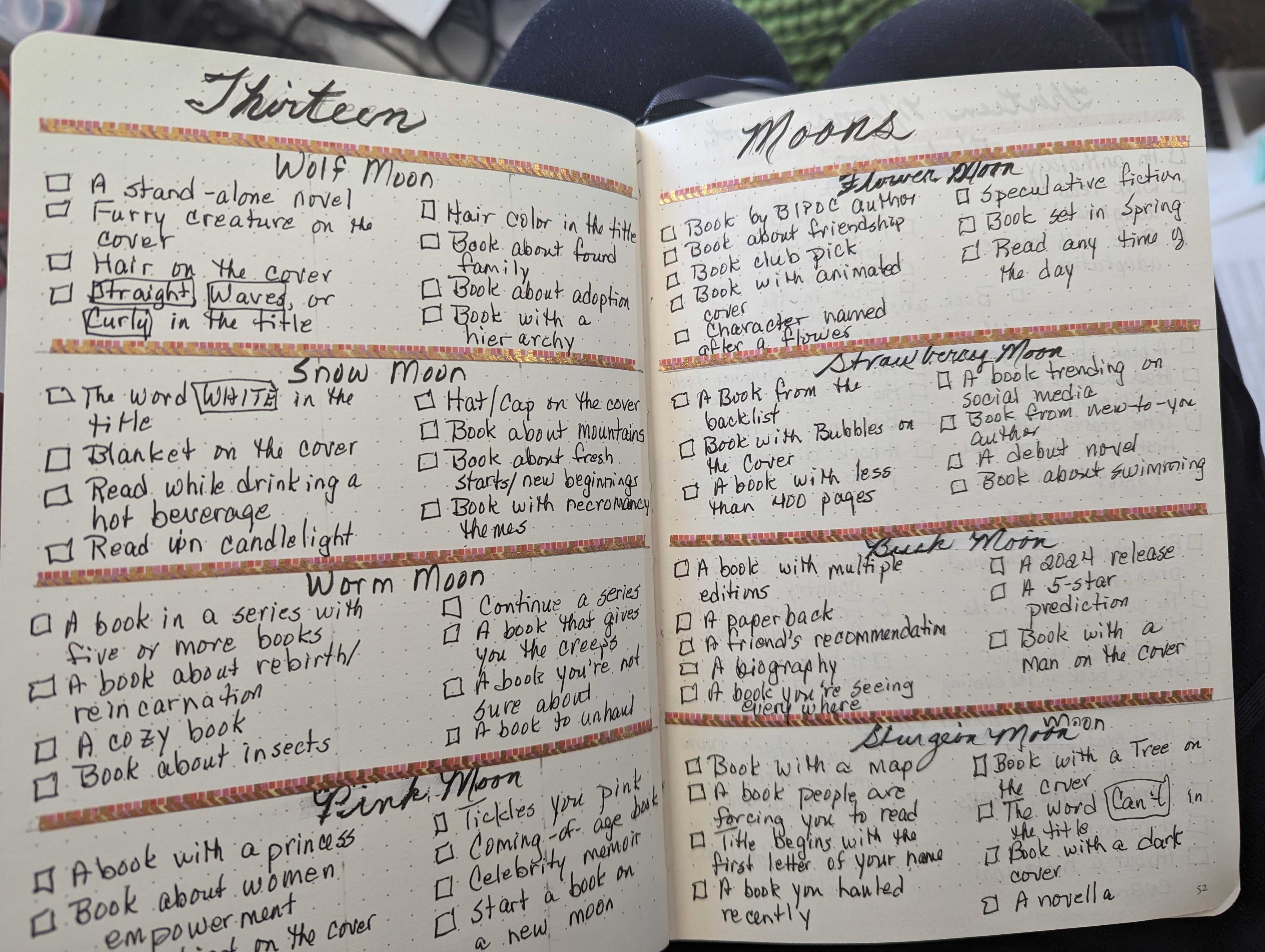
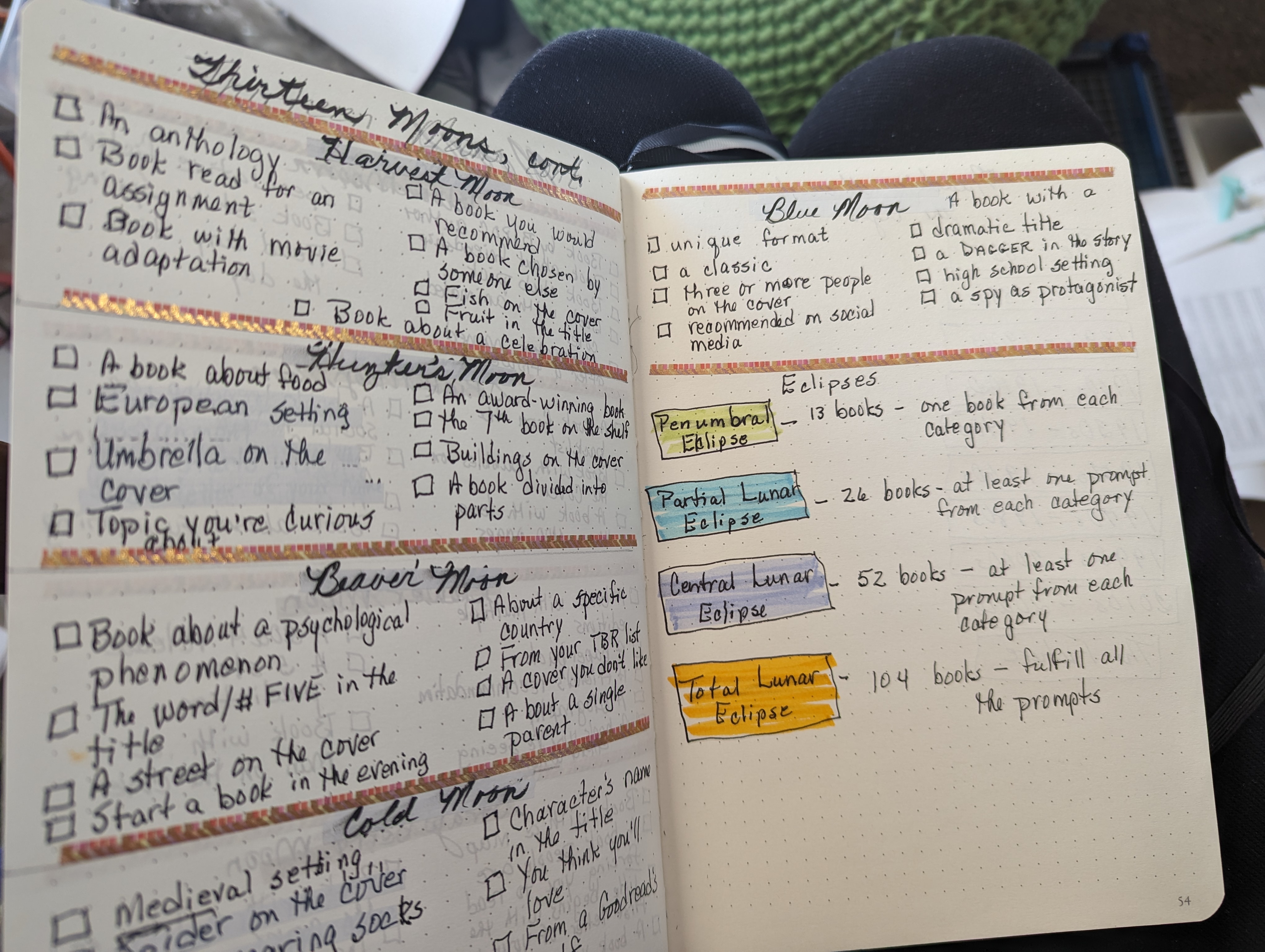
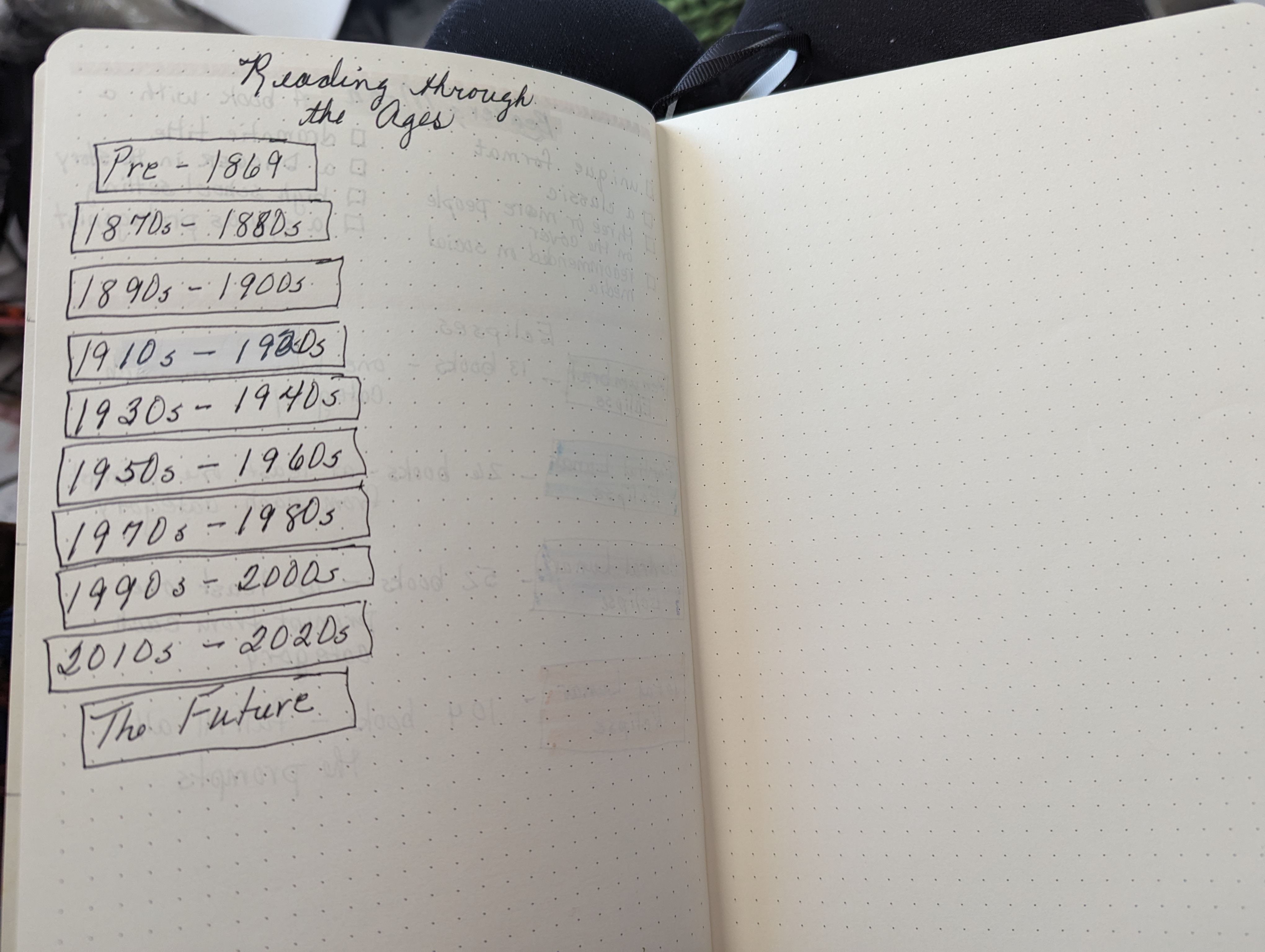
Sherry inspired me to create a book journal/book log to track my reading. I haven’t finished it yet; somehow, it keeps growing. My pages include the following:
a title page, which isn’t complete yet
a numbered grid to track my reading goal of completing 52 books this year
A goal tracker with includes some reading challenges for the year
a pretty bookshelf tracker (color-coded according to genre)
a pages read tracker and a genre tracker
“books I’m grateful for”–I want to add some books I’ve read before I began this journal, but I’m not sure about that. I’m thinking of printing off small book covers to put on this page of those books.
The Thirteen Moons Reading Challenge
Reading through the Ages Challenge
Book of the Month tracker
Reading the Classics Challenge
The Thoughtful Reading Challenge
Discover Your Next Favorite Novel Challenge with specific reading suggestions
I haven’t finished the last four spreads. On the occasional blank pages, I’m going to add some quotes about books and reading.
I plan to add a page for nonfiction as soon as I figure out what I want to do. My goal is to read twelve nonfiction books this year. (I have three or four already sitting on my TBR pile.)
So, here are my reading goals for the year. It’s going to be fun to see if I can meet that goal!







 Telling Stories