
October is “Spooky Month,” and this month’s reading includes its share of spooky reads.
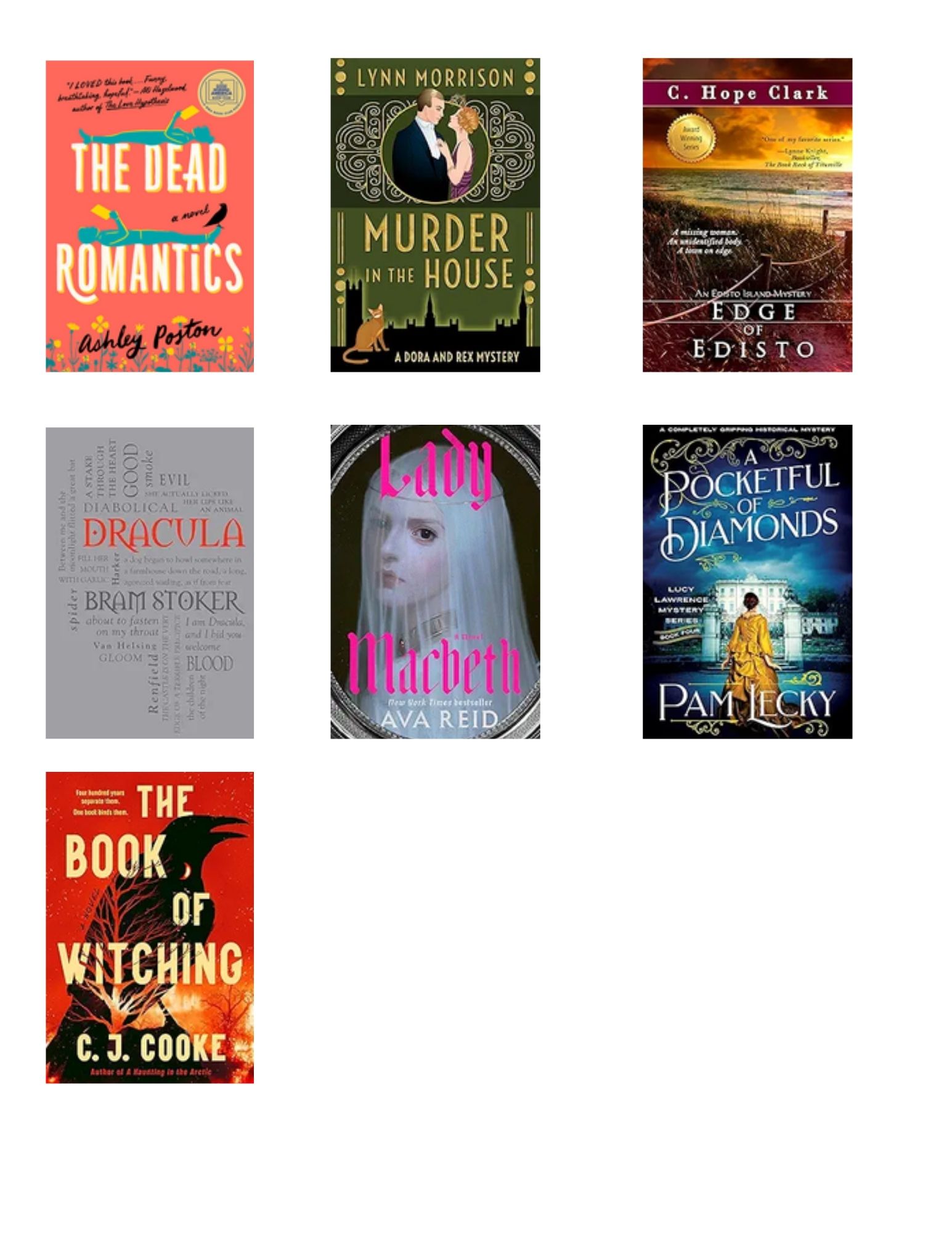
The Dead Romantics is a fun rom-com featuring a ghost writer haunted by her almost dead editor. Florence Day has the job of ghost writing for a popular romance author, but lately Florence hasn’t been much in the mood to write the typical romance novel with true love and happy endings after her break-up with her boyfriend. And to make matters worse, her father died, and she returns to her home in South Carolina. Oh, Florence also sees dead people. While she is home for the funeral, she is haunted by her new editor and falls in love with him. I enjoyed this novel. It is a light read.
Murder in the House by Lynn Morrison is the latest in the Dora and Rex mystery series. Dora and Rex assist their friend Clark Kenworth, Lord Rivers, investigate the death of the clerk for the Labor Party leader in the House of Lords of the British Parliament. Clark, a recurring character in the series, takes the lead in this book. I enjoy reading historical novels because I do learn about the history of the time and place of the setting. In this book, set between the two world wars, the conflict between the Communist Party and the Labor Party–and the growing threat of Hitler and the Nazi Party–form the backdrop. I enjoyed seeing how Clark is maturing as he takes on his role in the House of Lords.
Edge of Edisto is the last book in the Edisto mysteries by C. Hope Clark. In this novel, Callie has two cases to solve–a missing person case and a murder that at first seem unrelated. She also discovers a secret that the island community of Edisto Beach has kept for thirty years. Callie is coming into her own at last in this novel, and I think it is one of the better ones in the series for that.
An October reading list cannot go without including the classic Dracula by Bram Stoker. Horror is not my genre, but I have read and reread Dracula, both for my own “pleasure” and as a class novel in my English IV classes. I decided to reread Dracula after watching an episode of the Murdoch Mysteries in which Margaret Brakenreid reads the novel for her book club and comes away with the idea that it is about redemption. And it is, to some extent. What I noticed more this time as I read was the interplay of science, faith, religion, and superstition, especially in the character of Van Helsing. Of course, I also noticed the theme of “the New Woman” in the portrayal of both Lucy and Mina.
The Book of Witching by C. J. Cook could also fall into the horror category, but it is not the frightening kind of horror. When Erin goes on a three-week camping trip with her boyfriend and her best friend, no one expects that one will die, another go missing, and Erin end up in the hospital with third and fourth-degree burns–and that Erin will insist that she be called Nyx. Her mother then investigates to discover the cause of her daughter’s trauma. What I enjoyed about this novel was the dual time period narrative: the story of Alison Balfour, the first woman to executed for witchcraft in the Orkneys in 1594, and Clem’s determination to find out what happened to her daughter. The ending of the novel, which ties the two time periods and characters together, is satisfying.
A Pocketful of Diamonds by Pam Lechy is a historical mystery set at the end of the nineteenth century. Lucy Lawrence and Phineas Stone’s honeymoon in Paris is interrupted when Phin’s sister sends them a telegraph asking them to come to Lake Como to search for her missing husband. Murder and intrigue take the newlyweds into the criminal element of the Lake Como district and Milan. Of course, they do solve the case, but not before Ludy is kidnapped and Phineas targeted for assassination himself. This book feels like it could be the end of the Lucy Lawrence series, though.
Lady Macbeth by Ava Reid is NOT your English teacher’s version of the Macbeth story. Told from Lady Macbeth’s point of view, the protagonist Roscille is Macbeth’s second wife. Growing up, she was considered “otherworldly” or touched by a witch with her silver hair and strange eyes that were said to bewitch men. As a result, she always wore a veil so that men did not have to look into her eyes. At one point in the novel, Macbeth tells her that she will be the dagger in his hand. Macbeth is portrayed as almost larger than life–a large man with an even larger ambition to be “King Hereafter,” and he will do just about anything to ensure that he not only gets the throne of Scotland but keeps it, even if it means locking his own wife in the dungeon. Reid does take the traditional prophecies for Macbeth from Shakespeare’s play, but she turns everything on its ear. In addition to the witches, there are a few other fantastical beasts. Reid combines history and fantasy in this story of Lady Macbeth.
The next book on my reading list is The Stone Witch of Florence, another historical fantasy (is that a genre?) set in Florence, Italy, during the time of the Black Death. I am looking forward to reading it.
 Telling Stories