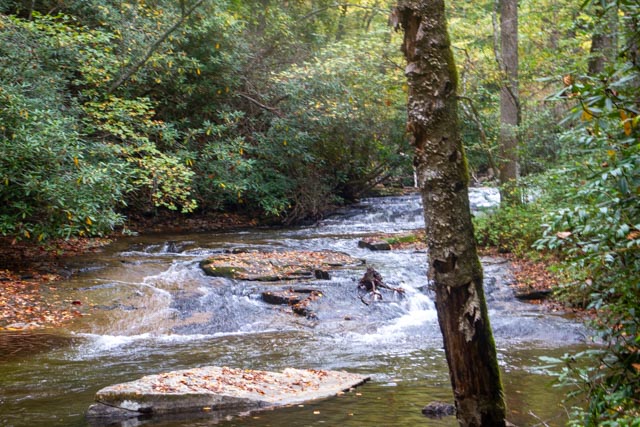
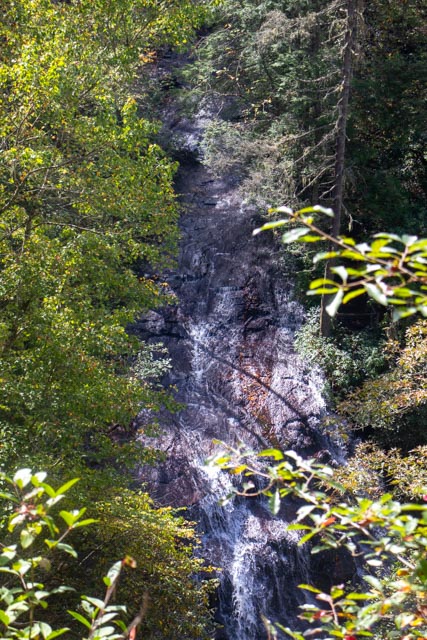
Yesterday was an interesting day. Grady and I went to the mountains of North Carolina for the day. Our first objective was to get apples from Granddad’s Apples. My personal objective was to visit as many waterfalls as we could fit into the day that did not require a strenuous or long walk. We went to Looking Glass Falls on Highway 276 and Connestee Falls.
A serene view of Looking Glass Falls surrounded by lush greenery in North Carolina.A scenic view of a waterfall cascading down the rocky terrain, surrounded by lush greenery in the North Carolina mountains. (Connestee Falls)
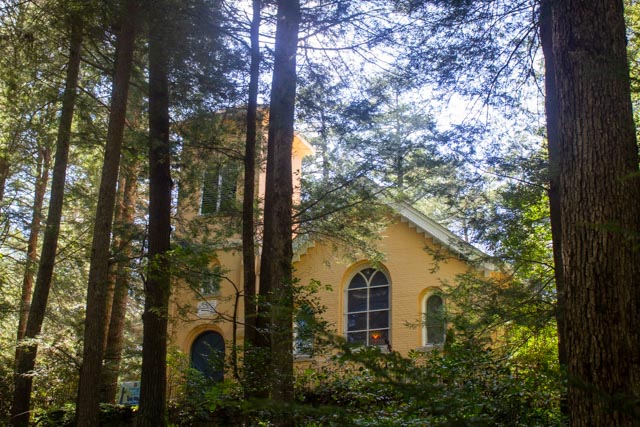
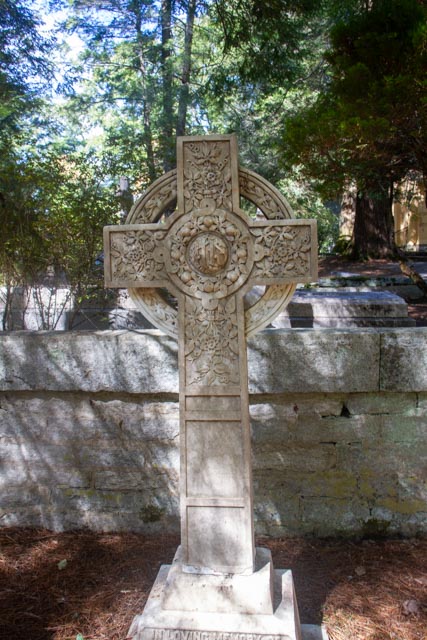
We also made a stop by St. John in the Wilderness Episcopal Church in Flat Rock. I spent about an hour walking through the cemetery (while Grady took a nap).
St. John in the Wilderness Episcopal Church surrounded by lush trees in Flat Rock, NC.
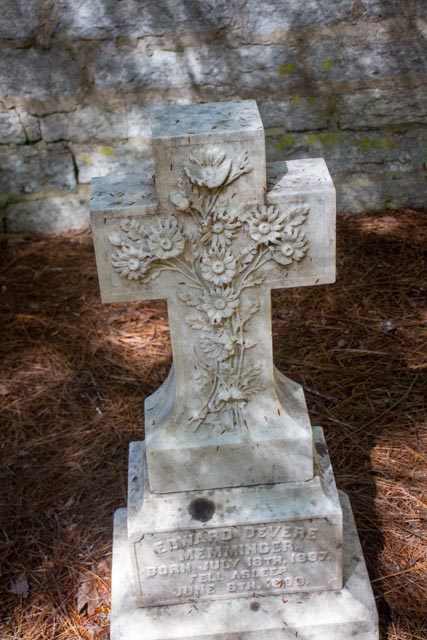
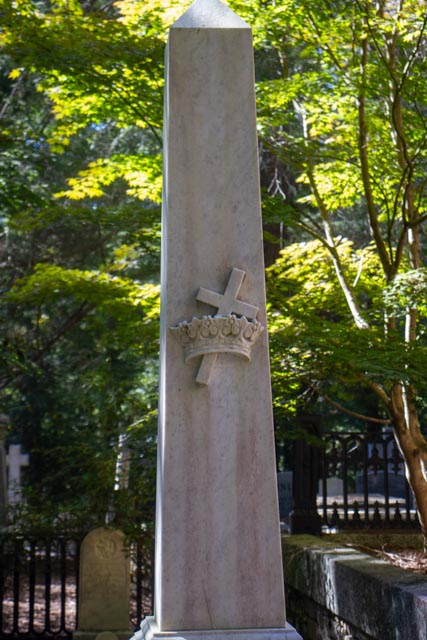
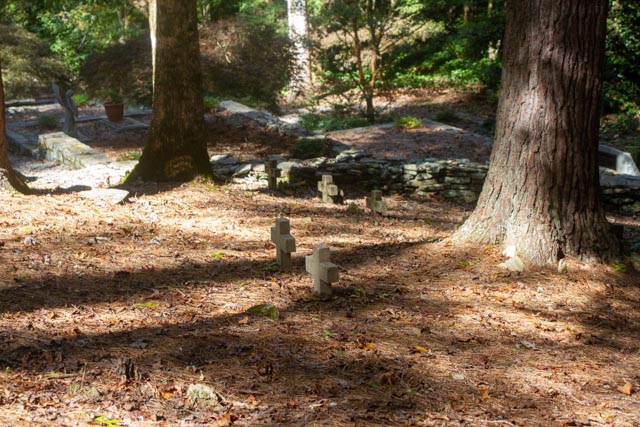
Stone is so permanent. The rocks along the falls and creeks have been there for millennia. These mountains will be here for even more millennia. Stone is lasting. In the cemetery, the stones have stood for almost two centuries, granite and marble monuments keeping those buried there in a kind of immortality. Yet, I was jolted when I found a plot with simple concrete crosses and field stones used as markers. Those interred under those markers were “known only to God.” They were the slaves and freedmen and their families who were members of the congregation. I am still sorting out what that means. How many people have been forgotten? Who will tell their stories?
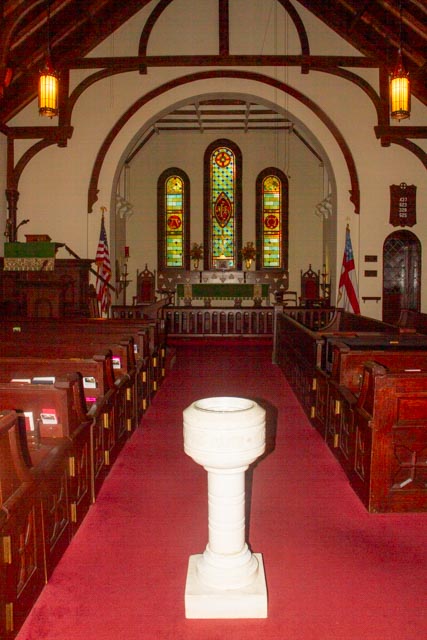
Water is one of the essentials of life. While at St. John in the Wilderness, I went into the sanctuary. The baptismal font is in the middle of the central aisle and filled with water. I dipped my fingers into that holy water and made the sign of the cross on my forehead, remembering my own baptism (or rather remembering that I was baptized as an infant). I stood there in silence.
The waterfalls, the creek bank, the cemetery, and the sanctuary–these are holy places. There are stories to be told in each place, places of remembrance, and ultimately grace.
This morning, I woke up earlier than usual because the HVAC technician was coming to inspect the AC system in our home. I opened Facebook to read a reflection on September 11. That put me in mind of the Allan Jackson song, “Where Were You (When the World Stopped Turning)?”
Twenty-four years ago, I was in my Newberry High School classroom, room 102, getting ready for a full day of classes. During the first period, we watched the news on TV (was it Channel One?) and moved into the lesson. It was an ordinary day. I don’t remember whether we had moved to alternate-day block scheduling yet. I don’t even remember what English course I was teaching during that first period. The second period began with a room of twelve tenth-grade boys. English II. The lesson started (who knows what I was teaching that day!), but around 9:30, the English department chair interrupted and told me to turn on the TV. I did, and we watched–in horror and shock–as the second plane hit the World Trade Center tower, as the Twin Towers crumpled to the ground. One of the boys, leaning forward on his elbows on his desk, breathed, “Man, that was cool.” After a second student chastized him, he explained, “It’s like seeing something you would see in a movie. I won’t forget that moment, or that exchange.
September 11, 2001, is my JFK moment. Allan Jackson wrote, “Where were you when the world stopped turning?” In my classroom with those tenth-grade boys, perched on my stool. Literature, grammar, writing, reading–for the rest of the day, none of these were important. No one cared about state standards, PET evaluations, lesson plans, or anything else related to “school.” We weren’t prepared for this. I grew up during the Vietnam and Civil Rights Eras. I watched the war play out on TV every night with Chet Huntley and David Brinkley on the Six O’clock News on WIS-TV, the local NBC affiliate. And I heard about the Irish Republican Army’s attacks on England as Northern Ireland sought their independence from England. Terrorism was something that happened overseas in other countries; it couldn’t happen here in America. Oh, there were riots here in America as protests against the war and for civil rights turned violent, but these weren’t acts of terrorism.’
But on 9/11/2001, something changed. The United States became a target for terrorists. First, it was the Twin Towers of the World Trade Center, then the Pentagon, and finally a field in Pennsylvania, where American passengers on a flight headed toward Washington crashed the plane so that it would not strike the third target–the White House. “No greater love has any man than to lay down his life for another.” (That’s not the exact quote, but you get the gist.)
We thought 9/11 brought Americans together, unified us as “one nation… indivisible”. Today, the world has stopped turning for different reasons. We are no longer united in one purpose. Sometimes, I think we look for reasons for division–race, creed, nationality, color, sexual orientation, political ideology–the list is endless. We may put “All Are Welcome” on our churches’ signs, but what we really mean is “All who think and believe like I do are welcome here.” We may live in a world more connected than ever by our cell phones and apps and by social media, but in many ways, we are more separated and isolated individually than every before.
Where were you when the world stopped turning? I’m not sure the world has started turning again.
Allan Jackson ends his song with the reminder from 1 Corinthians 13 that we have been given three gifts, faith, hope, and love, but the greatest of these gifts is love. I want a world where love is our greatest gift to each other.
Yesterday, I opened an email from a Substacker (The Art of Noticing) about the National Writing Project’s (NWP) annual Write Out event. Begun in 2018 in partnership with the National Park Service (NPS), the event encourages anyone to spend time outdoors observing nature and then writing about those observations. Educators, writers, and park service personnel offer prompts for all ages, children and adults alike.
I’ve been interested in the idea of place-based writing. It’s an idea that has nagged at me for quite some time, but I haven’t pursued it. This may be the year to pursue it actively. I am working on an idea of combining my Kinship exploration of the four elements of earth, air, fire, and water through photography with writing. A prompt from last year’s Write Out comes from Poet Laureate Amy Limon: What would you write in response to the landscape around you?
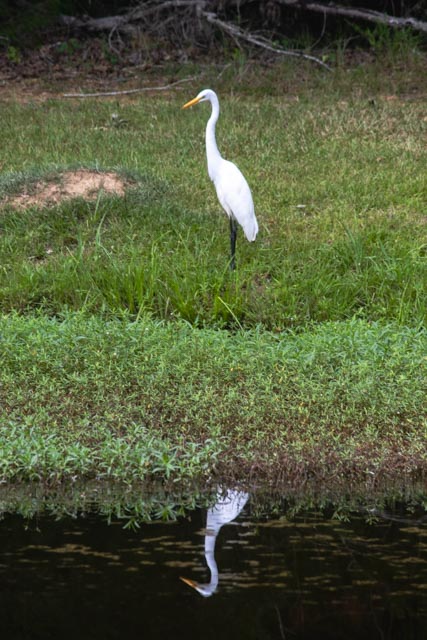
This is not actually a “landscape” photograph. It’s really more a “portrait” of the great egret that visits the edge of the pond in the backyard. I came home from a book club meeting to see this:
Such a beautiful and graceful bird. It stood statue-still on the bank of the pond for at least ten minutes, or perhaps longer. The egret stood perfectly still in the same spot even after I left the car and retrieved the camera with the zoom lens from inside. I was able to creep up to the edge of the pond on the opposite side to take several pictures.
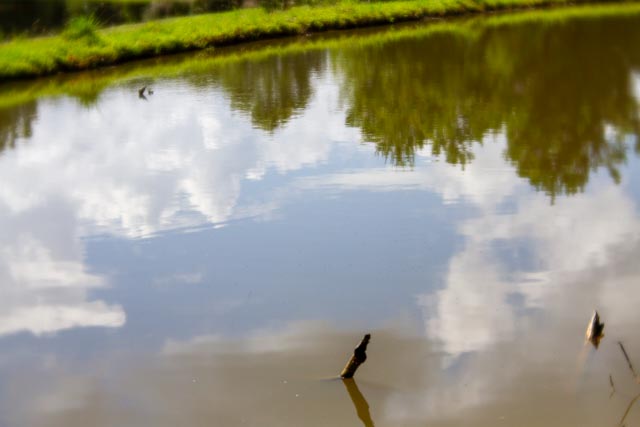
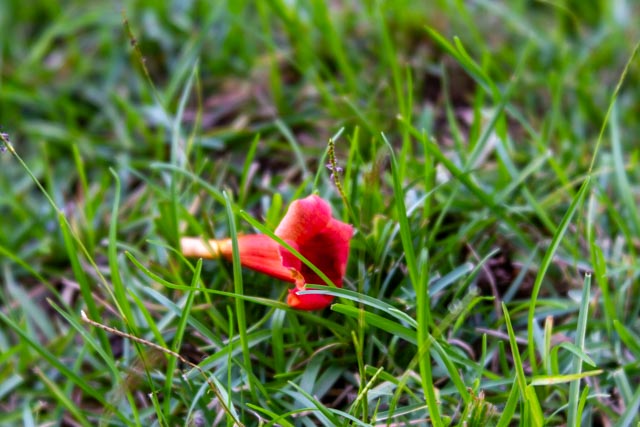
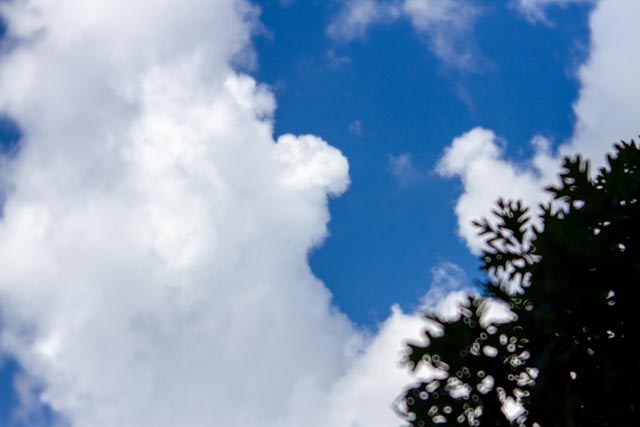
I am amazed by what I see in the landscape of that big two-acre pond (known to family as “The Big Pond”): turtles sunning themselves on the bank, fish darting through the weeds growing thickly in the shallow water at the edge of the pond, clouds reflected on the smooth surface. Clouds billow above. Deer creep out of the woods to drink from it and to eat the vegetation that grows there. Red trumpet flowers fall from the vines growing high in the treetops. Breezes ripple the water. Dragonflies dart from dandelion blossom to blossom. Cicadas and grasshoppers chirp, hidden away by the grasses, weeds, and wildflowers. Blackberries ripen to the darkest purple at the edge of the woods. White and yellow fleabane bloom as stars fallen to earth.
There is no shortage of beauty here.
If you’d like more information about the NWP/NPS annual Write Out, visit the NWPWrite Out page . Resources from past years are available.
I haven’t always given much thought to the four elements of earth, air, fire, and water, but the Kinship Photography Collective’s Call to Engagement has made me think. I’ve written some about it in my journal(s)–yes, I am one of those people who keep multiple notebooks and journals. I’ve decided that I’m going to make this engagement my year-long photography project and use the elements as a framework to explore my relationship to land, family-owned land in particular, but also shared, public land as well.
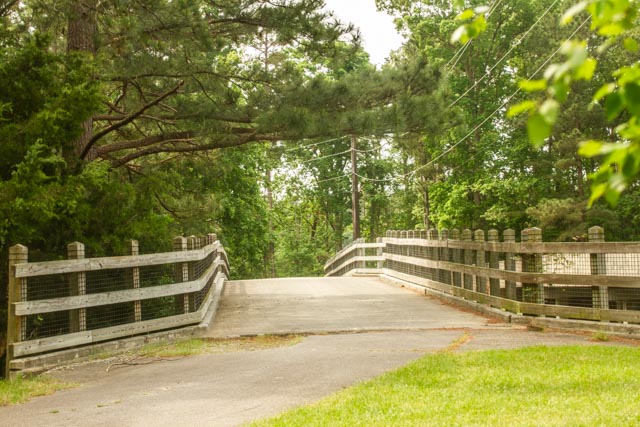
Dreher Island State Park (the original bridge)
Right now, two questions are kind of guiding me:
How do my images fit with my exploration of relationship to the land, both family-owned (generational) land as well as more public, shared land (i.e., public parks, state/national parks, etc.)?
How does being aware of the four elements of earth, air, fire, and water relate to that relationship between humans and land?
These questions relate to the notion of “sense of place.” We live in such a mobile society. Some people seem to move frequently and never establish “roots” in any one place. Other people live on land or in places that have been passed down from parents to children for generations. There is a connection one has makes that generational land feel like part of the family, and separation from it is difficult. I’m wondering if that feeling extends to the environs, the other bits of land that surround us. I hear people say, “I can’t imagine living anywhere else.” What makes us feel that kind of attachment?
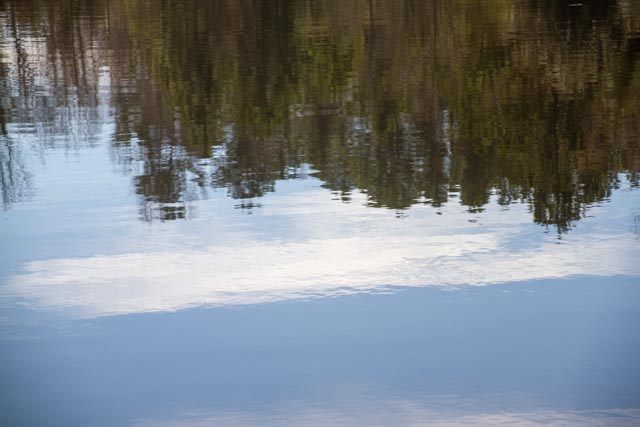
Air and water: clouds reflected on the pond behind the house
I live in a rural area. I grew up on a working farm; my parents were subsistence farmers. We lived on “the hill,” which meant, in part, that we couldn’t see the neighbors’ houses, even though they were in shouting distance away. Our house was surrounded on three sides by pasture land and woods. That pasture supported a half dozen head of cattle and four or five horses at any given time. The barnyard held pens for the three or four hogs Daddy grew out for butchers, the meat destined for our freezer, and his hunting dogs. We had a garden that provided the vegetables that fed us through the winter. I can’t tell you the number of days my sister, brother, mother, and I spent shelling butterbeans and peas and stringing beans to freeze, shucking and freezing ears of corn (both on the cob and cut off the cob), peeling and canning tomatoes, and making jelly. Some days it was so hot in the kitchen that we had two fans going–a box fan at the door to the family room to bring in some cooler air, and an oscillating fan to circulate the air in the kitchen. (We did not have central air conditioning.)
I still live in a rural area, but without a pasture or garden. My meat and vegetables come from the grocery store, prepared by hands unknown. In many ways, that has changed my relationship to the land. I am not dependent on it for survival or sustenance as I once was. Of course, intellectually, I know that someone else is depending on the land where my food comes from, and they depend on the land for survival and sustenance.
Still, the land does sustain me; it grounds me in both the physical sense and the metaphorical sense. It gives me a feeling of spaciousness. I can stretch my arms out and not touch anything; I can move about freely. I can breathe (mostly) clean air. I can hear the sounds of nature–birds, insects, rustling leaves, skittering animals–even with the sometimes constant sound of the traffic on the road in front of the house (almost nonstop this morning–where are all these people going?)
This year, as I explore the “elementals,” as I begin with the focus on air, I realize I cannot separate one from the other. Without air, there would be no water, fire, or earth. We cannot exist without breathing and respiration. Fire cannot burn without the oxygen in the air. Vegetation cleanses the air of carbon dioxide and replaces oxygen. Each element is necessary for life.
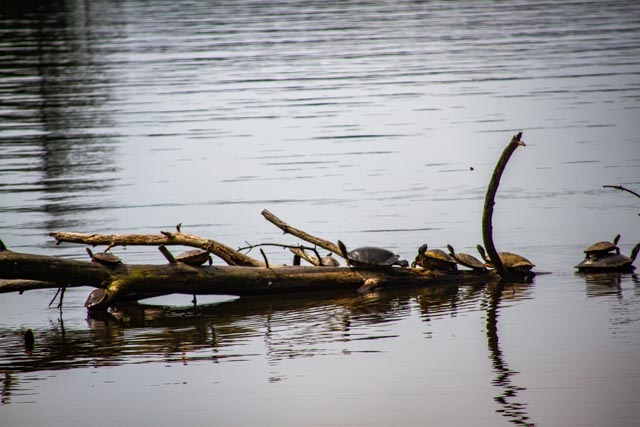
Turtles on the log at Dreher Island State Park
Now, the problem to solve is how to document these ideas into images.
Well, so much for the April 30-day A to Z challenge. The weekend was busy: Holy Week services at church, preparation for the Easter Sunrise worship, and a family dinner kept me busy, and blogging was not a high priority. I’m not even going to try to play catch-up. I’ll just do the best I can.
Today is Earth Day. I went for a walk this morning in a local state park. It was warm and humid. A friend called the humidity we had this morning “air you can wear.” I think some storms are coming in the forecast. I haven’t been in the park since Hurricane Helene blew through last September. The park had closed for several weeks while crews cleaned up the debris and cleared the roads around the campgrounds. There were lots of downed trees along the side of the road through the park.
My walk was a mile and three-quarters and took just about an hour. I make 59 images. And, no, I did not stop every minute to take a picture, even though the number of images and the time suggest that I took a photo a minute. The turtles were out sunning themselves on the fallen logs in the shallow waters, and there were yellow irises blooming at the water’s edge in several places around the loop. There were also lots of folks biking, walking, and fishing. It’s a busy place! And it’s a place of beauty and peace.
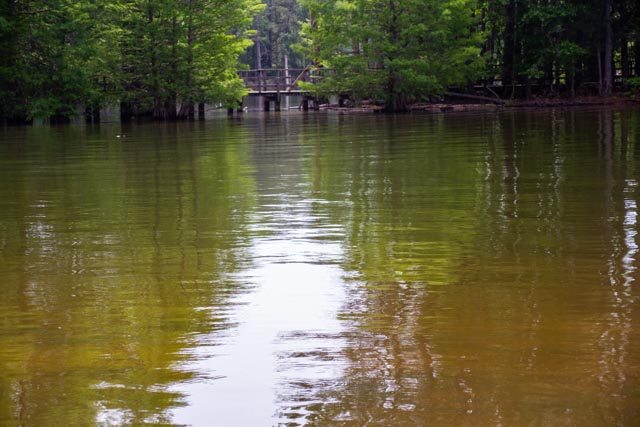
The Kinship Photography Collective is beginning a year-long exploration of the four elements of earth, air, fire, and water, beginning with the element air. It was still this morning, although there were some ripples on the water. There is an openness over the lake, space to gaze, and space to breathe. Sunlight created trails on the water for the eye to follow. It is likely to be the “calm before the storm.”
This Earth Day, which follows Easter Sunday, I am reminded of the Resurrection and new life. Last September, a storm blew through to damage the island, but this spring, it has come to life. I have never seen the irises before, but I’m sure they must have been there. The turtles are out. Birds hopped away; squirrels ran off and scurried up the trees. There was plenty of life in the park this morning. It is renewing itself daily.
Tough letter: enthusiasm, engagement, excitement, electric/electricity? All of the above?
What am I enthusiastic about these days? What makes me excited? Well, one thing is visiting my grandson (tomorrow!). He is at that age when everything is new to him. He will be four years old in October. I can tell you that he is full of energy. I know he will be going nonstop during our visit.
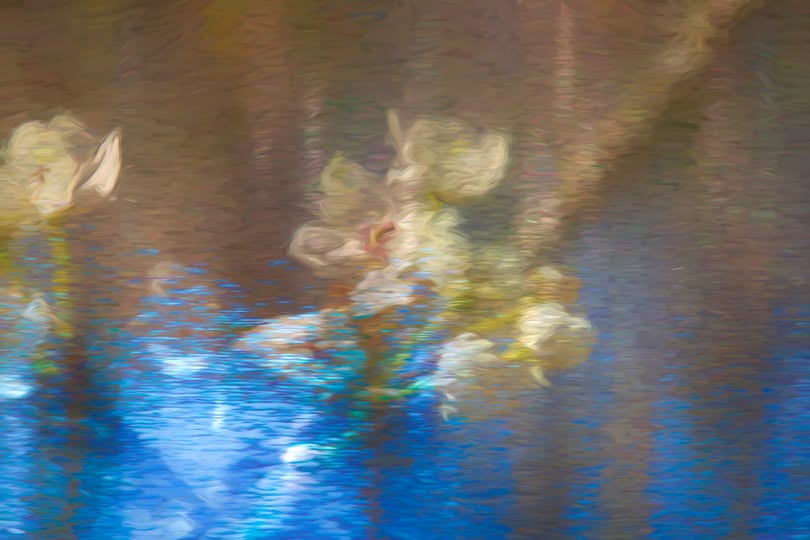
I am looking forward to some new photography classes through the Kinship Collective. I haven’t been as active in the collective since the first part of the year, but I am looking forward to renewing my love for creating photographic art. I have been participating in the Year of Creative Photography classes since January, and this month’s theme of impressionism has really captured my Interest. I’m working on the more “artistic” elements in post-processing. I have a lot to learn. I created this image last night:
This class reminded me that “way back when”, I purchased some presets/plug-ins from Topaz Labs. I resurrected those, reinstalled them, and played with them this month. I had fun!
E is also for EXPLORE, and EXPLORE is my word for this year. I have done a little exploring—mostly in terms of photography and a lot in reading. I’m exploring new ways of recording my “life” in art and in writing. I have to work on my One Word album. I’m a couple of months behind in recording. Now that the winter doldrums are passing, and the sap is rising, as the saying goes, I will get back into the work of exploring. I have two tools to encourage my explorations–kinds of adventure bucket lists, one for places to explore in South Carolina, and another for personal adventures. I haven’t opened either one except for a quick glimpse. It’s time to go for it!
So, excitement, enthusiasm, electricity, and explorations–all E-words to guide me.








 Telling Stories