C is for Communication

But I’d rather have the cookie (remember Cookie Monster’s song from Sesame Street?)

But for the sake of this year’s blog challenge, C is for communication and the many ways we communicate.

We use words, spoken and written. Perhaps the spoken words have the most impact because we hear them and often see the speaker behind them. We hear not only the words but the tone. Those words can be affirming or destroying. I’m sure you’ve heard of the “toothpaste lesson.” Once the toothpaste is out of the tube, it can’t be put back. Just so are the words we speak; once spoken, they can’t be called back, especially if they are hurtful words.

We also communicate through gestures. I often used the time out hand gesture when my classes got too rowdy or excited or when I simply needed to get them refocused on a new direction in the activity. Pointing can communicate a direction. Nodding can indicate approval or rejection of an idea or request. Our bodies communicate in a wide variety of gestures.

Facial expressions communicate. Expressions are related to gestures. A smile goes a long way in communicating acceptance, friendliness, affection, and love. The tight lips and “squinted” eyes communicate disapproval, dislike, rejection.

Then, there are the arts as communication. I was reading an article this morning about Picasso’s mural, Guernica, and the message it communicated about the destruction of the village by the Nazis (supposedly as a belated birthday gift to Hitler). The utter destruction of one village and deaths of so many innocent citizens shattered Picasso, and his painting communicated that. And communication is not just for the visual arts, but also for musical arts as well. My favorite Beethoven sonata, “The Moonlight,” communicates such a sense of peace and calm in the first movement.

I think all creatures have their ways of communicating, some profound and some not so profound, but communication makes all the difference.

Today, I will think about what I want to communicate to others in my actions and words. How can I communicate through my words and photography?

Blogging Challenge the April A-Z Challenge

Okay. I’m late to the party. That’s nothing new. I had forgotten about the A-Z Challenge until this morning as I wrote my almost daily morning pages. I say “almost daily” because I don’t always write on the weekends. My Monday to Friday routines are thrown off because my husband usually has the TV on before I emerge from the bedroom in the mornings. I have trouble concentrating on writing when the TV is on (but not so much when I’m listening to music).

So, on April 8, I will begin the A to Z challenge. This year’s theme is gratitude for the community, specifically the blogging community. I have a few folks who “like” my reading updates when I post them monthly. But I don’t really blog for an audience (though it’s nice to have readers!); I write for myself.

Today, the letter is A.

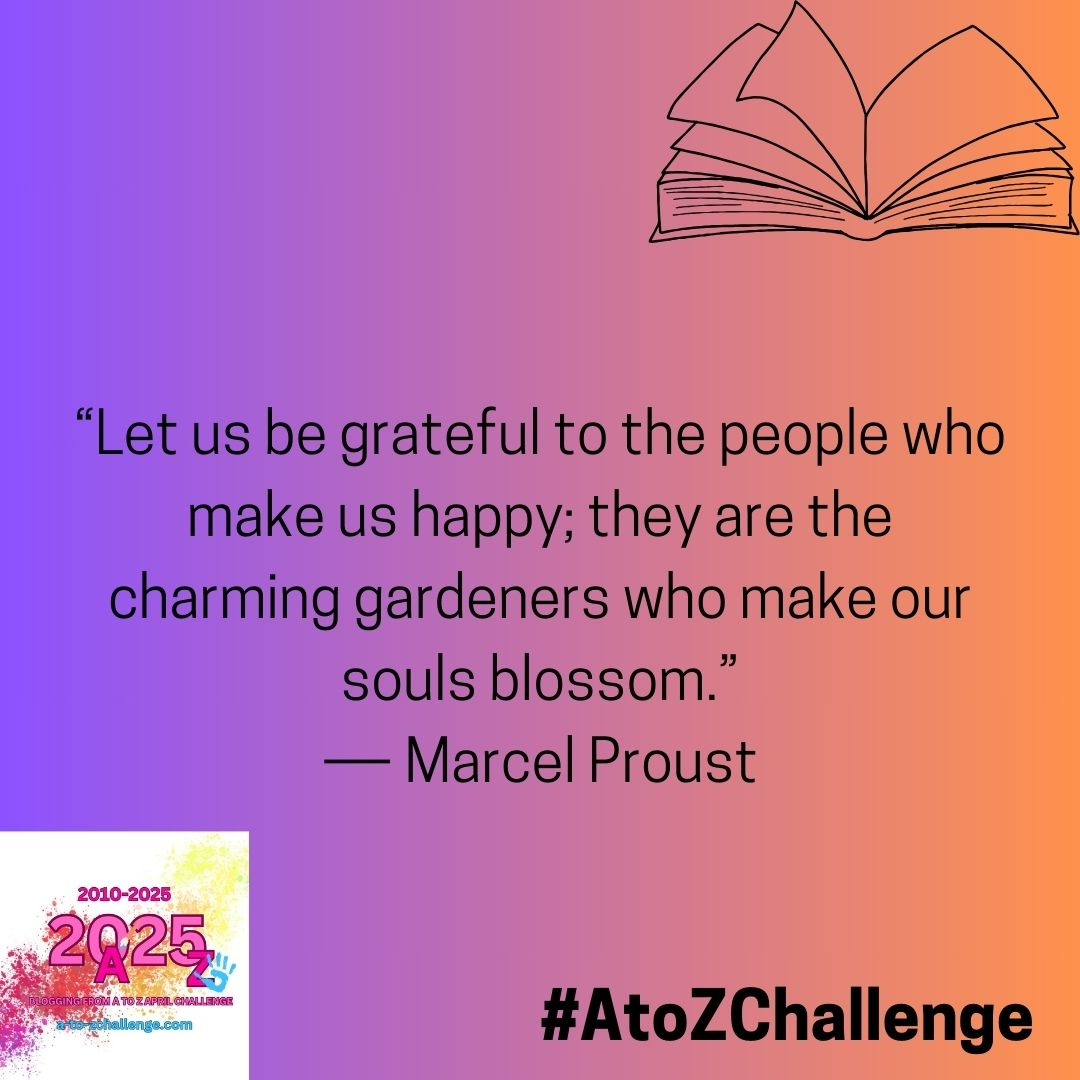
The quote for the first challenge day is a really good one, and to begin the April challenge, the focus is on the people who make us happy. I am grateful for some special people in my life. There is my husband of 41 years this June and our two adult sons. The older son is a musician and a middle school band director; the younger–the adrenalin junkie–is a full-time firefighter and EMT. I am proud of them. John always gives me something to think about and challenges my brain. Aaron makes me smile at his actions. Then there is my daughter-in-law, who makes me so proud that she is willing to stand up for the marginalized people in our society. And my grandson, Sully, just makes me smile! He is three years old (he turns four in October). He is almost always happy.

Last spring, I started a very small book club. These ladies are so special. We share a love of books and good conversation. Our little group ranges in age from 18 to 80+ (I’m not sure how old Ms. Biba is). I look forward to our monthly meetings at the local coffee shop. Isabelle, the 18-year-old, gives us so much joy in her enthusiasm for books and the way she just fits in with our group of women who are old enough to be her grandmothers!

Ms. Biba and Shana have been my support group over the last couple of months as our church goes through some changes that are not necessarily the “best,” if I am to be honest. They have had my back, as it were, when I feel afraid to speak my truth. I am so thankful for them. Shana makes me laugh with her zaniness.

And so the April challenge begins.

Spring Has Sprung–Almost

It has been a long winter. It’s been cold (even though some of the news articles I’ve seen have reported that the 2024-2025 winter has been warmer than usual); I have shivered and worn more layers than usual. Maybe it’s my age.

Regardless of the meteorological data, I am seeing signs of spring: the daffodils on the pond dam are blooming. The cherry, plum, and apple trees are in full bloom. A. E. Housman described the white cherry blossoms as “snow.” This is the kind of snow I like!

With spring comes the #100dayproject and the One Little Word month of developing a practice. I’m working on both of those this month. For the One Little Word practice for March, I have chosen to write “morning pages” a la Julia Cameron in The Artist’s Way: three pages first thing in the morning. I confess that I find Cameron’s practice a bit restrictive, so I modify it to suit me. Sometimes, I write three pages; sometimes not. Sometimes, I write later in the day. I don’t want my practice so restrictive that I don’t do it.

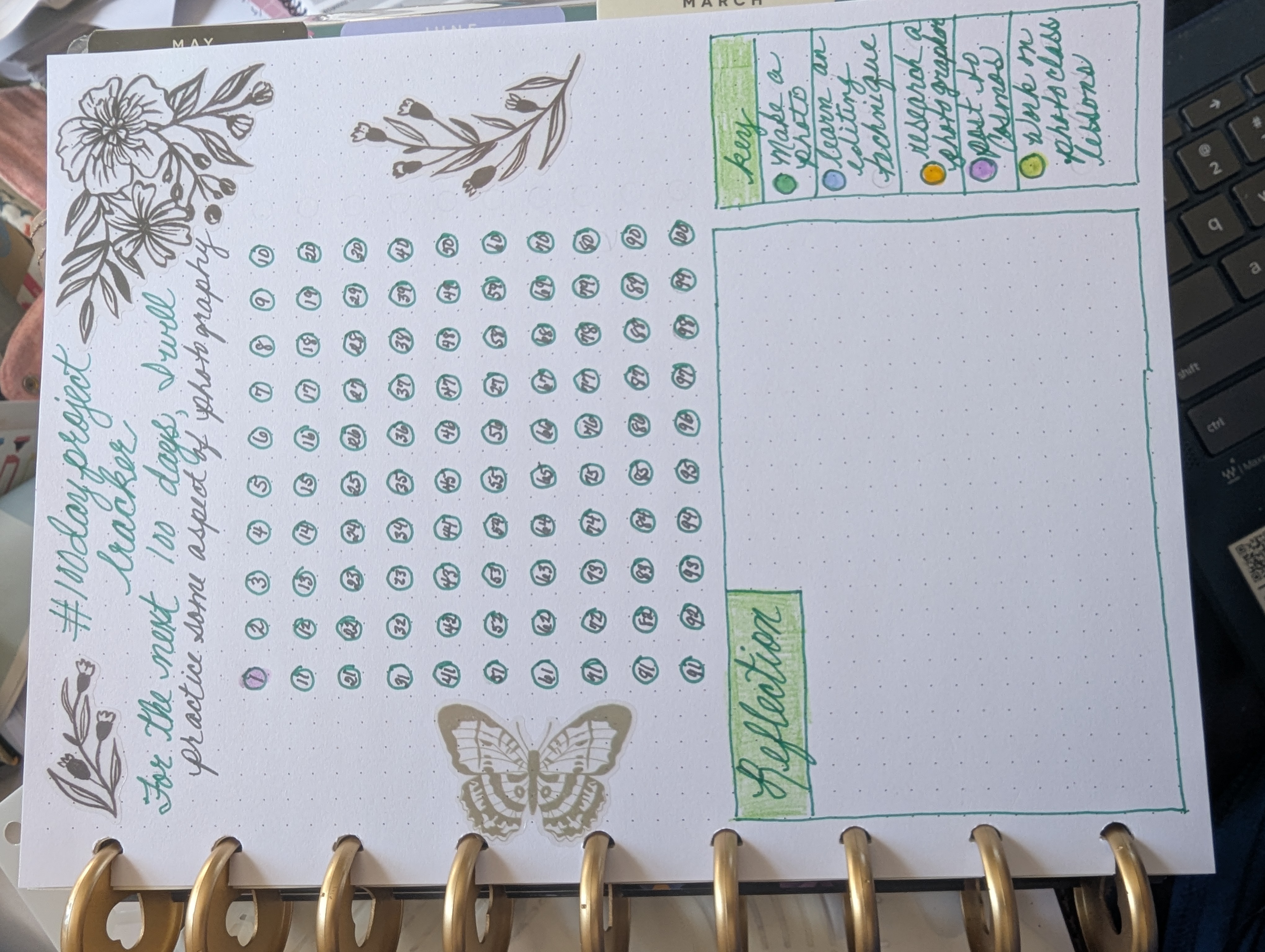
The morning pages are just part of a larger practice for the year. My word for this year is EXPLORE, and one element I want to explore is self-expression through “art”–writing, photography, doodling, drawing, etc. So, my 100 Day Project will center around developing my photography skills. I have set up five ways to work on this goal:

  1. Make photographs. Yeah, that seems simple enough. Just pick up the camera and go out and shoot. Or use my phone camera. I have a new Lensbaby, the Velvet 56, and I haven’t practiced enough with it to be “good.” That will certainly be one of my goals while making photographs.
  2. Learn new photo editing techniques and develop Lightroom and Photoshop skills. One of the things I like about the Year of Creative Photography class is that each month, Lori introduces a photo editing technique. I plan to experiment with them throughout the year.
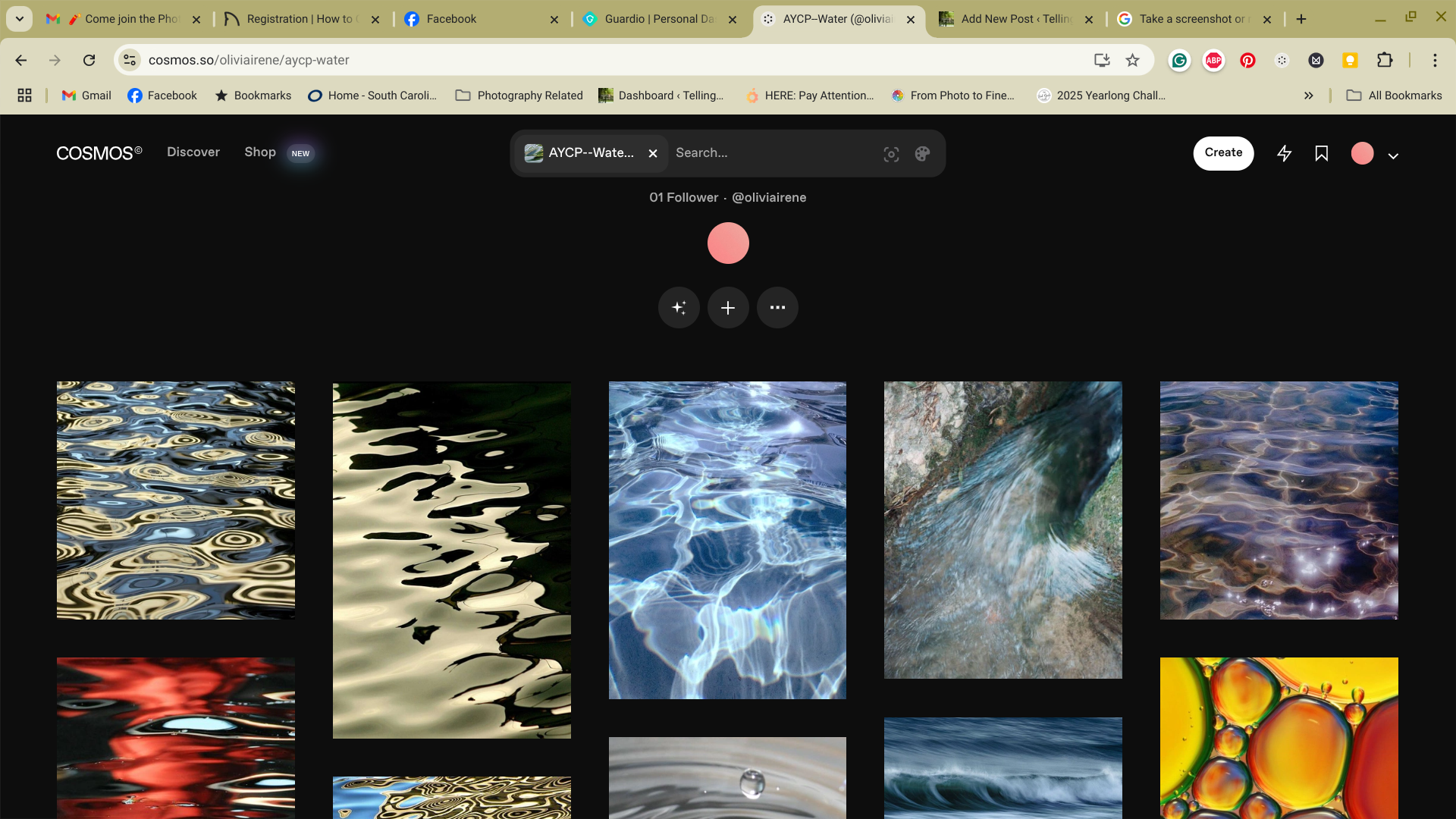
  3. Post things in Cosmos. Kim Klassen introduced Cosmos in a short four-week class last fall. Unlike Instagram, there is no need to write commentary (although there is a way to post notes and text). It’s not so much a social media share-to-brag site as it is a gigantic vision board from which to draw inspiration. By creating clusters around topics, I can search for inspiration and add photos, quotes, and videos to use as reference.
  4. Research other photographers. Again, the Year of Creative Photography has case studies of various artists and photographers in each month’s lessons as guides and inspiration for things to try. I will research other photographers as well to learn from them as much as I can.
  5. And, most importantly, work on the photography classes I signed up for. I have a bad habit of starting an online class and then giving up half-way through. So, I want to make follow through part of my practice.

I made a tracker for my planner to note by progress. I use reading trackers in my book journal, and I have a 31-day tracker in my OLW album to track my month-long practice of writing in my journal.

There is something to be said about putting one’s intentions out there in the world. If one announces it publicly, then there is a certain commitment to completely the things. So, I’m putting myself out there in the world. Day one has begun. (But there is also something to be said for every day being Day One. If I falter, I can always pick it up and make today Day One.)

By the way, I can color in my 100 Day tracker for gathering elements for the AYCP–Water cluster in Cosmos. I hope this gives me some ideas to try when I take out the camera later today.

Just a portion of my cluster for AYCP–Water cluster of images.

A Year to Explore

I have been choosing a word of the year for almost fifteen years now. Last year, my word was “manifest,” and some things really came into focus as a result. I became a reader again and discovered that I do like the magical realism genre after all (although I am not a big fan of Isabel Allende’s version in House of the Spirits). I began rereading some old favorites and found some new favorites. And I still read more than my fair share of Regency historicals, mysteries and romances alike.

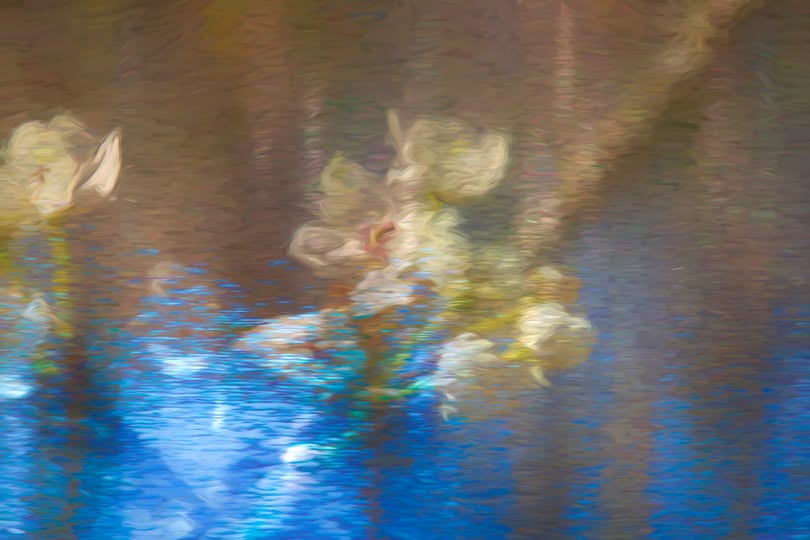
This year, my word is “explore.” I want to explore more new ideas and discover new opportunities. One area that I want to explore is photography and creative, artistic photo editing. To that end, I enrolled in a year-long class, A Year of Creative Photography. Already, I have begun playing with new ideas–using brushes and creative filters to alter my usual more documentary photos into something completely different. I’m also exploring ways to use my new camera lens, the Lensbaby Velvet 56. I took this picture of the camellia right after Christmas and after watching the video in the classroom about creative editing, I played.

Using a couple of filters in Photoshop changed the emotion of the image. I am intrigued by the motion and the color.

I also have on my bucket list of explorations are more trips to visit the state parks in South Carolina. Right now, it’s just too darned cold to go out for any length of time. I’m also exploring more of my family’s history. I know some of the family history on my maternal grandmother’s side. We are descendants of the Salzburgers, a group of Austrians who immigrated to Georgia in the 1700s and settled about 30 miles from Savannah in a small community called Ebenezer. They founded a Lutheran church, Jerusalem Lutheran Church, which is the oldest continuous congregation in the United States. Like so many others, these Lutherans came seeking religious freedom as well as economic freedom. I’m sure there is more to their history than these few details, and that is one thing I want to explore.

I also enrolled in Ali Edwards’s One Little Word class, another year-long exploration, as a way to document my journey through this year of exploring. I’m working through those prompts now.

This is my second full year into retirement. While I enjoy sitting in the rocking chair with a good books—an exploration all its own, and in the corner of the couch with my knitting needles or crochet hook and yarn, I also want to keep my brain active by learning and growing. I am exploring ways to use my voice in my church and community. I am actively studying the Bible. One of my reading goals for this year is to read more nonfiction although I have found that sometimes I do better listening to nonfiction books on Audible than I do by reading the texts. (I wonder why that is?)

So, here’s to the explorations for this year!

Wild Writing

[Note: the following is inspired by the poem “Eating the Avocado by Carrie Fountain. Linda Wagner provides prompts based on poetry for “wild writing.” This was the prompt for October 23.]

“I’ve Never Described”

I’ve never described the morning light through the living room window,

the slashes of light and shadow on the wheat-colored wall perpendicular to the window

the diagonal lines of light and dark that shorten and eventually disappear as the hours pass.

I’ve never described the cherry tree in the backyard,

the one my husband cut down because it didn’t produce edible fruit.

But he didn’t see, as I see, the value of the snow-white flowers with hints of pink,

the reminder in the still cold month of February that spring is not far away.

I’ve never described the surprise of the sesanqua in the backyard and the frilled pink blossoms that become transparent when the afternoon sun shines through them and I see the veined beauty in each petal.

This bush reminds me of the petite grandmother,

the source of the sesanqua and the red cameila that will bloom in January.

I’ve never described these red petals, either, with the golden crown of the sepals in the middle.

I’ve never described the feeling that when they bloom, I know Grammaw is nearby in spirit and that she has left a legacy of beauty for me.

I’ve never described the soft skin of a toddler, my sons as they were thirty-plus years ago (when did they become men of thirty-five and thirty-one years?) or that of my three-year-old grandson,

the tenderness and fagility of that white skin, unblemished and unscarred by time,

the soft velvet feel when I caress their cheeks,

the bow of their lips relaxed in sleep, tucked against my arm as I hold them those last few minutes before putting them down for the night,

the soft wisps of blond hair across their uncreased foreheads,

thankful that they do not know the worries and cares the next day might bring.

Finding Joy

[NOTE: This piece is inspired by the poem “I Do Not Order Two Sugars in My Americano” and the prompts from Linda Wagner’s 27 Powers Wild Writing prompts.]

Joy always finds me when I see the egret and the heron wading in the weeds at the shallow edges of the pond. I watch their stillness, statue-like, as they stare into the water for the dart of a small, silver fish. I study the graceful curve of their necks, the jaunty-jolty steps as they stalk their prey along the green edges. How can they see those small fish in that dark, murky water? I admire their graceful take-off when they spread their wide wings and lift off to glide inches above the sunlit water of the pond.

Joy finds me in the soft lapping of the water at the edge of the Lakeshore as I walk around the park or the shore at the church.

Joy finds me in the bright smile and giggles of my three-year-old grandson as he plays with his cars and trucks or wages a dinosaur war with his Nana.

I find joy in hearing and singing those old hymns of faith–and hearing in my head the sound of my father’s baritone as he sang those same hymns when he came home from church and walked through the house to change into his “everyday clothes.” I find joy in singing the hymns we used for his funeral service–even as the tears form and run down my face. (Has it really been nine years since he passed on?)

I find joy in seeing words crawl across the blank page when I write–and write and write more. Joy finds me in the old-fashioned fountain pens even when they spring a leak and my fingers are covering in black ink.

I find joy in hearing the birds sing and chatter outside my window. Joy finds me in the migration of those black birds (whose name I do not know, grackles, maybe?) that chatter and fly in in droves to cover the limbs of the trees and the brown grass each autumn. It won’t be long before they arrive again.

Joy finds me in the cup of hot cinnamon spiced tea served up in my favorite Pioneer Woman mugs. Before I take that first sip, I hold my hand over the cup to let the steam soothe the ache of muscles around the surgical scar. Then I take that first not-so-scalding hot sip and let the cinnamon “burn” across my tongue and down my throat to warm me through and through.

Even when I least expect it, joy always finds me.

The Simple Things

It’s the smallest things

the petals of the apple and cherry blossoms littering the ground like so many snowflakes;

tiny purple flowers like stars that have fallen between the blades of grass;

jasmine trumpets hanging in the tree branches.

It’s simple things

the sweet burn of the hot cinnamon spiced tea at breakfast.

It’s as simple as

the turtles sunning themselves on the water-soaked logs in the lake;

pollen-swollen pinecones in the making;

the rumble of thunder before the rain.

It’s the simple smell of bread baking and the taste of butter melting over hot-cross buns during the Lenten season.

It’s the glitter of sunlight on the water and the shadow of trees on the pavement.

It’s the sound–or rather the silence–of my steps along the straw-covered path through the woods.

Monday Musings–Remembering My Grandparents’ House

Every once in a while, a question on Facebook triggers something. Today, it was a question about what we remember about our grandparents’ house. I could write a chapter of a book about each of my grandparents’ homes.

Grandma and Granddaddy Wessinger lived in a “small” house. Granddaddy built the house for Grandma and custom-made certain parts of it just for her. Grandma was tiny, just barely five feet tall. Her kitchen was scaled just for her. It was a cozy kitchen. There was a wood-burning kitchen “warming” stove. That stove heated the kitchen in winter as well as cooked things like vegetables. The kitchen was also where the children ate. I can remember my oldest cousin being invited to eat in the dining room with the grown-ups. She was engaged to be married, and her fiance had come to eat with the family. Ginny declined the invitation. She and Wade ate in the kitchen with the rest of the cousins.

Naturally, the kitchen opened into the dining room and to the screened-in back porch. There was a bench on the porch where we often sat and played on rainy days. There was a sink on the porch as well. Granddaddy hung a metal dipper over the sink, and we all drank water from the dipper at some time or another. Uncle Lee’s room opened off the porch, too. We were not allowed to go into Uncle Lee’s room without his permission.

Another special room room was the “front room.” It was the formal living room or the parlor. Grandma had a Duncan-Fife sofa, a love seat, and an upright piano in that room, as well as her glass knick-knacks. She had a set of ceramic roosters. When we visited on most Sunday afternoons, we stayed in the den. We only visited as a family in the front room on Christmas. Grandma put her Christmas tree up in that front room. She had the most magical tree. Some of her ornaments bubbled. Granddaddy would roll dollar bills in Christmas paper and hang them on the tree. We thought we were rich when we took our rolls off the tree. (By the way, the “we” refers to my cousins, brother, sister, and me.)

This house burned in the fall of 1979 as a result of a chimney fire in the den. Although they rebuilt on the same sight, the new house was never quite the same as the one my Granddaddy built for his bride fifty years before (they were married in January 1930). When I remember going to see my grandparents, that white frame house is the one that I remember.

Monday Musing

Have you ever had a good idea and started writing it, but realized where you were writing was the wrong place and deleted it?

That happened to me this morning. I was writing a post for a Facebook group I’m in and got off on a tangent that would make a really great Monday Musing piece. I deleted it.

Now, I can’t remember what I was thinking and writing. . . .

Memory. If I were in my middle school classroom, I’d laugh and tell my students that I’m having a senior moment. My father would tell me that, if it was important, I’ll remember it in time. I imagine that both of these are true.

But I’ve got another thought. Technology. You see, when I deleted those really wonderful thoughts, I imagined I could just open up this space, hit Control-V to paste the sentences in, and, voila!, I would have the first part written.

It didn’t work that way this morning. Or WordPress didn’t work that way. Robert Burn once wrote, “The best laid plans of mice and men often go astray” (I’ve Americanized Burns’s Scots!). My plans went astray this morning, at least in terms of of my expectations for technology.

So now, I’m thinking about how much I’ve begun to rely on technology for many things. I lost my recipe books in a house fire some fifteen years ago. I had a whole cabinet full of those recipe books various organizations publish with the favorites of its members–churches, schools, civic organizations. Some of them were absolutely gorgeously printed edited that I enjoyed reading even if I didn’t cook any of the recipes. They were “inspiration.” Now, if I need a recipe, I “google” it.

Last night, I wanted to make potato cakes from the leftover mashed potatoes from Saturday night’s supper. Now, my mother made potato cakes all the time–leftover mashed potatoes, egg, a little flour, some baking powder, chopped onion, salt and pepper–no recipe. Then she fried them. Boy, could those cakes soak up some grease! I have an air fryer, and I use it to make french fries, cook bacon and sausages, occasionally hamburgers, etc. But something from a batter? I found several recipes online, borrowed some ideas from each, and made air-fried potato cakes, and they were delicious. I can’t give you my recipe because I just “added” whatever I thought it needed. I learned a trick or two as well. When you make something like a fritter or potato cake, line the fryer basket with a sheet of “tin foil” sprayed with cooking spray or wipe a layer of olive oil or some other cooking oil to keep the batter from sticking. I cooked the cakes for 15 minutes at 400 degrees, flipping them during the last five minutes to brown on both sides and get that crispy outside crust.

I’ve also experimented with some of the AI apps out there. I needed some “inspiration” to push through a tricky part of the novel I’m writing. I wanted a backstory, a myth or a legend, to explain the importance of an object–a mysterious and rare black sapphire. I asked ChatGPT to write that legend. Of course, I had to do some tweaking to make it fit my story, but it sparked some new directions. for me.

Technology can be a great help, but I think it can hurt as well when we become too reliant on it. I don’t think I’ll see technology take over the world in my life time. I don’t think AI will replace human intelligence and free thinking unless we rely on it without learning to think critically.

And, as you can see, my Monday Musing has been a Monday Meandering. Writing does that to me–one thought leads to another, and another, and another!

Have a great week!

Telling Stories, Part II

6-22 (3 of 13)

Last night, we have a summer storm—wind, heavy rain, sharp lightning, thunder that rumbled for minutes. And it lasted for nearly two hours. I confess, I am not one who particularly enjoys storms, meteorological or otherwise.  And last night, I stayed awake throughout the whole storm from 2:45 a.m. until nearly 6:00 a.m.  I roamed the house from window to window to see if I could see what the wind was doing to the trees that surrounded the house; I even turned on a local TV station to see if the weather crew were covering the storm.  I will probably be doing something similar this afternoon, if the forecasters are correct in predicting another band of severe storm coming our way.

6-22 (6 of 13)

And yet. . .

This morning, there is sunshine.  There is a freshness to the air that will be gone in the summer heat and humidity.  We will be grateful for the air conditioning, and some of us will be wondering how we did without it when we were children.  Though I grew up in a modern home with the conveniences of dishwasher, in-house washer and (gasp) dryer, baseboard heating, we did not have central air conditioning.  Only when my grandfather moved in with us did we have get any kind of AC—and that was a window unit to put in his bedroom.  It wasn’t too much longer when Mama and Daddy bought one for the family room.  I was married when they finally put in central heating and air.  To write this makes my childhood seem almost primitive, but then I didn’t think so. 

This morning, there is sunshine.  My husband is out cutting the grass around the house and probably later around the ponds as the weather permits.  I took out the camera to see this freshly washed world.

Jume 22

Honeysuckle, blackberries beginning to ripen, daylilies, vinca, daisies, Rose of Sharon—in bloom, leftover drops of rain in the petals.  Leaves torn from the trees scattered over the front yard. . . .

Remnants of the storm and the beauty that remains afterward.

Had I walked longer and farther around the pond, I would certainly have found more beauty, but for the moment, this was enough—enough to remind me of other stories: sipping the nectar from honeysuckle blossoms with my brother, sister, and cousins at Grandma Wessinger’s house during that week we spent with her and picking blackberries in the pasture behind the house and the blackberry pies that Mama would bake (with the gritty seeds of those wild berries). The rose of Sharon tree with its scars on the trunk from the fire eight years ago, still blooming, still standing, though transplanted, resilient and strong. Daylilies from Aunt Miriam, Granny.

These all have stories.

6-22 (12 of 13)

Picture may be worth a thousand words, but sometimes, for me the picture gives me the thousand words to tell the story.