September Reading Wrap-up

I know, it’s only the 26th and there are four more days. I probably will finish another book before the end of the month, but I’ve read the bulk of the books for the month. I didn’t read as many books as I have some months, but that’s okay. I started a couple that I haven’t finished, though, so I’m still reading.

Most of the books I read this month were lighter fare. At least four were murder mysteries of one sort of another. A couple could be classified as romance novels. One of the books fell into the category of magical realism. Several were historical novels.
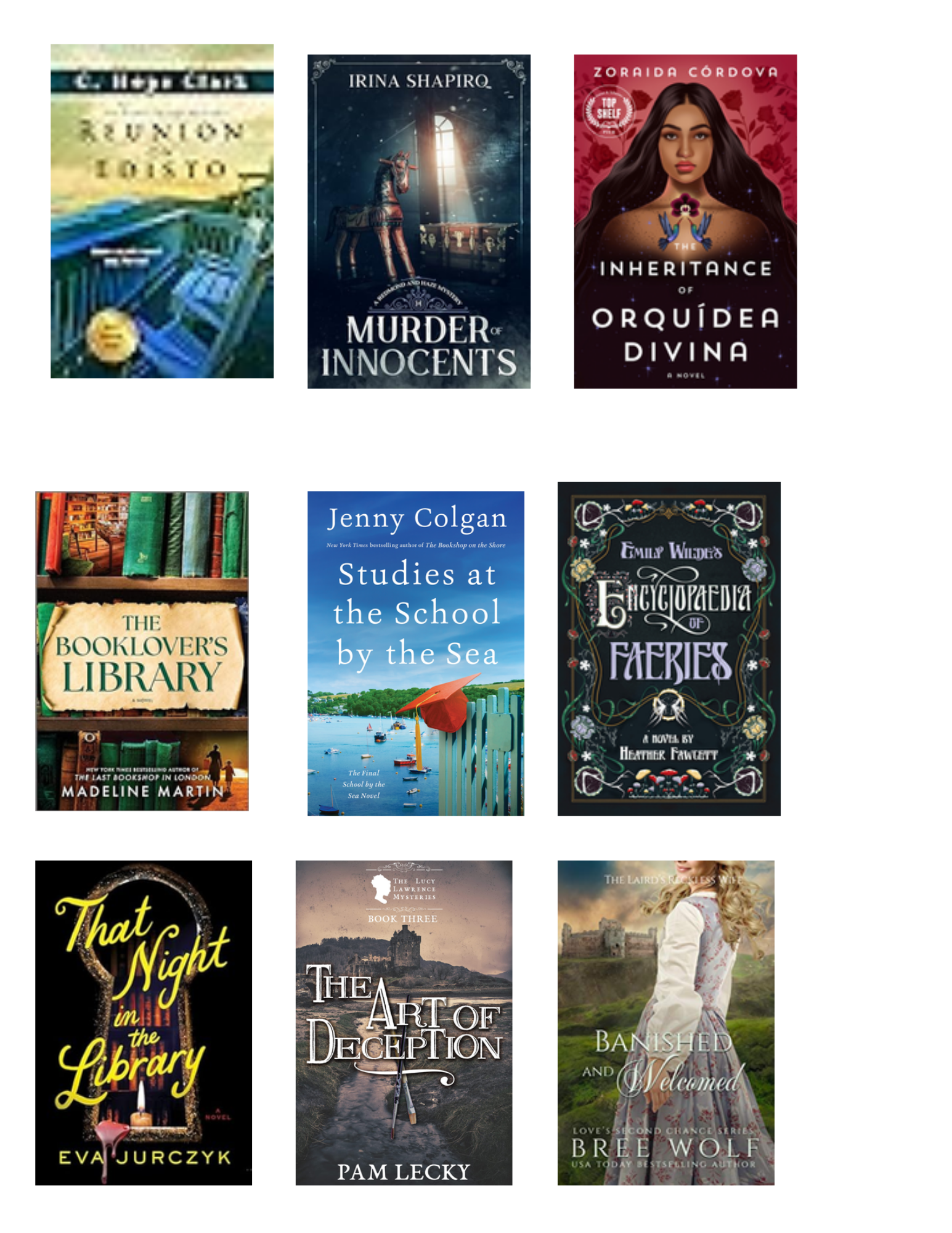
Irina Shapiro did not disappoint in the latest addition to the Redmond and Haze series. Murder of Innocents had Dr. Jason Redmond and Detective Daniel Haze searching for the murderer of two little boys. Dr. Redmond may be an aristocrat, but he is from America. He served as a surgeon for the Union army during the American Civil War and spent time as a prisoner of war in the infamous Andersonville prison. His knowledge of anatomy and medicine and Haze’s skills as an investigator make them a formidable team.

C. Hope Clark’s Reunion on Edisto follows the career of Callie, Edisto Beach’s first female police chief. In the seventh installment of the series, Callie, now sober for nearly a year and in a stable relationship with Mark, the owner of the new Mexican restaurant, El Marco, has to search for a missing classmate who has come to the island to plan a class reunion. As Callie works the case, she also solves a cold case from her high school days. While I was not sympathetic to Callie when I first began the series, I began to like her as I near the end of the series.

I read two books by Madeline Martin last year, The Last Bookshop in London and The Keeper of Hidden Books, both set during World War II. The Booklover’s Library is also set during World War II. Like The Last Bookshop in London, The Booklover’s Library is set in England. The Booklover’s Library begins before the Blitz and tells the story of a young widow who must make the agonizing decision to send her daughter to the countryside for safety. She also must find a job to support herself during this time. The novel speaks to the power of books to comfort during hard times. I learned more about the effects of war on women and children from this book. That’s the power of a good historical novel; it brings the history to life.

The Inheritance of Orquidea Divina is way out of my comfort zone in terms of genre. I liked the book. However, it took me quite a few pages and chapters to buy into the elements of magical realism. There are a couple of things that really struck me in the story. Orquidea’s need to have roots takes on a physical aspect when she turns into a tree the day she dies. We all need that place we can put down roots and belong. Marimar finds that place in Four Rivers on her grandmother’s estate. The second thing that resonated was the idea of “inheritance.” What do we actually inherit from our ancestors?

The book I disliked this month is That Night in the Library. I could not sympathize with any of the characters; they were all unlikable to some degree. The death from some kind of poisoning of one member of the small group gathered to re-enact an ancient Greek ritual sets off a series of additional deaths. By the time the group is rescued, only two of the seven remain alive. Moreover, with the exception of Kip, the first to die, nearly every one of the others kills, helps to kill, or witnesses the violent death of others. This is a “locked room” mystery in the vein of Agatha Christie, but there are no redeeming characters in this novel, and no feeling that justice has been served in the end.

Studies at the School by the Sea is a light-hearted romance of two teachers from two different schools, both English teachers, and both concerned with the well-being of their students. However, there are obstacles to their romance ranging from an ex-fiance’s accident to the lack of privacy on a school Outward Bound retreat. I haven’t read the first three books in the series; however, that did not hinder me from enjoying this book.

My pick, though, for the book of the month is Emily Wilde’s Encyclopedia of Faeries. Emily goes to an isolated island in the Arctic Circle to conduct research for book, an encyclopedia of faeries. From facing hostile villagers and down-right mean changelings, Emily has a number of adventures. When her colleague joins her, though, things get really interesting, and she discovers his secret identity. I had fun reading this book! I do enjoy a good fantasy.

Mid-month Reading Roundup

August is flying by–and I’m not even in school this year. I’m in my second year of permanent retirement as a high and middle school English teacher. That has given me the opportunity to read as much (or as little) as I want to read. And since I’ve always loved books and reading, I can say I’m enjoying the time.

So far, I’ve read ten books this month (even though my StoryGraph graphic shows only nine. The novel, The Unquiet Stairs, is not listed in the StoryGraph data base). One of my completed selections is the audio book Killers of the Flower Moon, the basis for the current movie. I was completely interested in that narrative of the murders of several Osage Indians in the late 1920s and early 1930s because of their wealth due to their control over the oil rights under their reservation. The narrative brought out the injustice shown to Native Americans, especially when they had no control over their own wealth. The conspiracy contrived to obtain the rights to the oil underground was complex and chilling. The subtitle, “The Making of the FBI” highlights the role of J. Edgar Hoover in this case, which he uses to build the reputation of the FBI as a law enforcement agency. I have not seen the movie yet, but it will be interesting to compare the book and the movie.

I have always been interested in the tales of King Arthur. I even had a copy of John Steinbeck’s unfinished retelling of the legends, which I lost a long time ago. Who knows what classroom I left it in over my forty-year career? Anyway, The Bright Sword is a new version of the Arthurian legends told from the points of view of some of the lesser known characters. The novel begins after Arthur’s death at the hands of his son Mordred. Among the characters included are Sir Bedivere, Nimue (Merlin’s apprentice), and Morgan le Fay. Guinevere, who according to Sir Thomas Malory, entered a convent and became a nun, re-emerges as a strong female leader in her own right, and Merlin, Arthur’s advisor and magician, becomes a hero. There are the typical tropes of Arthurian stories, including the damsel-in-distress and a holy quest. I enjoyed this novel very much.

I’m also a sucker for a good Gothic novel in the vain of Victoria Holt and Daphne DU Maurier. Return to Wyldecliffe Heights fits the bill. Agnes Corey, who had a troubled past herself and spent time in a school for troubled teenaged girls, has worked as an editor for a small publishing house, best known for the publication of one book which has a cult following. When Agnes writes to the author requesting a sequel, Agnes is sent to the reclusive author’s home to take the novel down. There, she encounters the “ghost story” and some links to her own past. Though set in modern times, the author draws on the history of treatment of mental illness as well as the goth scene of the previous century. It was interesting to see the influence of the Bronte sisters on the author, especially Charlotte Bronte’s Jane Eyre. I am glad this was not a part of a series, or I may have gone on a reading binge!

The Lord Meets His Lady is pretty typical of the Regency romance genre. The male protagonist is decidedly an anti-hero, banished from society after creating a scandal in a London gaming hell. He thinks he’s rescuing a “damsel-in-distress” who is actually a woman trying to escape an indenture forced upon her. Genevieve and Marcus are both looking to escape their pasts and start over. And they are able to find love and healing and restoration by rescuing horses. There is plenty of political intrigue in this novel as well.

I read two more books in C. Hope Clark’s Edisto Island Mystery series, Edisto Stranger and Tidings in Edisto. Callie continues to serve as the island’s chief of police. In these novels, she is beginning to get her act together and come to terms with her past, the loss of both her husband and her lover in the line of duty, her alcoholism, and the knowledge that the mother she grew up with is not her biological mother. Clark is developing Callie’s character is more depth although most of the characters are somewhat stereotypical. In Tidings, Callie is more stable as she deals with a complicated and twisting case involving the death of her neighbor (the husband of her biological mother) and a series of break-ins by the “Edisto Santa.” A new character is also introduced, a former SLED agent, the state’s law enforcement agency, who helps her solve this complicated case.

J. Courtney Sullivan’s The Cliff is a dive into the history of Maine, the Shakers, and spiritualism. It is Reece Witherspoon’s July book club selections as well. It is also the story of mother-daughter relationships, generational alcoholism and trauma and hurt, and healing. What intrigued me was the question of what one might do if one discovered an old family cemetery in one’s backyard? And what would the consequences be if one removed that cemetery? Although there are ghosts, The Cliffs is not a ghost story but in some ways a story of digging up the bones of one’s past to discovery one’s self. This is a book that is going to stay with me for awhile.

After The Cliffs, I needed something light and “mindless,” The Sapphire Intrigue, another Regency novel fit the bill. Lady Grace and Lord Roland Percy are called upon by the royal family to track down the Sapphire code book before it can fall into the hands of their arch enemy, France, after its keeper is found murdered in the Marine Pavillion in Brighton. These two aristocratic sleuths must determine which one of the guests of the Prince Regent’s guests killed Sir Jonathan without getting themselves killed. This is purely escapist reading for the fun of it.

The Unquiet Stairs is also in the Gothic novel genre with ghosts that haunt a swanky Scottish hotel. Originally, the hotel was a manor house built over the foundations of an ancient monastery-turned-convent. The author moves the narrative back and forth in time to tell the story of the inhabiting ghosts. Present-day Anna escapes from a disastrous wedding day to her Aunt Rita’s home in Scotland to hide from her parents, her husband, and her controlling in-laws. Rita helps her find a job at the hotel, first as a receptionist and then as the manager. When the ghostly inhabitants, Hugh Ferguson and Gideon Corsan, begin showing out and become violent, Anna calls on her aunt to help settle down the spirits. To help understand the ghosts’ actions, the author draws on the history of the Scottish Covenanters and the witch hunts of the mid 1600s. There is so much history in this book that reminds me of our own history of the Salem witch trials. I will be reading the sequel when it’s published to learn more about the history of this time.

There is a thread in this month’s reading–murder, mischief, and mayhem. A Whisper of Death is a murder mystery set in 1868 in London. Female investigator Matilda Wren primarily helps a solicitor investigate for women who want to seek divorces from their unfaithful and abusive husbands. When she begins to investigate the loss of her grandmother’s investment income, which has been managed by her husband’s cousin Sir Henry, Tilda meets Hadrian Becker, Lord Ravenhurst, who is investigating his own near-fatal attack. The two team up when it appears that Sir Henry’s death, the death of another peer, and Hadrian’s attack all appear to be connected. Whisper of Death is a plot-driven novel with little real character development. Hadrian and Tilda are likeable characters, and I did care about each of them. Typical tropes of this genre are present: the divide between social classes (Hadrian is aristocracy while Tilda is middle-class), the lack of rights and agency of women to handle their own financial and legal affairs, and the quest for real justice. There is an upcoming sequel to this novel as well, and I will be reading it to see if Hadrian and Tilda can cross the class lines to develop a relationship.

I am listening to The Boys in the Boat, about the eight-man crew from the Univeristy of Washinton that went to the 1936 Olympics in Germany. I am interested in this story as well. I watched the movie based on the book, and, frankly, I was disappointed in the movie. The movie focuses only on the year 1936 and, therefore, does not develop the characters and their relationships in any depth. Joe Ranse’s struggle with poverty during the Depression years and his estrangement from his family are merely hinted at. Also, the movie does not show the excitement of the various races the crew ran. The movie was rather anti-climatic, even at the end when the boys from America won the gold in a photo finish.

The month isn’t over. I have a whole stack of books on my TBR list to read. I’m not sure which book to open next.

Good Things on a Rainy Monday

It’s raining this morning. Heaven knows, we need it. The landscape was looking a little brown at the end of July, and the ponds behind the house, which rely on rain to maintain their levels, were receding quickly. Of course, the rains and the clouds are keeping the summer temperatures lower as well, a thankful relief from 100-degree days earlier this month. There are a lot of good things that happened this month.

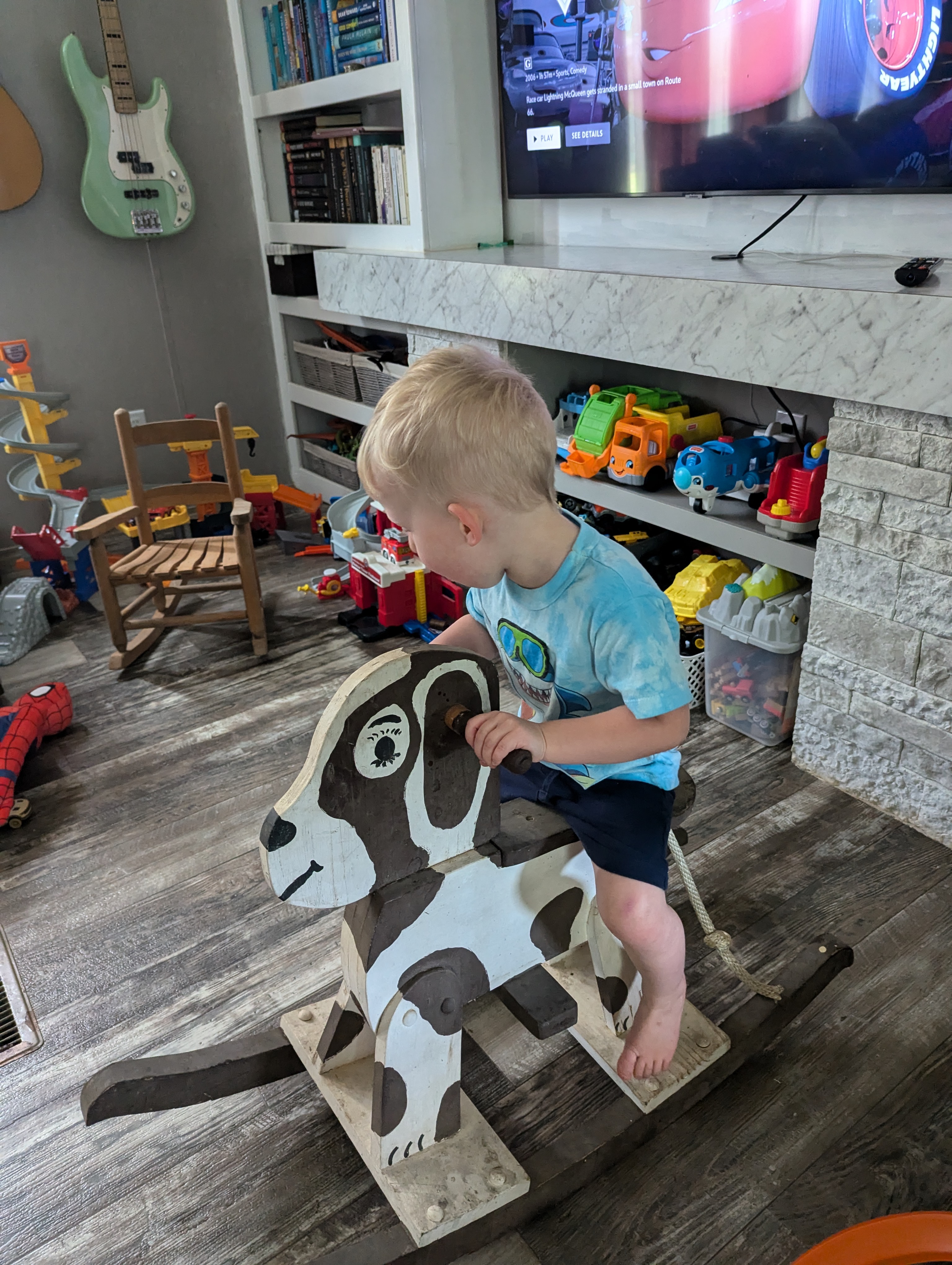
  1. We spend a Saturday afternoon with our sons, daughter-in-law, and grandson. Sully is two and a half, and a “miracle baby.” He’s beginning to talk and not just in baby babbles–whole sentences. He has two speeds: off and full steam ahead. It is rare for him to be completely still. When our sons were toddlers, my father made a rocking dog for them. Surprisingly, it survived the house fire, and we dusted it off and gave it to Sully. He was enchanted and kept saying, “That’s cool!”
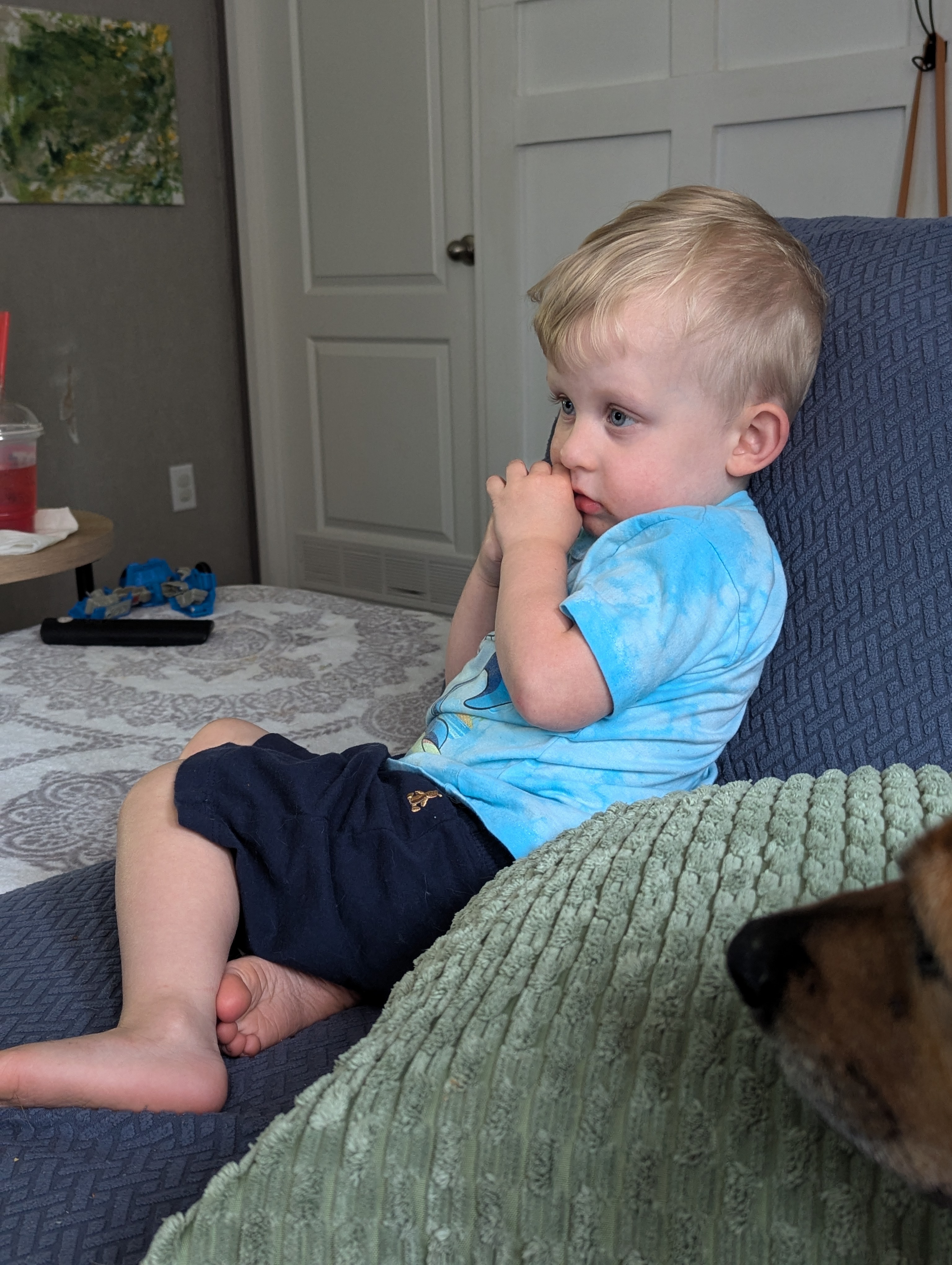
A rare still moment!

2. Books and more books! One thing retirement has given me is more time to read the books I want to read. I admit that I quite often binge read, especially Regency/historical novels, but this year, I took on a challenge to read at least 52 books. I have more than exceeded that number and working on 100 books for the year. At the rate I’m going, I may exceed that number as well! It’s hard to pick the best book for this month, but there are a couple that rank right up there. The Secret Book of Flora Lea is one of them. The Lost Story and A Novel Love Story are two others. This month I have read more in the genre of magical realism.

3. Crafting is one of my “things”. I knit or crochet just about every day. This week, I finished the nine squares of the Irish Fields afghan kit. I just need to assemble the complete afghan. This months Hooks and Needles crochet and knitting box arrived, and I completed two of the projects: a crocheted Granny square crossbody bag and a knitted shoulder bag. I also used some HTV (heat transfer vinyl) to make a book bag for Sully’s library books. He is entranced by the Disney-Pixar movie Cars, and LIghtning McQueen is one of his favorite characters, so he has a personalized LIghtning McQueen bag for his library hauls.

After that success, I made two more, one for me and one for Sully’s mom, Sherry.

4. My sourdough starter is working again. The last couple of times I made bread, the starter would bubble but would not grow after I fed it. I had lots in the jar, so I baked anyway. The bread turned out okay, but I wasn’t satisfied. Moreover, my starter kept separating with that dark liquid on top, which I found out is called “hooch.” Yeah, the same name given to moonshine, well, because, that liquid is alcohol from the fermenting process. I read all kinds of articles on making sourdough breads and maintaining starter, and I learned that my starter was starving. So, following the advice given, I fed the starter daily for two days, keeping it out of the refrigerator. After the second day, the starter bubbled AND grew–and I made a loaf of cinnamon-raisin sourdough bread. It turned out beautifully. Next time, I’m going to double the cinnamon; it needs a little more kick! By the way, raisin bread was my grandmother Wessinger’s favorite bread, so I’m eating this bread in her memory!

5. I splurged a couple of weeks ago and had a professional manicure. It’s nice being pampered. The only thing is, the polish chips off so soon. I need another one to fix this one.

Good things–definitely. They are all around. I just have to look for them.

A “Funny Thing” Happened on the Way to. . . .

I GOT LOST IN CHAPIN!

I had a couple of errands to run in the Harbison-St. Andrews area today, and the quickest way to get there is to use the Interstate.

Except it’s been a few months since I’ve had to use the Chapin Exit area to get on and off the Interstate, and the highway department moved the east-bound entrance ramp. That required making a circle through some back roads to get back on the main drag and to the correct entrance ramp.

Maybe I should be going to the Interstate via Little Mountain. . . .

Anyway, that got me to thinking about this small town where I grew up. The streets weren’t named with official street names, unless you count such monikers as the Old Lexington Highway, Highway 76, Road 48, etc., as street names. Those roads don’t have those titles anymore–Columbia Avenue, Broad River Road, Hilton Road. . . . Fancy.

There are other changes as well. Chapin High School has expanded from two main buildings to at least three now. From a one-A school in the 1970’s, it is now a AAAA school (and maybe growing); from the district’s “red-headed step child” to one of the flagship schools. Joe Chapman’s service station has been a garden/seed store, a fancy fastfood restaurant, and now a Chinese take-out restaurant. S &S gas station has been torn down for years. That’s where I could fill up my granddaddy’s light blue Mercury Montego, get the oil checked, windshield washed, and tires checked without getting out of the car. Oh, I filled up the tank with a five dollar bill and got back change! The S & S moved down the road a piece, but now, it, too, is closed.

The Red and White grocery store is no more. First, Winn Dixie, then BiLo replaced it–and moved a couple of times. Food Lion moved in, and so did Publix.

I remember when the 7/11 opened across the road from the old Chapin School. On piano lesson days, I would drive that Montego to get a cherry-cola Icee. After a robbery and murder, it closed, but in a few years, it became the Chapin Station (family restaurant) and now Zorba’s. Downtown Chapin has changed as well. The dime store has closed, and Judy Jarrett has her ArtCan studio there. The cloth shop is gone, so is the general store. The old Ellet Brothers building is home to a bar and several other shops.

And there are two traffice lights, one replacing the flashing yellow light at the intersection where Joe Chapman had his gas station.

It’s no wonder that I got lost this morning. My home town has changed so much in the last fifty years. I suppose it’s inevitable that change happens, but I miss the old Chapin where there were no traffic jams, no traffic lights; where there were full-service gas stations and people you grew up with (and who could tell you your family history and somehow claim kin with some five or six generations ago). The hometown feeling is not there as it once was.

Yet, I can drive two or three miles away to get into “the country”–acres of land covered in trees, though not planted for hay or corn like it used to be. The pastures that once held small herds of cows are grown up. So even though the town itself is changing, the area around it remains the same. I hope it stays that way.

Mid-month Reading Wrap-up

It’s been a while. . . . I had surgery on my hand on May 31, and it’s healing–slowly. Since then, I’ve done some reading and knitting and crocheting, and a bit of traveling to see some state parks, but that’s another post.

Today is about the reading.

I set a reading goal at the beginning of the year of 52 books—a book a week. Well, to say I’m a voracious reader is a bit of an understatement. I reached the 52 books in June. So, I upped my goal to 100, and at the midpoint of July, I’ve read 63. So, I may need to amend my goal once again.

This month has been a bit different in my reading selections. A couple of the books I’ve read are in the genre of magical realism. I had to look it up because I just didn’t teach much in the way of magical realism, and the only other book that qualified as magical realism that I’ve read was Allende’s House of the Spirits, which I thoroughly hated (that was one of the selections I had to read and plan a unit for teaching when I went through National Board Certification in 2000.) However, I loved the three books I’ve read that had a magical realistic bent to them.

Of course, there are my usual picks of purely escapist historical romance and a mystery or two.

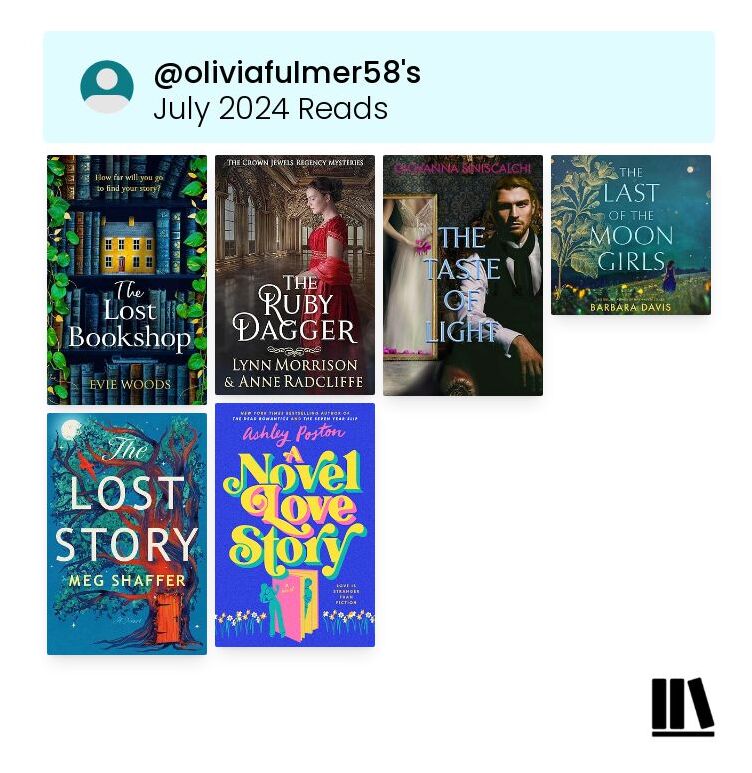
(How cool is this? StoryGraph, a reading tracker app, creates a graphic of book covers! StoryGraph is like Goodreads–sort of.)

Anyway, I can’t pick a favorite from the six books I’ve read so far, but my top two are The Lost Bookshop and A Novel Love Story. The Lost Bookshop is about a “magical” Bookshop in Dublin, Ireland. Martha escapes an abusive marriage and takes a job as a housekeeper for a retired actress, Madame Bowden, in exchange for room and board in a basement room. Henry is a scholar looking for the lost manuscript of Emily Bronte’s second novel. Opaline has escaped an unwanted marriage by going on a “grand tour” of sorts to France where she meets Sylvia Beach ( a real, historical person who opened a Bookshop in Paris and published James Joyce’s novels in the 1920s and hosted a number of American expats, such as Hemingway) and works for her until her brother discovers her whereabouts. She, too, escapes to Dublin where she opens her own bookshop, which somehow just disappears. The novel tells the story of how these three lives, two contemporary and one from the 1920s, intersect and influence each other. It is a book about second chances to find love, self-discover, and the love of books and reading and the way books can impact one’s life.

A Novel Love Story by Ashley Poston also features a bookshop along with a curmudgeonly bookshop owner, a lost traveler, and a town lifted right out of the traveler’s favorite romance series with all its characters in place. Eileen is traveling to a cabin in the Hudson Valley for the annual book club retreat–alone because everyone else has “life” interruptions. A rainstorm sends her in search of a place to wait it out, and she finds her way into Eloraton, the fictional setting of her favorite romance series. She meets the inhabitants, all characters from the novels except for the owner of the bookshop, Anderson Sinclair. Try as she might, she cannot place him in the plots of any of the novels and assumes that he must be a character the author envisioned for the fifth novel, which she never wrote because of her untimely death. Eileen isn’t looking for love after having her heart broken several years ago when her fiance dumped her a week before the wedding. However, with a title like A Novel Love Story, you know there will be romance involved. This book is also about the power of books and reading–and about finding second chances. it is a sweet story, with a glimpse through the open bedroom door but without pages and pages of descriptions of graphic sex. After finishing the book, though, I thought about the story of Brigadoon, that mythic village that appears once every 100 years in the wilds of Scotland. (I may have to find that movie and watch it again!) This is that kind of story.

And my third favorite, or a strong tie for first, is The Lost Story by Meg Shaffer. Two friends go in search of Emilie’s lost sister in the woods of the Red Crow State Forest, the same forest where they went missing for six months nearly fifteen years earlier. The thing is, Shannon has been missing for twenty years. After Emilie’s mother dies of cancer, Emilie discovers she has a half-sister who had been given up for adoption. She hires Jeremy to find her sister, given his success in finding missing girls, but Jeremy can only take on the mission if his best friend from childhood, Rafe, goes with him. However, they have been estranged (and hostilely so) for the last fifteen years. Reluctantly, though, Rafe agrees, since doing so will give him his memories back. This book is more than a book about restored memories; it is about restored relationships, about growing up, and about finding a place to “belong”. It is also about reclaiming the magic and imagination of childhood. I enjoyed getting lost in the world of Shanandoah (yes, that’s how it’s spelled in the novel) and getting to know Jeremy, Rafe, Emilie, and Skya (the queen). There are numerous allusions to C. S. Lewis’s Chronicles of Narnia throughout the novel.

The Last of the Moon Girls also fits into the realm of magical realism and follows many of the same themes as the previous books–self-discovery, restored relationships, finding that place that is home.

The last two books are more traditional historical romances with the happily-ever-after endings.

So, what’s next on my TBR pile? Probably too many to list. I just started Wolf Hall, a traditional historical novel that follows the life of Thomas Cromwell, one of Henry VIII’s advisors. I also have Vera Wong’s Unsoliticited Advice for Murderers, The Wishing Game, The Secret Book of Flora Lea, and Murder on Edisto on the list. That last book is the July book selection for my in-person book club, The Coffee Shelf Readers. I’ll start that book next week.

Now, it’s time to get lost in Tudor English. . . . Happy reading!

Currently in May

Loving the sound of the cicadas in the morning. We had the double emergence of the thirteen- and seventeen-year cicadas. Seeing them has convinced me that there are aliens on earth.

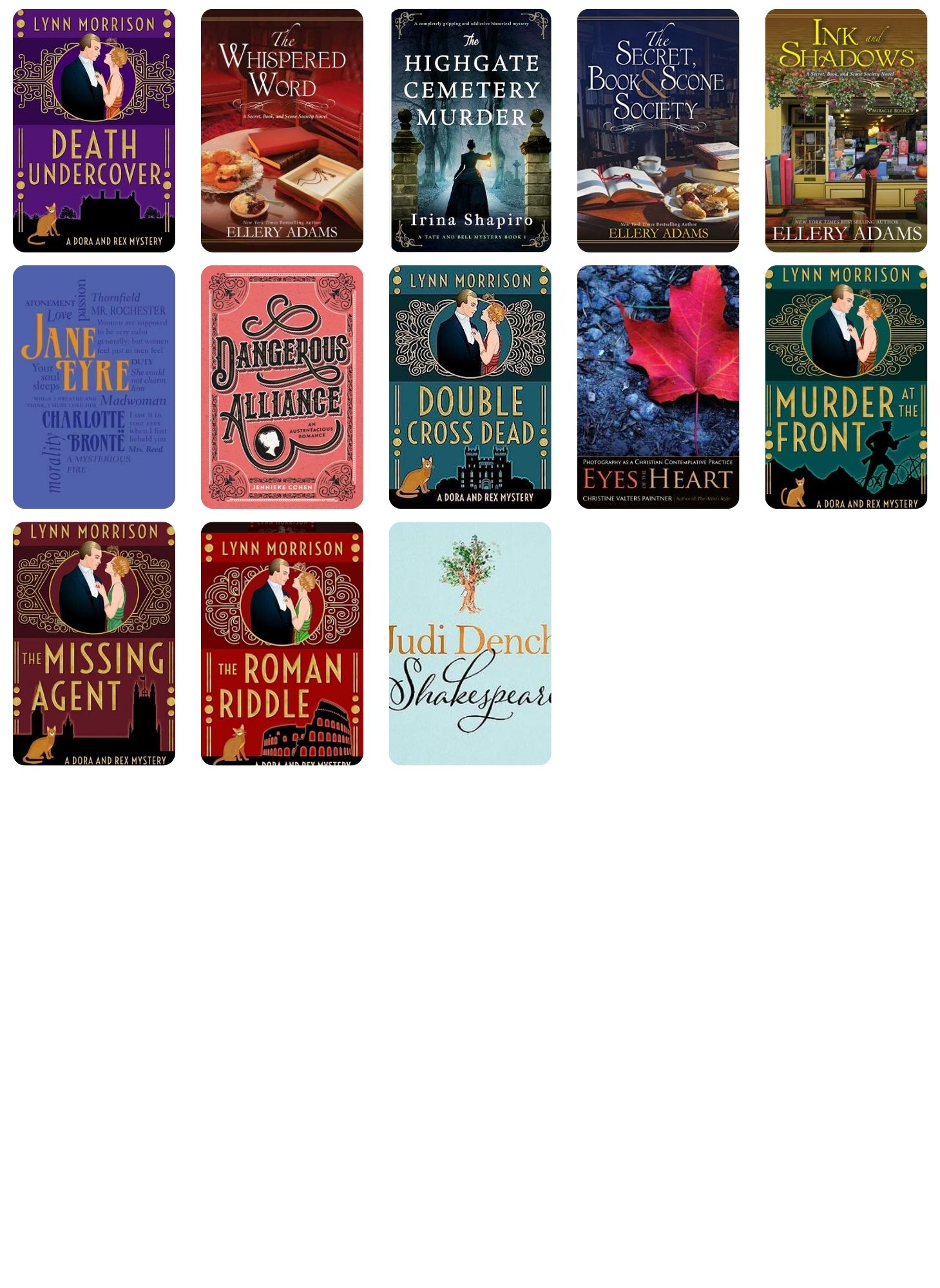
Reading two mystery series by Ellery Adams and Lynn Morrison. The Secret, Book, and Scone Society by Adams is set in contemporary times in North Carolina, and Morrison’s Dora and Rex Mysteries are historical mysteries set in post WWI Britain and Europe. I’m also reading Sarah J. Maas’s Court of Thorns and Roses series.

Watching old John Wayne westerns on GRIT TV and Masterpiece Mysteries/Theatre on PBS.

Eating fresh strawberries from a local farm. So sweet and juicy!

Making crocheted shawls with incredibly soft bamboo yarn.

Celebrating my mother’s eighty-ninth birthday with our family.

Looking forward to touring more state parks and learning more about my state and its history.

Surprised and Delighted

The prompt this month in the One Little Word class is to be “surprised and delighted” by the appearance of my word for the year. This year, I have chosen “manifest” as my word. I probably mentioned that the word came to me during the Advent season. The last line of a hymn goes “God in man made manifest.” That line continues to hum its way into my brain every once and a while.

First of all, the word doesn’t have those “new-age” meanings for me. I think of the word’s meaning as “revelation.” What is being revealed to me? What new things am I becoming aware of? What new “understandings” are coming to me? These are the things that “manifest” means to me.

So, what is surprising and delighting me this month?

Cicadas. Yes, insects! This year, we have a double treat. The thirteen-year and the seventeen-year cicadas are emerging at the same time! We have been treated to their singing or chirping, or whatever you want to call it, for the last three weeks. I have loved waking up to their songs. They have also been accompanied by the chirping of birds. This morning chorus has been a delight and a highlight of my day.

But more than anything else, this emergence of cicadas has occurred during the liturgical season of Easter (from Easter Sunday to the Saturday before the Sunday of the Pentecost). I have been thinking about the idea of resurrection in the religious, spiritual, and physical senses of the word. I believe in the resurrection of Jesus Christ as a Christian. It seems such a physical impossibility. Yet, I think about the cicadas: they have been dormant and hidden (entombed?) for years, and suddenly, they emerge as living, active beings. That is resurrection. That is new life. In a couple of weeks, the cicadas will be gone, and the world will be quieter (I’ll have to get used to that different kind of quiet). When I’m seventy-nine years old, the cicadas will emerge again. That is resurrection. It is tangible proof that it can happen.

I have been tracking the changes in the backyard by taking weekly photos, focusing on the cherry tree in the backyard. It is fully green now in mid-May. The changes are more subtle now than they were in October when I began the project. I have to get closer to the tree to see the changes. The white and pinkish blossoms have turned into little green cherries (hard as rocks!). As I track the changes, the idea of resurrection has manifested more than once–from bare limbs in winter to the pink buds to white blossoms to green leaves and now to the fruit itself. Wildflowers, roses, gladiolas, and other plants have emerged. There is new growth all around me.

Having this word “manifest” is making me aware of life around me. I’m already thinking about my word choices for “next year.” What can follow this word for inspiration and contemplation?

And just delightful is that grandson of mine who is growing and learning and loving. . . .

Reading Roundup–April 2024

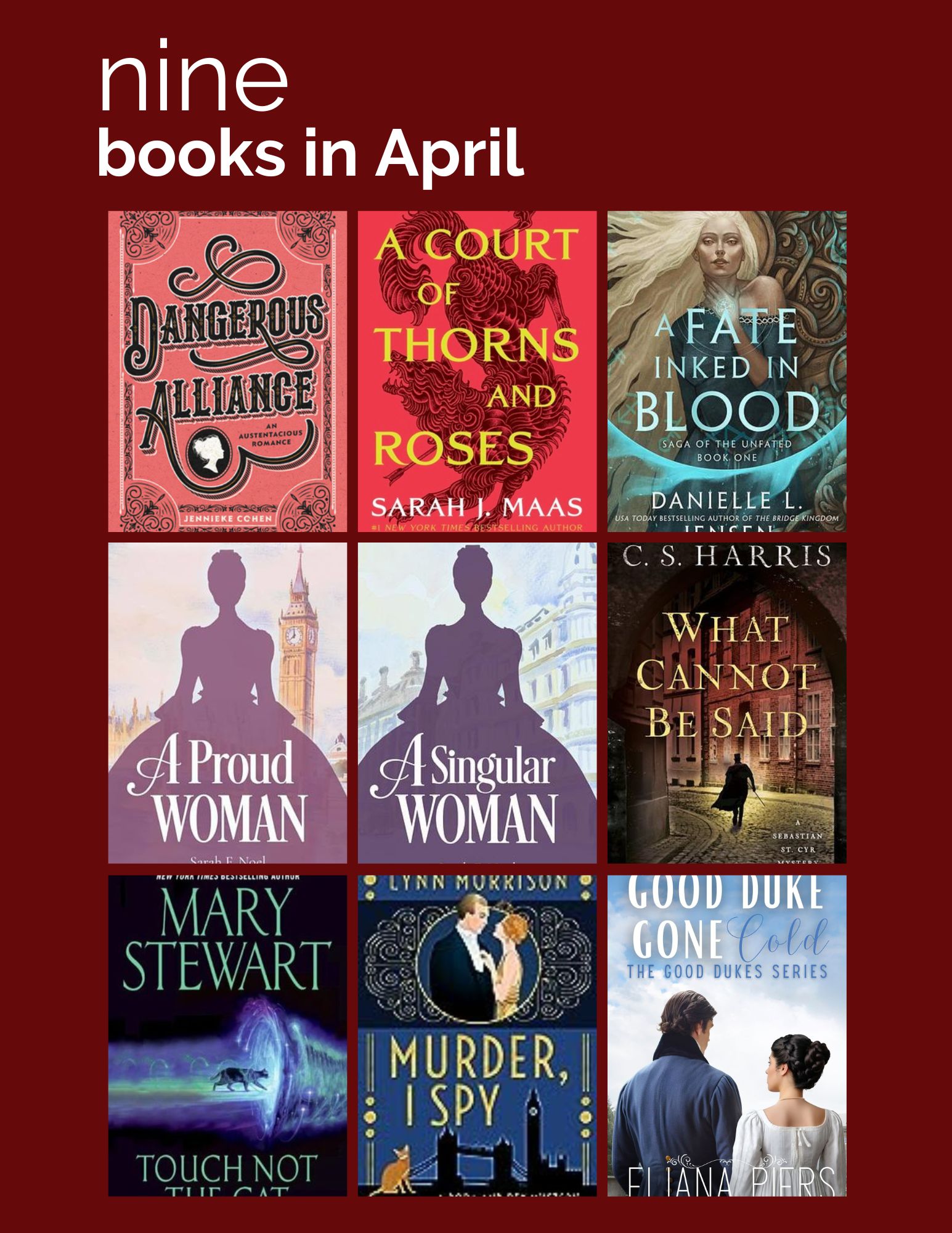
April was a productive month for reading. I read nine books, two of which were audio books, and started two others. Most of the books were “fluff”–easy and escapist reads (yes, they were Regency historical for the most part. Sorry, but those are my guilty pleasures.)

I didn’t read many of the books that came with the two monthly book club boxes; the only one I read was A Fate Inked in Blood, a fantasy novel based on Norse mythology. It is one of several books I read in April featuring strong female characters. I enjoyed this book, but it dealt with some hard issues: father-son relationships; female friendships, loyalty and betrayal; and domestic violence, not to mention war and the threat of war. The novel provided lots to think about while reading it.

Murder, I Spy was advertised as Downton meets Miss Scarlett. I loved the PBS series, The Miss Scarlett Mysteries, and I enjoyed a couple of the books on which the series was based. The lead character is a femme fatale, sort of, who lives a double life as a frivolous socialite and a spy for the British government. When a friend and fellow spy is murdered, she teams up with a British aristocrat to solve his murder. There is mischief and mayhem a-plenty in this novel.

A Proud Woman and A Singular Woman are the first two books in a series by Sarah F. Noel. Lady Tabitha (aka Lady Tabby Cat) is recently widowed. She teams up with the new earl, her husband’s cousin, to solve a variety of mysteries and murders. The novel is partly romance as the recently widowed Tabitha and Jeremy, the new earl (aka Wolf) work together. The Dowager Countess, unfortunately, becomes something of a fly in the ointment for them as she pushes her way into their investigations. I thoroughly enjoyed these books. I wasn’t sure I would like listening to them, but I found that I did! I know I read to my students quite often, and they loved the “read-aloud” days. I think I do, too.

I have read the hype about Sarah Maas’s books, so I gave A Court of Thorns and Roses a read. I “think” I liked it. I know that it kept my interest, and I wanted to see how it ended. It is most certainly a retelling of the Beauty and the Beast fairy tale with a hint of The Hunger Games in the setting of a distant, but oppressive “government” controlling the provinces and districts. I did not find the male lead very appealing, though. I liked his sidekick better. I have not read the other books in the series yet; the second one is waiting in my Kindle library and in my Audible library.

Of the books I started in April, Jane Eyre is a re-read, or maybe it’s a re-re-re-re-re-read (think Aretha Franklin’s refrain in “Respect”). I remember reading Jane Eyre in high school at the recommendation of my English teacher, Norma Richardson, who suggested so many favorite books and led me to so many literary discoveries. I still remember the cover of the first copy of Jane Eyre: a Scholastic book club edition with a white cover and the title is black stylized type face. I couldn’t name the font now if you asked me! Reading at age 66 is quite a bit different from reading at age 16. I see how the character of Jane was rebeling against the societal norms for women in the nineteenth century and how that rebellion created the problems she dealt with. I am savoring this book, making it a slow read.

Another series of books that I read in high school were the books in Mary Stewart’s Arthurian trilogy, beginning with The Crystal Cave and The Hollow Hills. I did not realize that she also wrote mysteries. So, I was pleasantly pleased to discover Touch Not the Cat, published in 1974. I enjoyed this book. Again, it featured a female lead as the investigator into the mysteries surrounding the estate she is trying to save from her cousins who are trying to sell it out from under her to pay off their debts. There is a hint of the supernatural as the main character has a psychic link with another she calls “lover.” In the end there is a romance and a happy, if not completely joyful, ending.

In the midst of these books, I am still reading Les Miserables–another slow read so that I can savor the language, the characters, and the complexities of the plot. I may finish it by the end of summer!

As I write this, I am expecting my next shipment from Book of the Month. In a day or two, the books from the Aardvark Book Club will arrive. In addition, I will be receiving a nonfiction book about the photography of Thomas Merton. Over the weekend, the complete set of Jane Austen novels arrived. I will have plenty to read this month, and I’m looking forward to it!

I Write Because. . . .

Something different on my usual Thankful Thursday. I finished the 21 Days of Wild Writing class from Laura Waggoner’s 27 Powers writing classes. It’s an on-demand class. There is no deadline. In fact, she acknowledges throughout the 21-day course that sometimes, we may skip days because–well, because “life” happens.

Today was my 21st day. The prompt is called “I Write Because,” a piece written by Anele Rubin. The jump-off line for today is “I Write Because”. Here is my first-draft, slightly edited, fifteen-minute piece inspired by that line.

I write because–because I cannot NOT write. I write to get the thoughts running around in my brain on that hamster wheel out and lined up so that they make sense.
I write because if I don’t write it down, I will forget. And forgetting sometimes seems worse than death.
I write because I want to remember how Grandmother took us fishing in the shallow creek under the bridge in Peak, and Elaine caught a gar, and the cars crossing the old wooden bridge rumbled like thunder against the quiet of the day.
I write to remember the night Peak burned–the doctor’s office, the drug store. My cousin Jimmy giving the firemen cold drinks from the ice box in Aunt Mayme’s store, red flames shooting upward in the sky; we could see them from our house two or three miles away.
I write to sort things out, to solve a problem, make a plan.
I write to share my days with old friends from school whom I have seen in forty years.
I write because in February the cherry and apple trees bloom; in March, the jasmine blooms, and the camellia I brought from Gramma’s house is red with blossoms.
I write because the birds are singing between the showers of rain.
I write because my grandson and I had a dinosaur war on his Uncle John’s 35th birthday, and Aaron went back to work after an injury and received a promotion, but he still has to relearn the knots he learned as a Boy Scout twenty years ago.
I write because time is passing and I’m getting older and one day there will be only my words to tell my story.
I write because I have to write. I said it before, I cannot NOT write. I write because I like the feel of the heavy fountain pen in my hand, the feel of the nib moving across the page, the texture of the paper against my palm, the quiet scratching that could almost, but not quiet, drown out the writer’s voice in my head.
I write because it’s raining outside, and the sky wavers between light gray as if the sun wants to break through and the heavy darkness just before the “bottom falls out.”
I write because the dandelions are blooming and turning into puff balls and the false garlic is white bells across the front yard and the honeysuckle will soon bloom and the rose buds are opening.
I write because I have to.

When You Feel Alone

I know there is a difference between being alone and being lonely or feeling alone. A young neighbor brought that sharply to mind this week. I know those feelings well.

First, I’ll reiterate that I am an introvert. I enjoy my time of solitude, aloneness if you will. I like being in the company of others, but it drains me, sometimes to the point of developing migraines, which are no fun at all. Being in large groups, having to be “social”–it takes its toll on introverts. I have to have time, sometimes days, to recharge and “recover.”

However, feeling lonely and isolated is something totally different. Even the most extroverted person can feel lonely and isolated, or even alienated, in the crowd that normally gives him or her energy and joy.

My time with my young friend yesterday made me think about that line of discrimination between solitude and aloneness and loneliness and isolation. What if those feelings of loneliness are brought on by difficult circumstances? What can another person do to help?

The first thing is to listen. Just listen. Let the other person tell you what she is feeling and why.

The second thing is not to try to fix her. Most of the time, the other person does not want you to fix her; she just wants to be heard.

The third thing is to empathize. Most of us have had those times of loneliness. Let her know that she is not the only one. I told my friend that she could always come over to sit on the swing. I would give her a cup of tea and hold her hand while we sat there watching her children run around the yard (It’s been almost 20 years since little ones ran around the backyard). If she wanted to, we’d gather a handful of rocks and throw them in the pond. I must admit that there is something very satisfying about chunking that rock into the pond with all the force I can muster; the same goes for slamming a door! If you have your own story, sometimes it’s helpful to share that story–not what you did to fix the situation, but enough to let her know that she is not the only person who has felt that way.

This is pretty simplistic. I’m sure psychologists have much more insightful advice. But these are things that we can do right now. I also believe in the power of prayer. Certainly, my young friend is now on my prayer list. I can’t fix her situation or give her the one solution to remedy it. I can pray, though, that a solution or remedy is forthcoming. Sometimes, just sharing your burden with another person is enough.

Our conversation brought me to another point that is important to me. For whatever reason, mental and emotional health issues are just not talked about openly, and therein, at least to me, is the reason why we often feel isolated and lonely. My friend told me that once others said, “I feel or have felt that way, too,” to her, she felt better. She still struggles, but she knows she is no longer alone. We need to have these discussions openly with each other. We need to take away the stigma that often accompanies discussions of mental health. It is still another way to relieve the isolation of loneliness.

And I will be checking up on her in the coming weeks. She will know she is not alone.